Showing posts with label 99 Islands. Show all posts

Wednesday, April 11, 2007

Showing Off "My" Japan

I'm sorry it's been such a long time since my last post. I'm so busy having adventures that it's hard to find time to write about them! As always, click on the images for larger photos.

Even though I've still got things to write about from last summer and fall (Thanksgiving, meeting various porcelain artists, the Yosakoi festival, a parade I happened upon one day, etc.), I want to give you a glimpse into more recent events, as they are (of course) fresher in my mind. But trust me, I'm keeping notes, so eventually you will hear about it all.

On March 19, my friend (and mentor and ex-employer and author-for-whom-I-design-books) MM came to Japan to visit. His plan was to spend three weeks in this beautiful country, with the first nine or ten days spent based in Sasebo, visiting me. Due to a miscommunication (and a stomach bug) on my end of things, we didn't meet up until the 21st, when I took the train to Fukuoka to escort him back to Sasebo. The train trip was pleasant, as always, as we rode alongside the incredibly green rice paddies and through long tunnels cut through the abrupt and shaggy mountains. Luckily, MM is as adventurous as I am, so when he said he could probably eat something just before we boarded our train (standing in obedient lines--no clustering or shoving here!), I jumped out of the line to purchase a bento lunch at the little food kiosk there on the train platform. I had no idea what specifically was in that particular bento, but I was reasonably sure it would have something from the standard range of rice and pickles, with perhaps shreds of omelette (tamago) or bits of mushroom or pieces of fish. I think it was a great introduction to Japanese life for MM , as we shared the mushroom-studded rice and bits of Japanese pickle (no fork, of course, only chopsticks), and watched the countryside slide by.

That evening, we headed out to Fearless Husband's favorite curry restaurant, Coco Ichibanya (it was FH's last night at home for a while). I'd worried at first that it was a little too "chain-restaurant-with-plastic-booths" for a guest, but decided that MM would have plenty of chances in Japan to go to fancier restaurants, and this was the sort of place that Japanese families frequent on a regular basis...this was the REAL Japan. FH got his usual level 6 or 7 (I don't remember which...either one will blow away mere mortals with powerful heat!) and I got my tamer-but-still-spicy level 3. I think MM got the level 2, and even that was a little much for him! (Note to self: start visitors out with a level 0 or 1, unless you KNOW they're chili-heads!) However, despite the heat, it was a fun evening, talking and laughing and catching up, and showing MM various little things about Japanese life. For example...I hang onto the o-shibori (wet cloth) we're given at the start of a meal, because there usually aren't napkins -- and if there are, they tend to be not-very-absorbent little scraps of tissue -- and I always, ALWAYS need something to wipe my face/hands/shirt/table with...the waiter seats you and gives you menus, but does not come back to the table to bug you ("Ya'll ready to order yet?? *heavy sigh*) until you push a little button to ring a bell...curry in Japan is a saucy, messy dish, and simply can't be eaten with chopsticks, so large spoons are provided, and it's expected that you will use them (much to MM and FH's relief!)

The next morning, I took FH to the ship and said my goodbyes (*sniffle*) and headed back to the house. MM and I had breakfast, and ended up sitting on the kitchen floor (I know...weird!) and yakking away for a couple of hours, catching up on several years of adventures for each of us. Finally, we got our acts together, and headed out the door. We
went to Kashimae Pier to enjoy the spectacular weather -- cool breezes, blue skies and bright sunshine. After woodfired pizzas at Pinocchio's (sounds Italian, but with the various mushrooms and seafood, they were very Japanese-influenced Italian!) we strolled the docks, and MM (of course) ended up discovering some really spectacular architecture sort of hidden away, almost as if the architect had designed the building for his own pleasure. We decided to take the hour-long Kujukushima (literally 99 Islands) cruise around the 208 or so little islands in the harbor. I took a late-afternoon cruise on my own last fall, and it was really beautiful...but it was hazy, and the sun was setting, sending long shadows into the various hollows. This cruise was quite different, with the bright sun, flags snapping in the wind, intensely turquoise water and wind and wave-scoured rocks. We speculated on the various kinds of aquaculture around us (found out later it's almost all oyster farming), and pointed out particularly Japanese-looking twisted pines and interesting wind-scuplted embankments to each other. The first time I took the cruise, the recorded announcements were in Japanese and Australian-accented English. I guess that day there were more English-speakers on board than just me...this time, with MM, we seemed to be the only non-Asians on board, but there were many Chinese tourists, and a tour group from Taiwan. So, the announcements were in Japanese and Chinese...no English at all. Oh well! However, I knew from prior experience that the captions on the illustrated map of the islands were almost identical to the announcements, so we weren't missing much -- and it was interesting to realize that I can now REALLY tell the difference between spoken Japanese, spoken Chinese and spoken Korean. They all used to sound alike to my American ears, but now they're as different as German and French!

After the cruise, we wanderered a little more, and MM suggested the aquarium and shipping museum. As much as I love aquariums, for some reason, I'd never felt particularly drawn to this one. But our cruise tickets entitled us to a reduced admission, so off we went. The place was near empty, but in this land of virtually no unemployment, there were two employees at the ticket desk, and two more to bow and welcome us into the museum itself. I was pleasantly surprised at both the shipping museum and at the aquarium. Both were quite small, but both were really beautifully designed, with a great deal of fascinating information. Though most of the signs were not in English, there were little green boxes on pedestals scattered throughout the shipping museum.
One picked up the single padded earphone and held it to one's ear, and hit the appropriate button on the box (English, Japanese, Chinese, Korean) to hear a recorded spiel about that particular exhibit. There were astonishingly beautiful wooden models and cros-sections of ships and hulls, a scale-model of a Japanese merchant ship that one can walk through, a reproduction of a portion of a Viking longboat (along with a very funny horn-hatted Viking mannequin with a bushy red moustache), a dugout canoe, a timeline of the various boat types through the ages and how each developed (dugouts, reed/rush canoes, etc.) and more. It was really fascinating!

The aquarium was very small, but equally wonderful. The first exhibit I came to was a large table covered in shallow plastic pans, with two plump, grinning grandmother-types with head kerchiefs and rubber gloves. It looked like a temporary craft area for kids, but it was an oyster table, and for 500 yen (about $4) one could purchase an oyster with a cultivated pearl inside, open it then and there with the provided tools, and take home an opalescent shell half and a real (cultured) pearl in pink, black, gold or white (the color was the main "surprise" as each oyster was guaranteed to have a pearl). MM had gone on ahead, so I succumbed to touristy, childlike temptation and plopped into a folding chair, handing over my 500 yen. The two old ladies gave me a glove for my left hand (that was a Charlie Chaplin moment, as the two tried to put the glove on my hand FOR me, at the same time, stuffing my fingers every which way and snapping the latex against my wrist, arguing in Japanese!) Then I was handed an oyster -- very different from the tough, lumpy, granite-colored oysters I'm used to. This one was bronze-colored, with a tear-drop rounded, delicate shell, flanged on one side where the hinge was. I inserted the oyster knife, and tried to follow the pantomime of my two helpers as they contradicted each other, lectured me in smiling Japanese and eventually grabbed my hands to "guide" me in forcing the hinge apart. I sat back for the ride, letting them manipulate the oyster, the knife, and both of my hands. Satisfied that I'd done it right (with their help), they handed me a long pair of tweezers. MM came up at that point, to find me gleefully digging for the pearl, the two ladies laughing at my efforts. Finally, out popped a perfect, luminous white pearl -- really surprising me as it suddenly surfaced in the grey mucous of the oyster like the moon rising from a swamp. The ladies gasped with surprise and pleasure, and I beamed happily. Whether it was real or, as I strongly
suspect, part of their act, they seemed to imply that MY pearl was one of the BEST pearls, and I was supremely lucky. They took it from me, wiped it clean, tucked it in a tiny cellophane bag with a clean (not splintered by three sets of hands) irridescent oyster-shell half, tied the top prettily with a piece of gold ribbon, and ceremoniously presented me with my treasure. Silly? Sure. But I had so much fun!

Off to the next exhibit we went. I was enjoying the brightly lit tanks of colorful saltwater fish set into the fake rock walls of the darkened "cave tunnel" hallway, when I gasped in shock and surprise. Right beside a waist-high exhibit of vivid tropical fish was a tank that reached to the floor level...and my toes were about an inch of glass away from a huge tangle of vicious-looking moray eels in semi-darkness. Wow...THAT was a powerful juxtaposition! Their tangled bodies were each quite a bit thicker than my arm, and their jutting jaws seemed full of malicious intent. I couldn't tear my eyes away from them for a long time....the way their tank seemed to be a long, rock-walled tunnel from ceiling to floor really added to the feeling of secretive and powerful danger. Then movement caught my eye, and I was immediately drawn to the next exhibit...a huge
tank taller than my head with a thick "arm" that jutted out into the room. Recorded gull cries and waves echoed as I stood, fascinated, first staring into a school of silvery fish moving flashing and moving like one sparkling creature instead of hundreds of tiny individuals...then absolutely captivated by several HUGE sea turtles swimming majestically by me, only a couple of inches away from my outstretched fingers. I could've stood there and stared all day. There were other exhibits, of course...glowing, tiny jellyfish pulsing with slow grace to move their impossible, transparent bodies...tanks of pufferfish and luminescent lionfish...a large "touch pool" of urchins and crabs and whelks...tank after tank of astonishingly-colored live corals and aenemones. I'll definitely be going back!

Afterwards, we wandered through the touristy shops in the "cruise terminal", looking over the various items that are specifically "Sasebonian", such as biwa (loquat) pies and jellies, and various bottles of sake and shochu. We bought a little biwa pie for dessert later, and a bottle of shochu, and headed home. Our supposedly "slow paced day of relaxation" was surprisingly tiring for us both! We shared some shochu at home, along with a quick dinner of kielbasa/cabbage/onion/apple, and then were both more than ready to sleep!

Next up: our trip to Huis Ten Bosch!


A trio of videos (I have sharper versions, so let me know if you want me to send you the higher resolution versions):
A Silvery School

Sea Turtle

Jellies

Sunday, August 13, 2006

Floating Altars Everywhere

(Edited August 14 to add a few photos from Emiri!)

I know, I'm woefully behind! But FH is home, and the preparations for his return and the fact of his return do give me some leeway, I hope! Here is "the rest of the story" of Emiri's wonderful visit. Click on the images for larger versions.

On Thursday, Emiri still needed to find Sasebo City/Nagasaki Prefecture-specific gifts (preferably food) to take back to her friends in Okinawa. So, we headed out to Kashimae Pier and the Sea Pearl Resort. Kashimae Pier is the "jumping off point" for the 99 Islands (really there are 208, depending on the tides, but it's more poetic the other way, I guess!) If you've seen the opening 30 seconds of "The Last Samurai", you've seen the 99 Islands--they're really lovely.

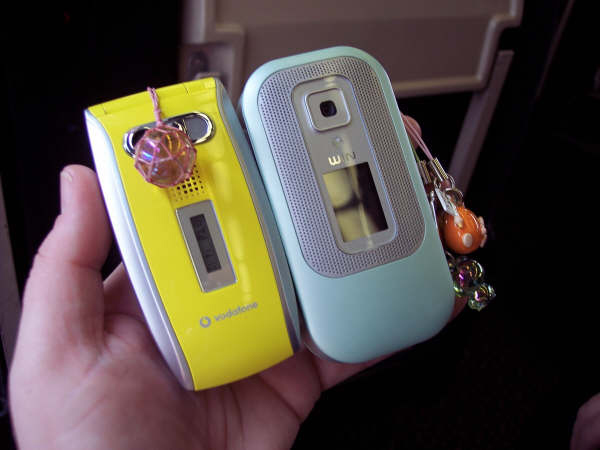
First, we wandered through the gift shops. We discovered that the area where I live is famous for loquats (also known as biwi), a small orange tropical fruit. To me, it tastes like a cross between apricot and mango. There were lots and lots of different loquat pastries, loquats in jelly, loquat mochi (rice paste balls), loquat caramels...even funny little plastic loquat charms with smiling faces on teeny leashes, to hang from one's cell phone! (Yes, I now have two fat, grinning little plastic loquats dangling from my mint-green phone, although you can only see one of them, along with my little transparent green frog. Em has a miniature version of the Japanese fishing floats, made by her friend in Okinawa.) Loquats are considered unusual, because they flower in the fall or early winter, and produce their fruit in late winter or early spring.

I find the selection of "gifts" in these little shops to be fascinating--pickles of all kinds, dried squid, raw squid, dried fish of all kinds, and lots and lots of cute but useless plastic "charms". Emiri got lots of special attention, due to her great skills with the Japanese language. I'm so in awe of her! Even before she speaks, she draws people to her, with her smile and her attitude. After a brief walk along the pier in the beautiful sunshine, we enjoyed lunch at an Italian restaurant (Japanicized, of course!) on the pier. I tried Calpis, a very lightly carbonated, opaque white soda. It's supposed to have a lot of calcium, and had a very mildly sweet, slightly chalky taste. It was interesting, and I rather liked it, despite the fact that the name sounds like something vulgar in English!

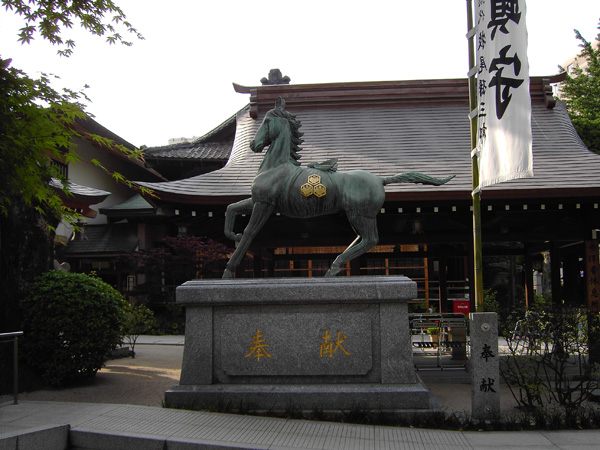
Then we parked the car, and headed for Fukuoka on the train. This time, we got off at the right station! We took a taxi to a part of Fukuoka called Hakata, to the Kushida Shrine (built in 757 AD), and enjoyed wandering around. Though most shrines have similar features, there is always something distinctive about each one, and this one was no exception!

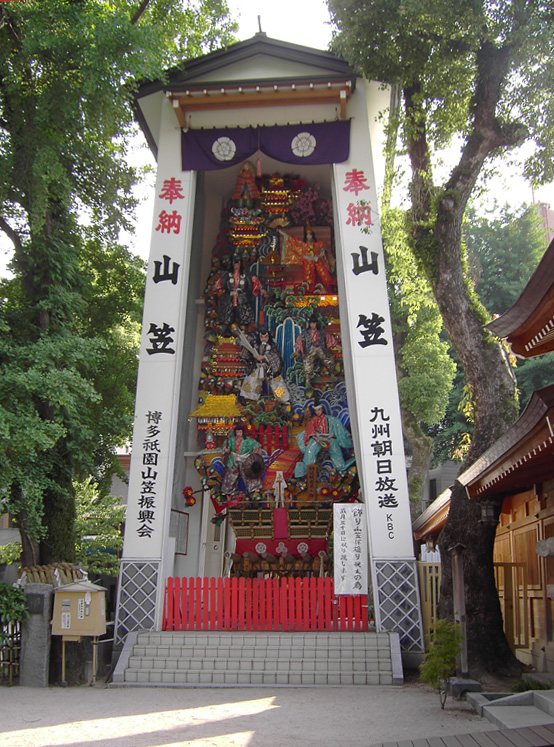
Kushida Shrine oversees the Hakata Yamakasa festival, which originated in 1241, when a Buddhist priest named Souichi Kokushi was carried through the town on a platform, from which he sprinkled holy water to eradicate evil spirits responsible for a plague that had struck the town. The festival takes place from July 1-15 every year, and the climax, Oiyama, begins at 4:59am on the last day. On Oiyama, a drum signals the start to the first kakiyama, a one-ton "race float" shouldered by a team sometimes numbering over a hundred men. The team carries the float, sort of like a giant portable altar, on a five kilometer route through the streets of Hakata. Six more kakiyama follow, each one hoping for the best time on the 5K route. The seven nagare (teams) are drawn from more than 10 areas within Hakata, and can be distinguished by the different patterns of cloth used to make their happi. Each team of bearers has special short coats (mizu happi) made of the team fabric, sort of like a team uniform to be worn while carrying the floats, and matching long robes (naga happi) that they wear at other times during the festival. The various team members have different roles and responsibilities, indicated by different colored head cloths.

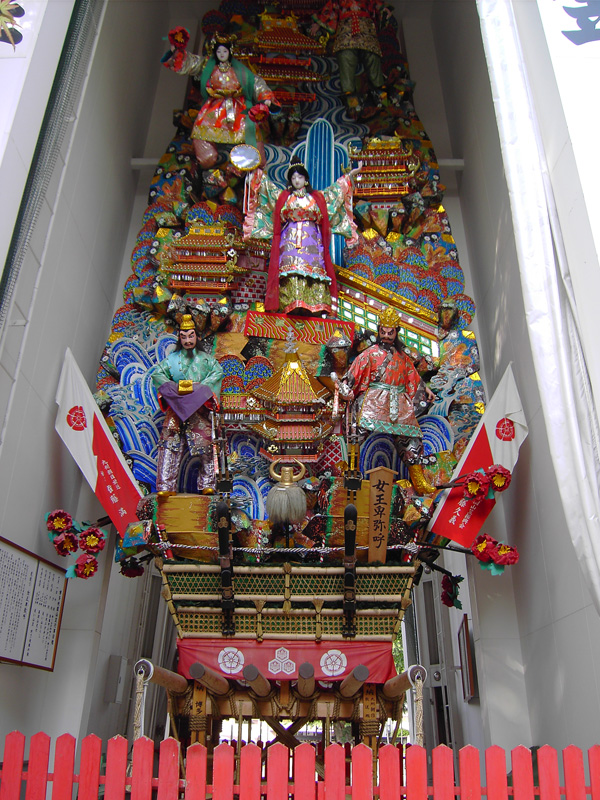
There are special traditions associated with Hakata Kamakasa. For example, participants must not eat cucumber during the entire festival period, becasue the Kushida Shrine crest resembles the cross-section of a cucumber. Also, all team members are forbidden from having sex during this time, so as to save their "life force" for carrying the one-ton kakiyama. It's considered an honor to be allowed to participate, and the participants take the various rituals and traditions very seriously. During the 15-day festival period, the whole Hakata district is the festival site, with the kakiyama on display, as well as the kazariyama, which are insanely tall "decorative" floats. The altar floats made to be carried are made of heavy wood hung all over with gleaming golden plaques and decorations. (Please forgive the bad photo of the kakiyama--they were in a dark "garage" and I could only take a photo through the glass, my camera was dying, and that was the only image that even came close to turning out. I'm sorry!) The decorative kazariyama are decorated with figures ranging from samurai warriors to cartoon characters. The one on display at the Kushida Shrine was fascinating, covered with lifesized figures, with vibrant colors and lots of sparkling silver and gold.

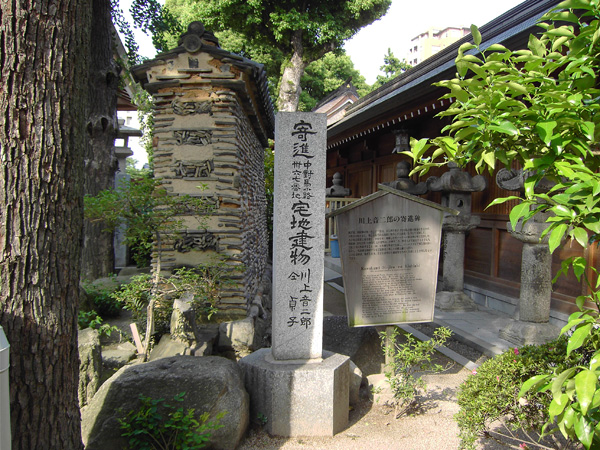
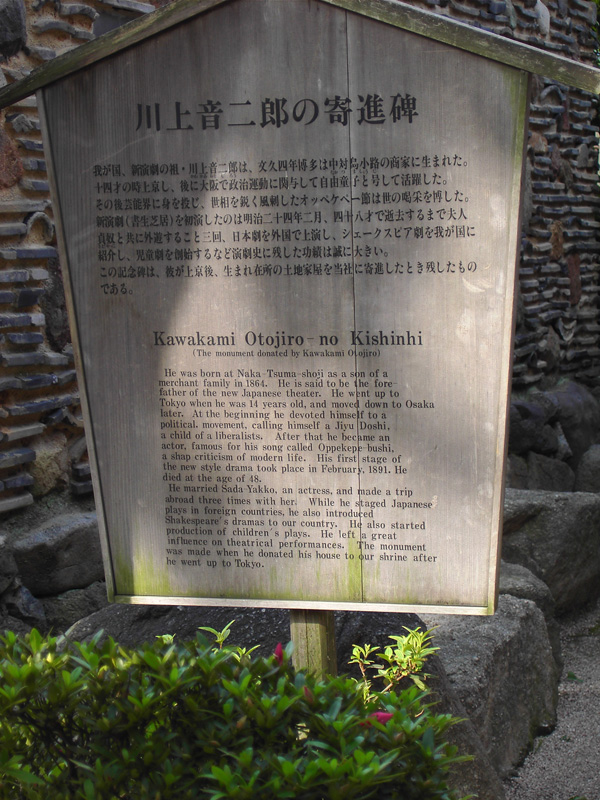
There was also a memorial to the forefather of modern Japanese theatre, Kawakami Otojiro-no Kishinhi (1864-1912). He was the first to bring Shakespeare to Japan, and the first to stage productions of plays for children. I was thrilled to find the little memorial plaque at the back of the shrine itself!

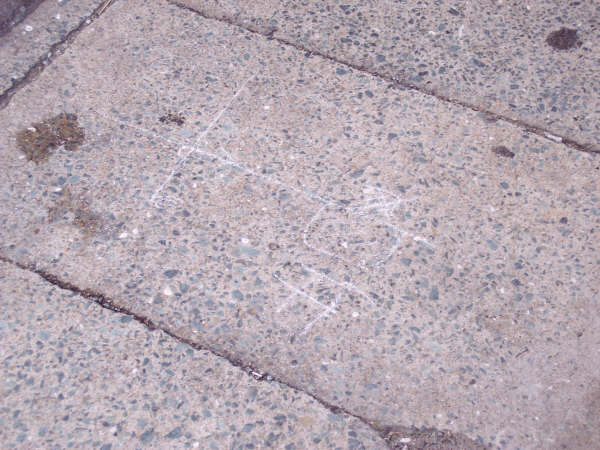
Then Em and I set out to find the Hakata Machiya Folk Museum, which was much easier said than done! We walked for a while in one direction...nothing. Consulting the little guidebook map and the very vaguely placed "this is it" red dot, we tried another direction. Nothing. We stopped a man about to get into his car, and Em asked directions. He offered to take us there in his car, but we demurred. So he grabbed a rock, squatted in the street, and drew a map for us on the pavement! Hurray, we've got it! So we head back in the direction from which we came. And walked. And walked. Arrgh--nothing! We stopped again, this time at a shop filled with American-style t-shirts and jeans, and Emiri worked her magic in Japanese again. Ok, back we go. Finally, we found it...about half a block from the Kushida Shrine! Our search was frustrating and sweaty, but ended up being worth the trouble, at least to me. If Em didn't think so, she was generous to keep it to herself.

The museum was small, but interesting. We wandered through the little exhibit building, where I learned much of the information about the Hakata Kamakasa festival and the floats we'd seen at the shrine! They had miniature dioramas, and a bank of old fashioned phones for visitors to listen to the "funny Hakata dialect." Of course, those didn't do anything for me, since I can't tell the difference between one Japanese dialect and another!

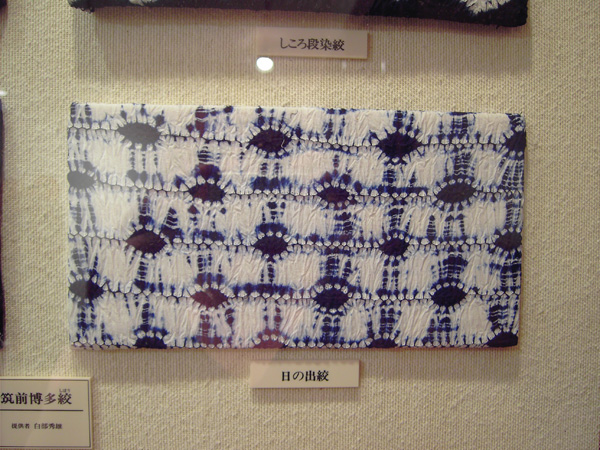
There were some absolutely amazing fabrics on display that looked sort of like batiks or tie-dye...the fabric of some looked as if it had been stitched very carefully in a specific gathered pattern, dyed with the deep indigo dye, and the stitches taken out once the fabric was dried. I could not read the Japanese that explained the exhibit, so my guess may be wrong. Regardless, they were really lovely. I believe these are the fabrics used for the naga happi and mizu happi of the altar float teams.


There was also a series of life-sized dioramas depicting a shop and a home at the turn of the century, complete with appropriately-dressed mannequins. There were displays of other local crafts as well, such as the Hakata dolls, Hakata-ori and Hakata shibori textiles, Hakata magemono (cylindrical boxes made from thin sheets of wood bent into shape), heisuke brushes (for calligraphy and painting), hariko (bobble-head animal figures made in a medium similar to paper maiche), multi-colored worked glass similar to Murano glass, fighting tops (a totally different shape than the tops Sasebo is famous for making), and famous Hakata scissors. Unfortunately, we were too late for any of the many demonstrations of these fascinating crafts, and for the chikusen-biwa Japanese lute playing.

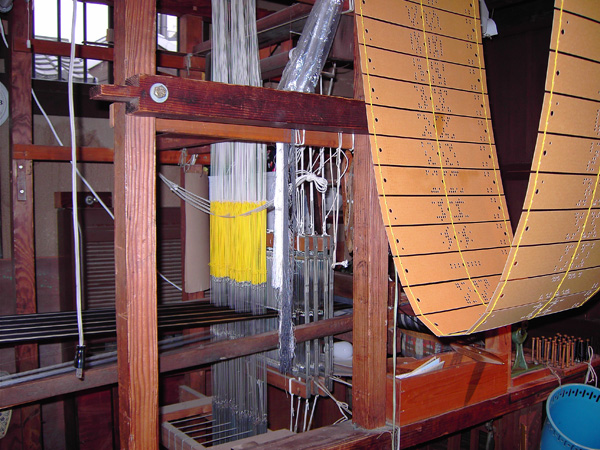
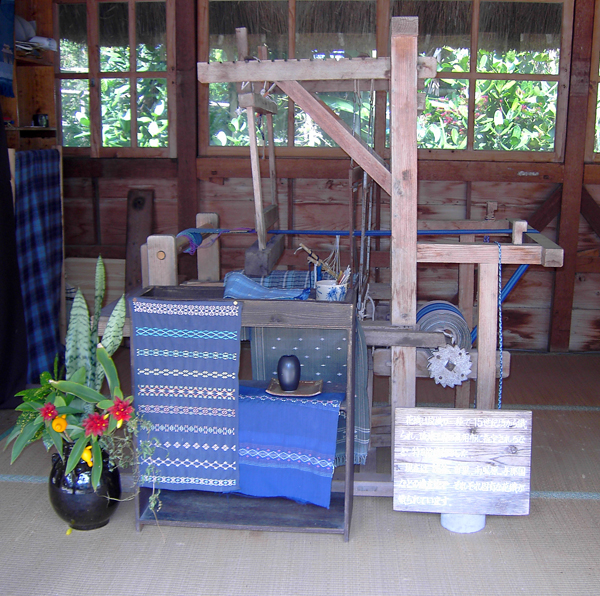
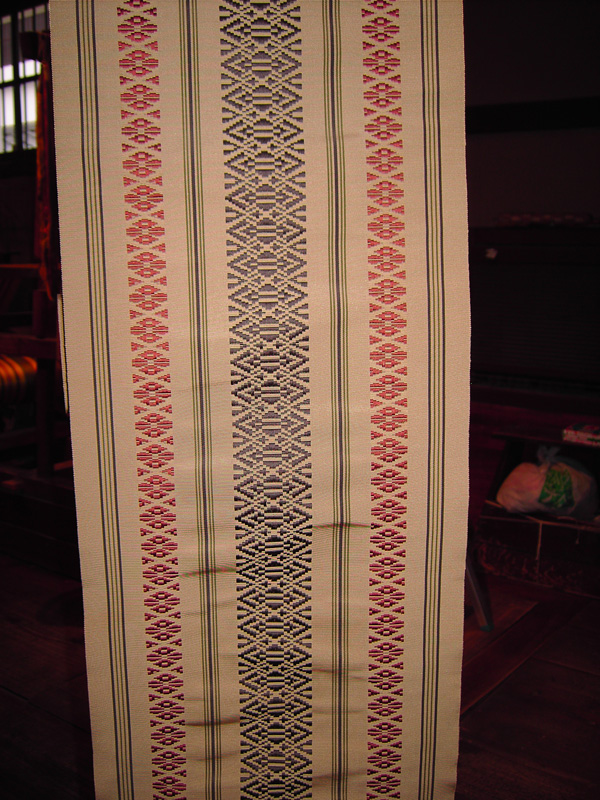
The other part of the museum (Maichiya Hall) was a relocated and restored Hakata-ori textile-weaver's house from the Meiji and Taisho eras (turn of the 20th century). The building itself is long and narrow, with the tatami rooms on either side of the central hallway built to become larger towards the back, in a fan shape for good luck. In the center of the main room, the ceiling opened up, giving a sudden impression of space and light. The main pillar of the house (the daikoku-bashira, representing the head of the household and his strength) was intricately carved, and soared up in the space. The hall was fascinating, with several very intricate looms and displays of astoundingly complex woven fabrics. I was so sad that we'd missed the demonstration, as I wanted to see how the big loom worked. There was a long loop like a conveyor belt of wooden plaques, each with a different pattern of holes. I think that somehow, the holes in each plaque help direct the heddles of the loom, each plaque moving into place for a different part of the pattern, kind of like a player piano's paper scroll. But I am not sure, and I want to see it in action! Unfortunately, they were closing, and so I snapped several photos, and we had to head out.

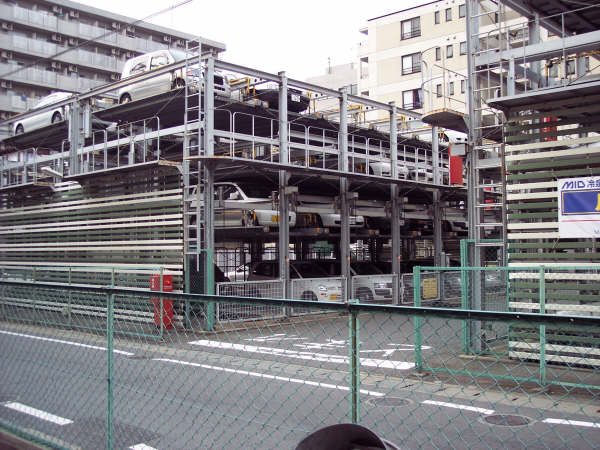
We headed back towards the train station, trying to catch a taxi as we walked (we were pretty far away!) Despite the humidity, I enjoyed the walk, looking in shop windows and people-watching. Though I thought Sasebo seemed like a pretty big city to me, I now understand why it's considered sort of small-town and rural, despite its 300,000 residents. Fukuoka is very much more "big city", with tall buildings and modern shops, and fewer old-fashioned Japanese storefronts. I got another sense of what a premium is put on space in this country, as I passed a parking lot. The lot consisted of a relatively small footprint, but had "racks" on which each car was driven. The rack was then raised until it was almost touching the rack holding the car above, and another car was driven in and raised. I've never seen so many vehicles crammed horizontally and vertically into such a small space! I guess that's another reason for the intense and very expensive car inspection required every two years...I sure wouldn't want the car above mine leaking oil or transmission fluid or whatever onto the roof or hood of my car! Thanks to Emiri for the photo.

We finally got a taxi, and got back to the train station. We grabbed a quick bite to eat in the station itself, which, like many Japanese train stations, was like a shopping mall, filled with stalls and shops and restaurants. Then Emiri headed on the short trip to the Fukuoka airport to fly back to Okinawa, and I headed for the train back home to Sasebo. Even that experience was interesting! The platforms were crowded with people headed home after the workday. In the US, the crowds would swarm towards the doors as the train pulled in, shoving and jockeying for position. Not so in Japan! Every few feet was a mark on the pavement to show where the doors would be when the train stopped . At each mark was a single line of people, snaking carefully so that no line intersected any other line, and no line blocked the pathway up and down the platform. It was amazing--everyone knew what to do and where to stand, no one was pushing, no one behaved as if he or she were more important than anyone else or in more of a hurry.


I didn't know where my particular mark was (some cars are "first come, first serve", other cars are "reserved seat only", and I had a reserved seat. So I excused myself and asked a fellow traveller where I needed to be, with my few words of Japanese, some charades, and my out-thrust ticket. She smiled, bowed, chattered in Japanese, and gestured down the platform. In the next line someone looked up and saw what was happening. She beckoned to me, smiling...so I went to her. She looked at my ticket, smiled, bowed, spoke to me in Japanese, and pointed me to the next line, where a young man beckoned me to come to him. This went on from line to line down the row, until I was at the appropriate mark...then I was handed down the line to my spot at the end. It was very funny! Rather than gesture to me to go down eight lines to find mine, my fellow passengers took the bakka gaijin (idiot foreigner) in hand and gently herded me to my place. I loved it!

Emiri's visit was quite short, but despite my propensity for running late, we still managed to cram an awful lot into three days! I hope she can come back again, and I hope to get a chance to visit her in Okinawa. In the meantime, she was a very tolerant guinea pig, as I discovered where I can take visitors to Sasebo. Thanks, Em, for being such a fantastic, easy-going and fun guest!