skip to main |
skip to sidebar

Happy New Year… Happy Year of the Ox… Omedetou gozaimasu! Wishing you all peace, health and joy in the New Year. (Yes, I began this in January, but since the Chinese New Year was just a couple of days ago, let’s pretend, shall we?)
Fearless Husband came home from deployment at the beginning of December, so we were able to have Christmas and New Year’s together (hurray!) Between Christmas and New Year’s, my friend Hiroko took me to a little neighborhood shopping area to get some wagyu beef (what Americans refer to as Kobe, but this was from Hirado Island) for FH. Before buying the beef, we walked around, peering into the little shops lining the road. One shop was the smallest I think I’ve ever seen. I’ve had bigger closets! A teeny, tiny old lady with radiant skin and a lovely smile sat inside, surrounded by bottles of a golden oil, and pamphlets with photos of camellia flowers. Turns out the oil was camellia oil! It’s supposedly very good for both the skin and the hair, and can even be used for cooking! The little old lady was quite a good advertisement for her own product..her skin was that of a woman MUCH younger, though she was in her 80s!
 We window-shopped (or would that be awning-shopped, when there are no windows?) our way through kitchenwares, fish so fresh it was still flapping, gorgeous vegetables and jewel-like fruit, organic chicken, various homemade condiments, and more. I ended up with some fresh yuzu-koshou (a paste of yuzu rind – a very aromatic citrus fruit – chilies and salt that’s delicious on fresh tofu), the prettiest turnips I’ve ever seen, a packet of sweet potato mochi, a bamboo spatula/spoon, several skeins of yarn from another teensy shop basically lined floor to ceiling with brightly colored balls of yarn, some traditional Japanese New Year decorations, and of course, FH's beef.
The butcher shop was on a corner, as such shops often are, and the shop itself was open to the outside air – no windows, no door. There were refrigerated display cases filled with meats, but Hiroko ignored it all. Instead, she spoke at length to the butcher, who then straightened his apron and disappeared into the back. A minute later, he emerged, carrying a chunk of beef as if it was a velvet cushion holding the crown of the realm or something. He walked slowly, with dignity and reverence, presenting the piece of meat as if waiting for me to admire his newborn son. I’ve never seen a butcher so proud of his own product! More negotiation, in English and Japanese, about how much of the beef I wanted (though money was NEVER mentioned, not once – I guess if you have to ask, you can’t afford it!) and then the “baby” was transferred to the cutting table.
 The butcher laid out three different knives, and proceeded to lovingly separate the smaller chunk I’d indicated, then very carefully trim all the exterior fat, inspecting it and turning it and basically making a big production out of the whole thing. Yes, he used all three knives. The meat was then weighed (he was careful to point out that I was paying only for what we’d be eating, not for the trimmings!), then the chunk was carefully wrapped in a flexible, paper-thin piece of wood (yes, wood!), then white paper over that, then more white paper, then finally the swaddled bundle was put into a bag for me and placed on the counter *just* out of my reach.Oh, right. Gotta pay for it. *gulp* Imagine an eye of round roast just over a pound and a quarter, but prettier and marbled to such an extent that it looks like a mosaic on the cut end. Now imagine paying $35 for it. Now imagine being absolutely thrilled at the incredible deal you just got! Ok, enough about the beef. Suffice to say I cooked it with nothing else but a bare sprinkling of salt, stretched it to serve the two of us for three meals, and was the most amazing, tender, savory beef either of us have ever eaten. Ever. In our entire lives. Period.
 I also bought a traditional Japanese New Year’s decoration(shimekazari, which I can’t believe I forgot to photograph!), to go over our front door. It’s a fat, heavy twist of rice straw, with two sprays of rice straw sticking down to either side, a little fountain of rice kernels on their stem in the middle, various bits of folded and rolled special paper, and a sour orange skewered in the center. Most of the houses in our neighborhood already had similar decorations, and Hiroko encouraged me to get one, too.
Hiroko explained further about the various New Year decorations:
“As for the door decoration, we decorate today until 7th or 10th of January when depends on the area or family. Please do not decorate tomorrow (the 31st). Since this is the pray to gods for the new year, we don't decorate on 31st of December. Gods may think that we haven't prepared enough for gods. You'll see the twisted straw of rice stem at the shrine and the paper. Rice is Japanese main food and we pray for good or better harvest for the new year to the god using rice stem straw and the twisted means pray. When we pray something, we sometimes twist something such as a small sheet of paper which we call Koyori or O-hineri (which includes money inside). The paper means gods. The orange, which we call daidai, shows to refresh for new year and another words play that daidai term itself means from generation to generation. Dai means one generation. Daidai orange juice can be eaten with fish or scallop etc. As a whole the decoration shows the pray to gods for the better harvest and prosperity. Please hang above and middle of the entrance door not on the entrance door. Probably your next neighbors will hang today. We will burn it 7th or 10th of January and we say the smoke will avoid decease the rest of the year.
In the Japanese guest room there is alcove which we call Toko-no-ma. I saw you had one at your home. We decorate a several things to pretend for gods to eat. They are 2 double omochi (smooth, chewy cakes made from pounded sticky rice), orange, dried squid, dried persimmon, yuzuri-ha (a kind of evergreen shrub) which means generation change, i.e. prosperity, because a yuzui-ha leaf falls down when a next new leaf grows up, on urajiro (a kind of fern) which is just like words play as ura means backside and jiro means white, accordingly urajiro means that we show gods that we have nothing bad to hide. Japanese men tends not to do housework but the above decorations are for the work of a father. Even my father is willing to do.
I forgot to tell you about the leaves that my mother gave you. They were called "Sen ryo." Sen means million and ryo is old Japanese currency unit in Edo period. At the beginning of the year we pray so many wishes such as happiness, prosperity, longevity, peace, richness etc. For each wish, we have each god and each shrine. For each wish, we eat the represented things as osechi and display the ornament. Sen ryo mean that we pray for millionaire.”
New Year’s eve itself was pretty quiet – we stayed in, and listened as various solemn processions wound through the streets throughout the night, ringing a gong or clacking some sort of wooden clapper as they chanted and walked. At midnight, temple bells all over Japan rang 108 times, to release people from the “108 worldly sins.”
 The morning of January 1, many Japanese get up very early to watch the first sunrise of the new year…this is considered a harbinger of the year to come, and one is supposed to be at peace, with a smile, to watch the sun rise. Unfortunately, we couldn’t see the sun rising here in Sasebo. Instead, we had fat flakes of snow!
In the afternoon, FH and I were invited to join my friend Morinaga-san at her house for a traditional Japanese New Year’s meal. There was another American couple there, as well as Morinaga's sister and daughter (we met Morinaga's mother on the way out of the warren of houses/rooms...she was sitting in a kitchen of another house, watching TV by herself and grinning. She may be slightly demented, or just happy to be alone, not sure!)
We had special sacred sake, poured into special sake saucers (the large one had Mt. Fuji painted/embossed in gold into the red lacquerware, the medium-sized one had a hawk, and the small one had an eggplant -- all traditional decorations for the various sizes). One by one, we each were served the special sake in our choice of the three dishes. We were to sip it three times, finishing the sake on the third sip. After drinking, we were given a tiny handful of dried squid (though I don't remember the meaning). There was a solemnity to the ritual, and it made me think of Holy Communion.
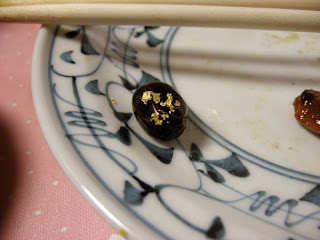
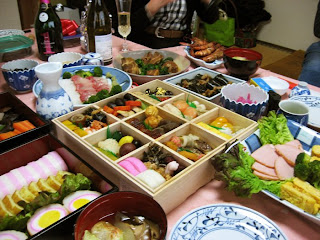
 On the table were plates and plates of food (Chinese cooked pork, fresh mackerel sashimi, knots of savory seaweed, slabs of omelet and slices of ham, etc.) as well as the traditional osechi -- special large wooden divided boxes of very beautiful New Year's foods, each with its own meaning for the New Year (good fortune, money, happiness, fertility, etc.) Traditionally, nobody cooks on January 1, 2 and 3, so the three-layer boxes are all foods that will last. There were all sorts of things, from black beans decorated with gold leaf, to sea cucumber (neither of us liked that AT ALL, but of course had to eat it, as it was fancy and very, very expensive) to tiny carved squashes and pretty fish paste shapes. Champagne was served as well, and the other American couple brought brownies and vegetables with spinach dip. I felt bad that I hadn't contributed to the feast, but luckily, I'd brought gifts for Morinaga-san and her daughter, and a fancy bottle of French wine (regifting what the architect and his wife next door gave us!) and a container of homemade candies. The candies were the insanely simple ones... small pretzels with a Rolo chocolate-and-caramel candy put on top, the whole thing popped in the oven for three minutes, then a toasted pecan half pushed into the Rolo to make it smoosh down on the pretzel. VERY easy, and surprisingly delicious, like a chocolate/caramel/pecan turtle, but with the salty crunch of the pretzel. Luckily, the candies were a HUGE hit, and everyone ate them all up and argued over the last few.
On the way out, through the warren of the three homes perched on the hillside (all owned by Morinaga-san, or possibly communally owned by the women of the family), Morinaga-san pointed out a single tatami room with a fancy lacquerware altar. She said it was the family altar to their ancestors, and they all prayed there every single morning. That was fascinating to me, as I had not thought of Morinaga-san, with her girlish curled ponytail and blue eye-shadow and talk of "fashion" as a particularly spiritual person. Teach me not to judge!
 Over Christmas, FH and I enjoyed Norwegian meatballs and Norwegian Christmas cookies (thank you, Grandma!) from his family traditions. We spent our New Year’s morning quietly together, and had my family’s traditional New Year’s collard greens, black-eyed peas and ham for lunch. At Morinaga-san’s house that afternoon, we sat on tatami mats, with sliding rice-paper doors on two sides, and a painted scroll of cranes hanging in the special alcove, over the ancestor/God offerings of mochi and oranges and shiny wire decorations. It was pretty wonderful to sit in that beautiful and very foreign room, beside my familiar husband, making new Japanese and American friends, at a table covered with food from both cultures, with conversation and laughter flying. What a great way to start the New Year!
 Here is another vignette from our lives here in Japan. There is so much more to tell you, but not enough time to tell it in! More to come, of course. Please forgive the blurry photos, as I was dealing with the dark, and my camera was NOT behaving. (Of course, I felt flash photography would not be appropriate in the least!) As always, click on the photos for larger images.
Last summer, when we got back to Japan after Annette's funeral, my Japanese friend Miyuki felt it was imperative to take Fearless Husband to the Obon festival. She was very serious about it, and insisted that we join her. For three days every summer, the Japanese believe the spirits of family and friends who have passed on come to visit for a time, especially those who have departed in the past year. In other parts of Japan, Obon is in July, but in a few towns, Sasebo included, Obon is always in August.
 Family members put out special sugar cakes molded into beautiful flower shapes, rice cakes, various fruits, and liquor for the visiting spirits. On the third night, there is a HUGE festival downtown. One particular part of the festival is specific to Nagasaki prefecture (of which we are a part) and is a tradition that comes from China. One may pay a token amount to purchase a paper lantern to honor the spirit of the deceased. The lanterns are square, and delicate, in white and yellow and pink with lotus flower blossoms and messages for world peace printed on them.
 One buys a lantern, writes messages to the departed on the lantern (in past days, I'm sure elegant calligraphy brushes were used, but in this case, there was a multitude of Sharpies available). The lantern is handed to the first in a line of twelve Buddhist monk apprentices in black pants, white dress shirts and sober ties, lined up on a floating dock that juts out into the river. The apprentices pass the lantern down the line, and the last man in line carefully sets the lantern onto the river to float away to the nearby ocean, using a long pole to ensure they don't clump up, or drift back to shore. The view of hundreds and hundreds of flickering paper lanterns drifting down the winding river to the sea in the gathering darkness is both poignant and beautiful.
 Miyuki purchased a lantern for Annette, as her tribute to the mother of her friend, and FH wrote messages to his mother before handing it to the acolytes to set adrift. We stood together, watching the lantern join hundreds of others on its journey to the sea, and I think we both felt a sense of closure within our sorrow. We watched until Annette's lantern was out of sight.
Many of the Japanese around us were dressed in traditional kimono, including the children. Others were in very casual clothes. There is sorrow, and some people and children are quietly crying as they prepare their lanterns...others are purchasing and eating street food like chicken skewers, squid-on-a-stick, roasted ears of corn, and snow-cones from the various vendors lined up along the riverside, and laughter drifts through the crowds. It's a celebration of both life and death, of honoring family, and of letting go. For many, it seems to bring closure -- a final goodbye.
After the lanterns are set afloat, people make their way to the main streets, to watch the "floats" go by. The floats are large platforms carried by teams of men and women in matching happi coats, with a roofed structure on top, and many large lanterns hanging under the roof. From what I understood at the time, most of the floats are specifically  dedicated to the owners of various corporations who have passed away in the past year (or years?), and the bearers are workers from the companies. Glittering signs are carried on poles to escort each float, and Miyuki told us the signs specify the name of the company. She explained that years ago, the wealthy and powerful (the elite, the movers and shakers, etc.) were able to pay for such tribute, but now only corporations can afford to have the floats and bearers, signs and fireworks. Each float is carried (sometimes for miles) through the streets of Sasebo, to come together in a large municipal sports field next to the city library.
 There, under brilliant floodlights (think night baseball game), each incredibly heavy platform is brought to the center, one at a time, and then jerked and turned and "danced" in circles as the teams shout and yell, firecrackers explode and columns of heavy smoke rise to the skies. This supposedly scares away any evil spirits who might be hanging around the spirit of the executive. The various teams vie to dance the fastest, shake their float the hardest, and make the most noise. A small but steady stream of townspeople come, each delivering a football-shaped straw package containing the various offerings (rice cakes, fruits, etc.) that have been sitting out for three days for the ancestral spirits. The pile of straw bundles grows and grows, to epic proportions as each family brings their offerings. These "footballs" will be burned in a HUGE bonfire after the event itself, to send the offerings up in smoke to heaven, carrying the offerings back to the spirit world.
 As one enters the field, whether carrying a float, bearing a straw bundle, or just coming to see the spectacle, one may stop at a white tent canopy with roof and three walls, to pray. Under the canopy are many bouquets of flowers and various offerings, and a lovely statue of Buddha. Three priests kneel and bow, chanting and swaying without cease, and the public may pause outside the encircling fence to pray and to light incense and candles and place them in the sand-filled troughs on the fence top.
Though the entire thing was very foreign to our eyes, it was also very beautiful. There was a sense of kinship, of universal humanity as people recognized the inevitability of death, the pain of loss, the joy of living, and the hope of the world to come.
I'm trying to catch up....I'm sorry for the delay! I'm headed to Hong Kong in about two weeks to see Fearless Husband, and I am so excited! I'll take lots of photos, and promise to post them and our adventures there before the end of November! We're hopeful that he will be home for Thanksgiving, and again for Christmas.
Back in June, I had one of the most foreign experiences I've ever had in my life. Miyuki invited me to join her on a trip to a temple with Rumi, a 12-year-old 7th grade student. Rumi’s parents are both dead, and she had asked her teacher, Miyuki, to join her as she went to say prayers at the temple where her parents "sleep".
 Rumi is shy and awkward and just darling--very eager to please. She and her 14-year-old brother are being shuffled back and forth between two aunts and an uncle. No one wants them, so they spend one month with one relative, then get sent for one month with another relative.
The brother is really going down the juvenile delinquent road, according to Miyuki, but this little girl is still bright and bouncy. She doesn't show her sorrow at all...but I'm afraid in a couple of years she could become a very hard case. Her mom died of cancer three years ago, and then a year ago her dad died of a heart attack from "overwork and stress." I want to adopt them both! But I don't think FH would jump for joy at the idea of adopting a 12 year old and a 14 year old, neither of whom speak English!
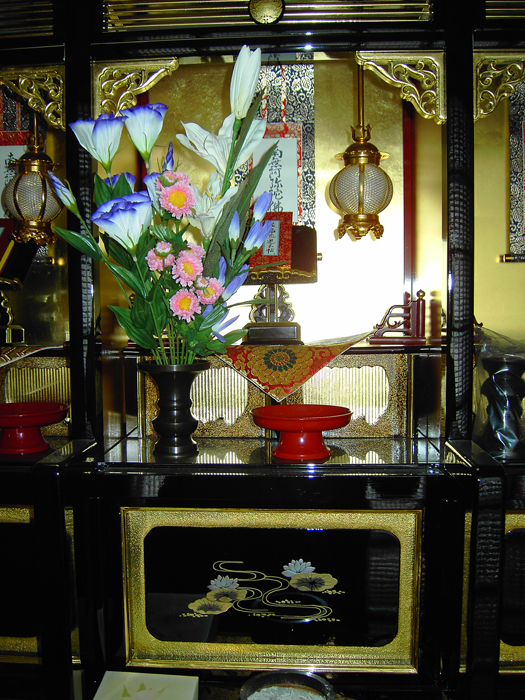
Going to the temple was not sad at all though. The temple itself was simply a two-story, relatively non-descript building on the main road. The only thing that distinguished it from its neighboring shops was a particularly fine tile roof. We found parking (amazing!) and walked up the stairs to the front door on the second floor. Inside, we took off our shoes and put on leather slippers before moving through the main temple room, with a beautiful gold-leafed statue of Buddha at the altar area at the front of the room. We went down some narrow stairs, past a photocopy machine and some boxes and stacked newspapers (like an office storage room) into a plain room with fluorescent lights and a wooden floor…very much as if we’d walked through an American church and into the fellowship hall in the basement! The room might have been a fellowship hall, or a classroom or an office, except for the fact that it is the resting place for the remains of hundreds of people. Shiny black cabinets trimmed in gold line the walls and march in long rows down the length of the room. The bottom part of each cabinet is a closed cupboard; the top is an open shelf/alcove, lined in gleaming red and gold paint. Each shelf has a little tiny golden altar, some silk flowers, a little book with the names of the deceased written in it in flowing and beautiful calligraphy (each person receives a new name at death), a little dish for burning incense, and a little dish for offerings. The bottom closed cabinet holds the ashes of the dead for that family. All Japanese are cremated. There is not enough land for them to be buried whole. Lots of containers of ashes can fit in each cabinet, so the family stays together even after death!
 Some offering dishes had cans of beer for the deceased, one shelf had soda and candy--Miyuki said it was for a child who’d died. A modern disposable lighter was placed beside each incense bowl. Rumi lit some incense, looped the prayer beads over her folded hands and said a prayer. Then Miyuki said a prayer, and then I said a prayer...all silently. The whole time, when they weren’t praying, they were both laughing and talking in normal, happy voices.
Miyuki said I should "introduce myself to Rumi's parents" when I said my prayer. It was not the way Americans act at cemeteries, full of sorrow and longing. Instead, it was as if we were really visiting her parents, and I felt as if my prayer should have begun “It’s very nice to meet you!” Then they both laughed and talked about how surprised Rumi's parents were going to be to meet an American. It was very upbeat, as if her parents were on a higher plane, but they were ghosts, not far away in heaven—as if her dad would enjoy being offered a cold beer, and her mother would be ducking her head in shyness to meet an American.
During the three day Obon holidays in August, Miyuki said that Rumi would host a memorial service for her parents in the main part of the temple...but people here do not go to regular services. There are no "weekly services", just funerals and memorials at the temples, weddings at the shrines, and visitors to both temples and shrines whenever anyone feels the need to pray for strength, hope or luck, or for the spirits of the departed. During Obon, families make trips to the resting places of their ancestor's ashes...some in the city, some far out in the country. The spirits of departed ancestors are invited "home" and offerings are given of new rice and other food. Many people picnic at the outdoor cemetaries, eating what they've first offered their ancestors. At the end of the three day festival, lanterns are lit and floated down the river in huge numbers, to "light the way back to the underworld" so no ghosts stick around to bother the living. The river filled with lanterns in the twilight is an amazing sight.
 I felt so odd in the fellowship-hall-mausoleum, like I should whisper, and I was embarrassed that I had bare feet in the provided leather slippers, because I’d worn sandals to the temple. Miyuki said bare feet were no problem, but 99% of the people I've seen have had socks. The young women wear knee-highs peeking out at the tops of their stiletto-heeled boots, and everyone seems to wear socks or stockings. I'm going to start carrying a pair of socks or knee-highs in my handbag for when I wear sandals. I wonder if it's sort of too casual to go barefooted, for health reasons, cleanliness, etc. The traditional Japanese outfit includes tabi socks with the zori--the wooden thong shoes like clunky flip-flops. Tabi socks are like mitten socks, with a single divider between the toes for the thong, and they button up on the inside of the ankle.
Miyuki and Rumi were giggling and laughing, and didn’t seem to think that my bare feet were a problem at all. Miyuki asked if I wanted to take a photo, which really surprised me. It turned out that made Rumi very proud, as she was the "owner" of her parents’ altar, and could give me permission to photograph her parents “home”. So I'm thrilled to have photos of that...but of course I didn't take photos of the Buddha in the temple. (That’s frowned upon.) They even directed me as to what photos I should take, so I have one photo of Rumi's parents' shrine, one photo of a line of little altars, a photo of Miyuki with Rumi in front of the altars, and one of me and Rumi ("Say Cheese!" insisted Miyuki in English!)
My heart goes out to that little girl because of her current situation of being tossed from aunt to uncle once a month...but her laughter and pleasure at “introducing me” to her parents seemed somehow healthier than our American obsession with grieving for many years after death.
More soon...
(Edited August 14 to add a few photos from Emiri!) I know, I'm woefully behind! But FH is home, and the preparations for his return and the fact of his return do give me some leeway, I hope! Here is "the rest of the story" of Emiri's wonderful visit. Click on the images for larger versions.
On Thursday, Emiri still needed to find Sasebo City/Nagasaki Prefecture-specific gifts (preferably food) to take back to her friends in Okinawa. So, we headed out to Kashimae Pier and the Sea Pearl Resort. Kashimae Pier is the "jumping off point" for the 99 Islands (really there are 208, depending on the tides, but it's more poetic the other way, I guess!) If you've seen the opening 30 seconds of "The Last Samurai", you've seen the 99 Islands--they're really lovely.
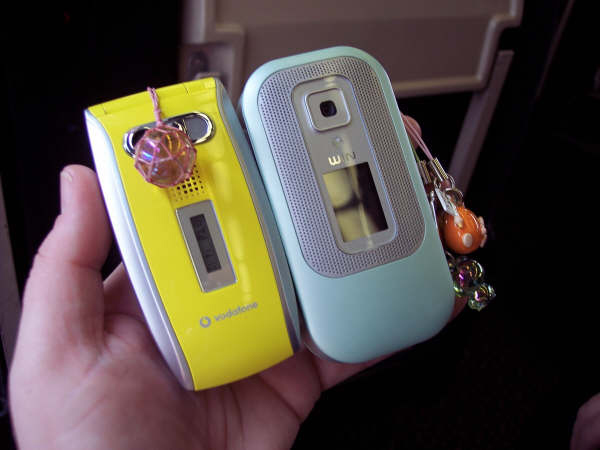
 First, we wandered through the gift shops. We discovered that the area where I live is famous for loquats (also known as biwi), a small orange tropical fruit. To me, it tastes like a cross between apricot and mango. There were lots and lots of different loquat pastries, loquats in jelly, loquat mochi (rice paste balls), loquat caramels...even funny little plastic loquat charms with smiling faces on teeny leashes, to hang from one's cell phone! (Yes, I now have two fat, grinning little plastic loquats dangling from my mint-green phone, although you can only see one of them, along with my little transparent green frog.
 Em has a miniature version of the Japanese fishing floats, made by her friend in Okinawa.) Loquats are considered unusual, because they flower in the fall or early winter, and produce their fruit in late winter or early spring.
I find the selection of "gifts" in these little shops to be fascinating--pickles of all kinds, dried squid, raw squid, dried fish of all kinds, and lots and lots of cute but useless plastic "charms". Emiri got lots of special attention, due to her great skills with the Japanese language. I'm so in awe of her! Even before she speaks, she draws people to her, with her smile and her attitude. After a brief walk along the pier in the beautiful sunshine, we enjoyed lunch at an Italian restaurant (Japanicized, of course!) on the pier. I tried Calpis, a very lightly carbonated, opaque white soda. It's supposed to have a lot of calcium, and had a very mildly sweet, slightly chalky taste. It was interesting, and I rather liked it, despite the fact that the name sounds like something vulgar in English!
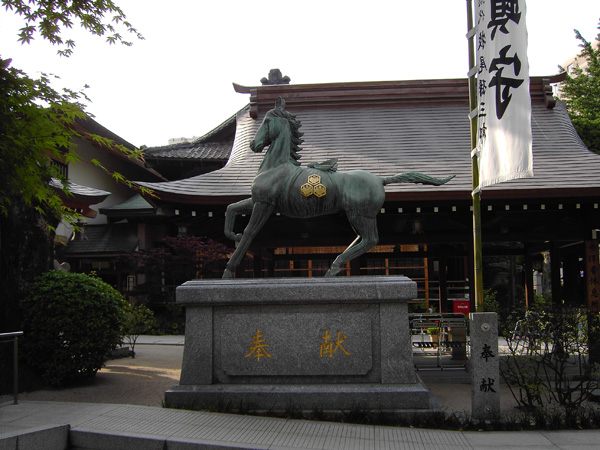
 Then we parked the car, and headed for Fukuoka on the train. This time, we got off at the right station! We took a taxi to a part of Fukuoka called Hakata, to the Kushida Shrine (built in 757 AD), and enjoyed wandering around. Though most shrines have similar features, there is always something distinctive about each one, and this one was no exception!
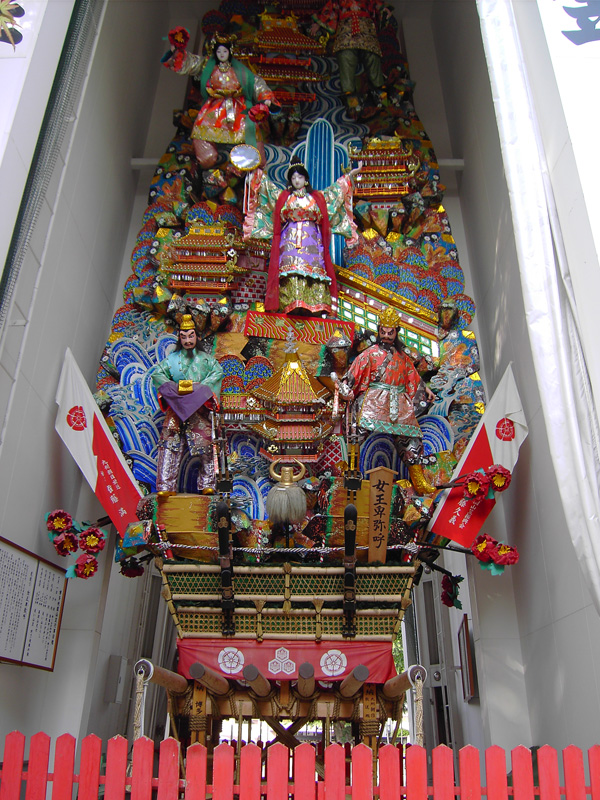
Kushida Shrine oversees the Hakata Yamakasa festival, which originated in 1241, when a Buddhist priest named Souichi Kokushi was carried through the town on a platform, from which he sprinkled holy water to eradicate evil spirits responsible for a plague that had struck the town. The festival takes place from July 1-15 every year, and the climax, Oiyama,  begins at 4:59am on the last day. On Oiyama, a drum signals the start to the first kakiyama, a one-ton "race float" shouldered by a team sometimes numbering over a hundred men. The team carries the float, sort of like a giant portable altar, on a five kilometer route through the streets of Hakata. Six more kakiyama follow, each one hoping for the best time on the 5K route. The seven nagare (teams) are drawn from more than 10 areas within Hakata, and can be distinguished by the different patterns of cloth used to make their happi. Each team of bearers has special short coats (mizu happi) made of the team fabric, sort of like a team uniform to be worn while carrying the floats, and matching long robes (naga happi) that they wear at other times during the festival. The various team members have different roles and responsibilities, indicated by different colored head cloths.
 There are special traditions associated with Hakata Kamakasa. For example, participants must not eat cucumber during the entire festival period, becasue the Kushida Shrine crest resembles the cross-section of a cucumber. Also, all team members are forbidden from having sex during this
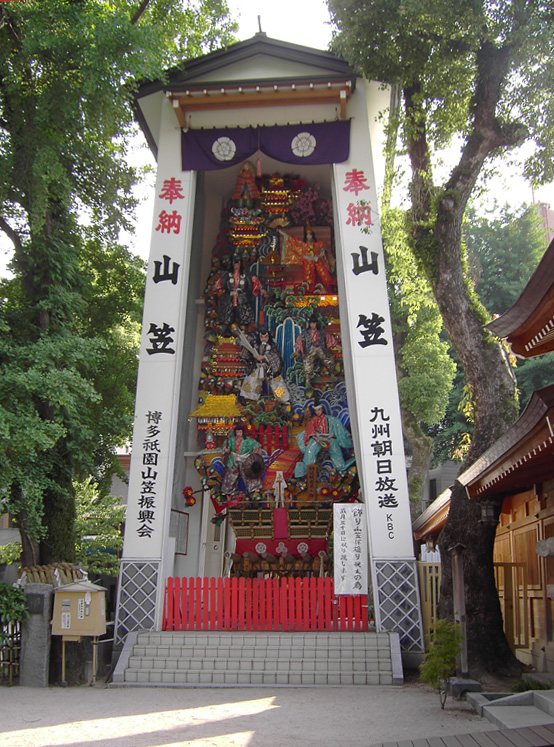
 time, so as to save their "life force" for carrying the one-ton kakiyama. It's considered an honor to be allowed to participate, and the participants take the various rituals and traditions very seriously. During the 15-day festival period, the whole Hakata district is the festival site, with the kakiyama on display, as well as the kazariyama, which are insanely tall "decorative" floats. The altar floats made to be carried are made of heavy wood hung all over with gleaming golden plaques and decorations. (Please forgive the bad photo of the kakiyama--they were in a dark "garage" and I could only take a photo through the glass, my camera was dying, and that was the only image that even came close to turning out. I'm sorry!) The decorative kazariyama are decorated with figures ranging from samurai warriors to cartoon characters. The one on display at the Kushida Shrine was fascinating, covered with lifesized figures, with vibrant colors and lots of sparkling silver and gold.
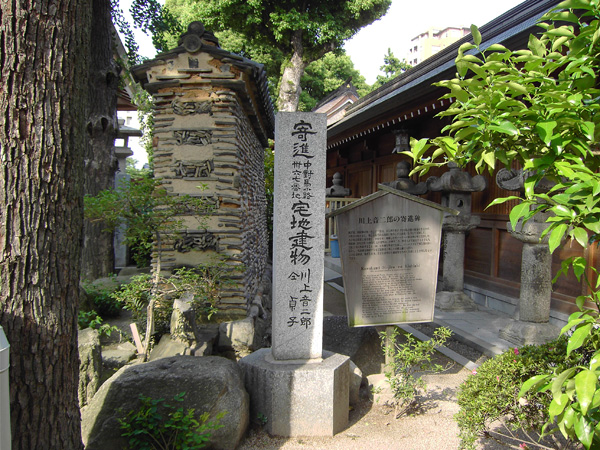
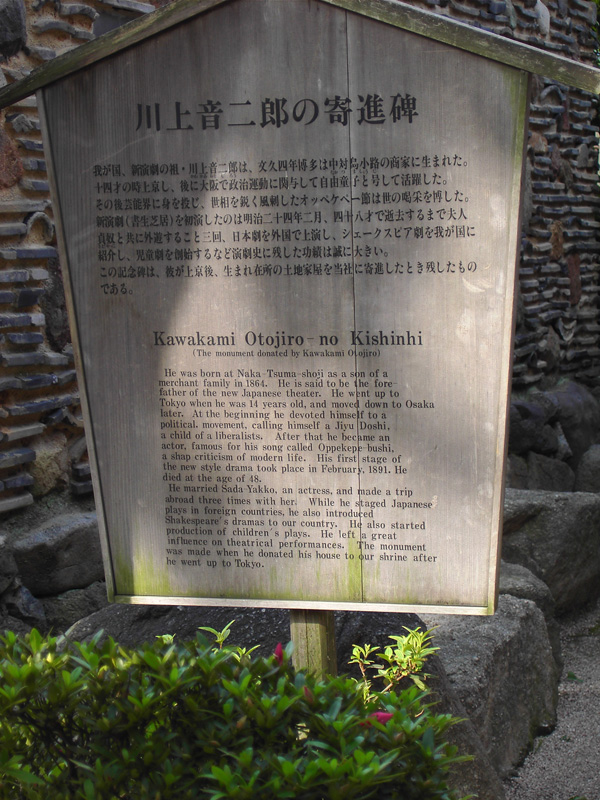
 There was also a memorial to the forefather of modern Japanese theatre, Kawakami Otojiro-no Kishinhi (1864-1912). He was the first to bring Shakespeare to Japan, and the first to stage productions of plays for children. I was thrilled to find the little memorial plaque at the back of the shrine itself!
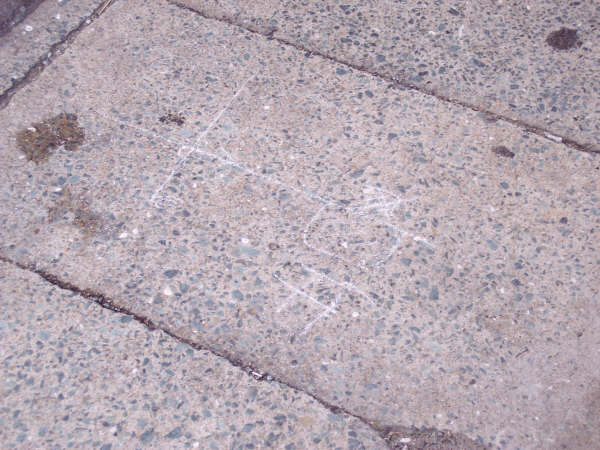
 Then Em and I set out to find the Hakata Machiya Folk Museum, which was much easier said than done! We walked for a while in one direction...nothing. Consulting the little guidebook map and the very vaguely placed "this is it" red dot, we tried another direction. Nothing. We stopped a man about to get into his car, and Em asked directions. He offered to take us there in his car, but we demurred. So he grabbed a rock, squatted in the street, and drew a map for us on the pavement! Hurray, we've got it! So we head back in the direction from which we came. And walked. And walked. Arrgh--nothing! We stopped again, this time at a shop filled with American-style
 t-shirts and jeans, and Emiri worked her magic in Japanese again. Ok, back we go. Finally, we found it...about half a block from the Kushida Shrine! Our search was frustrating and sweaty, but ended up being worth the trouble, at least to me. If Em didn't think so, she was generous to keep it to herself.
 The museum was small, but interesting. We wandered through the little exhibit building, where I learned much of the information about the Hakata Kamakasa festival and the floats we'd seen at the shrine! They had miniature dioramas, and a bank of old fashioned phones for visitors to listen to the "funny Hakata dialect." Of course, those didn't do anything for me, since I can't tell the difference between one Japanese dialect and another!
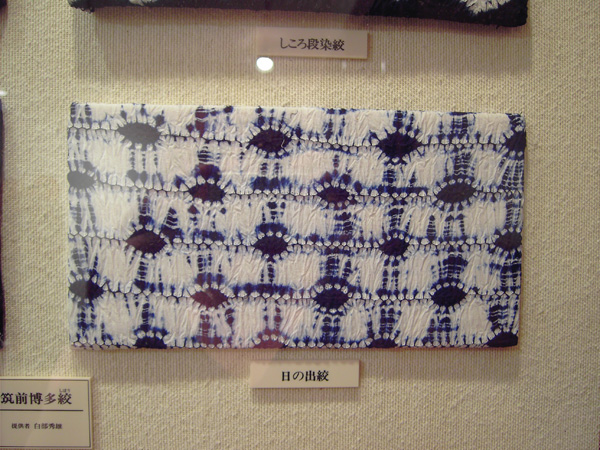
There were some absolutely amazing fabrics on display that looked sort of like batiks or tie-dye...the fabric of some looked as if it had been stitched very carefully in a specific gathered pattern, dyed with the deep indigo dye, and the stitches taken out once the fabric was dried. I could not read the Japanese that explained the exhibit, so my guess may be wrong. Regardless, they were really lovely. I believe these are the fabrics used for  the naga happi and mizu happi of the altar float teams. There was also a series of life-sized dioramas depicting a shop and a home at the turn of the century, complete with appropriately-dressed mannequins. There were displays of other local crafts as well, such as the Hakata dolls, Hakata-ori and Hakata shibori textiles, Hakata magemono (cylindrical boxes made from thin sheets of wood bent into shape), heisuke brushes (for calligraphy and painting), hariko (bobble-head animal figures made in a medium similar to paper maiche), multi-colored worked glass similar to Murano glass,
 fighting tops (a totally different shape than the tops Sasebo is famous for making), and famous Hakata scissors. Unfortunately, we were too late for any of the many demonstrations of these fascinating crafts, and for the chikusen-biwa Japanese lute playing.
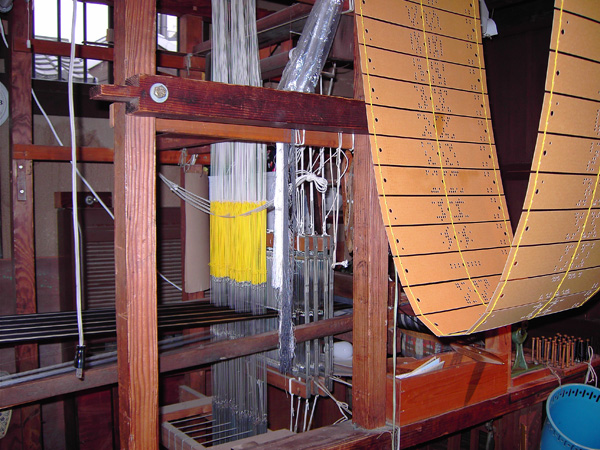
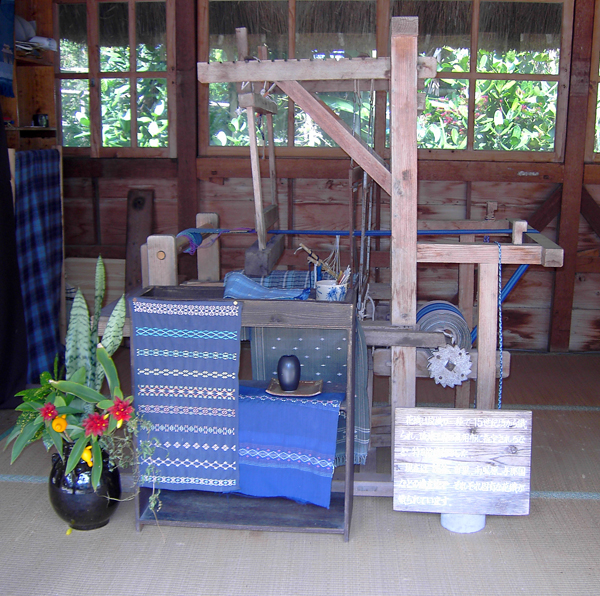
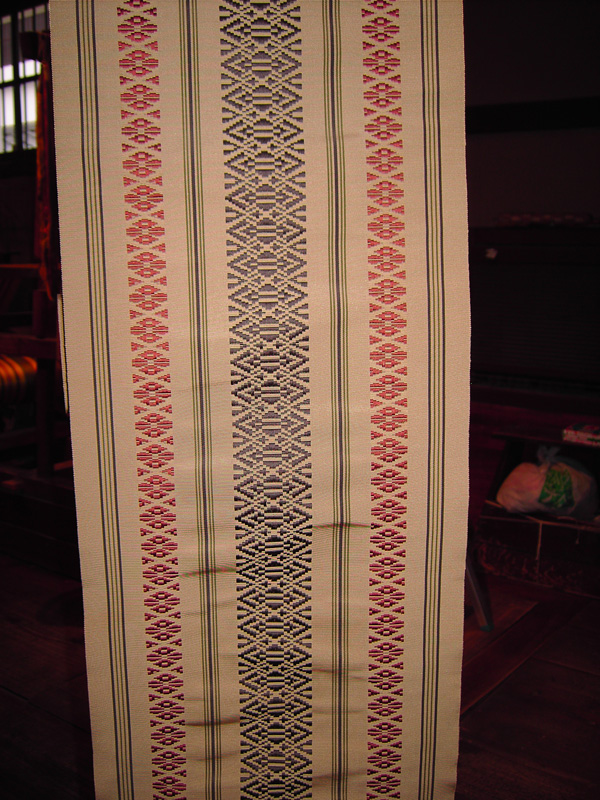
The other part of the museum (Maichiya Hall) was a relocated and restored Hakata-ori textile-weaver's house from the Meiji and Taisho eras (turn of the 20th century). The building itself is long and narrow, with the tatami rooms on either side of the central hallway built to become larger towards the back, in a fan shape for good luck. In the center of the main room, the ceiling opened up, giving a sudden impression of space and light. The main pillar of the house (the daikoku-bashira, representing the head of the household and his strength) was intricately carved, and soared up in the space. The hall was fascinating, with several very intricate looms and displays of astoundingly compl ex woven fabrics. I was so sad that we'd missed the demonstration, as I wanted to see how the big loom worked. There was a long loop like a conveyor belt of wooden plaques, each with a different pattern of holes. I think that somehow, the holes in each plaque help direct the heddles of the loom, each plaque moving into place for a different part of the pattern, kind of like a player piano's paper scroll. But I am not sure, and I want to see it in action! Unfortunately, they were closing, and so I snapped several photos, and we had to head out.
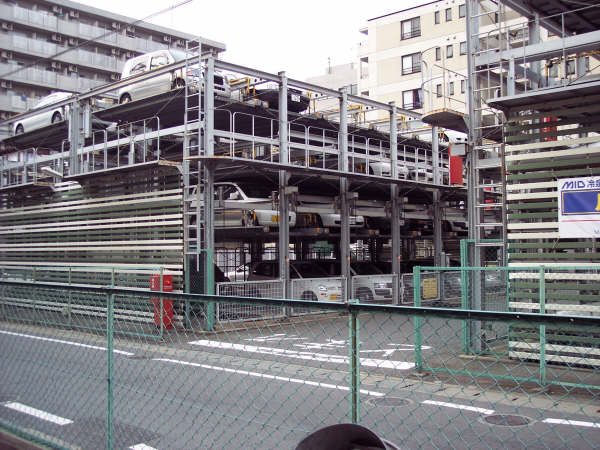
 We headed back towards the train station, trying to catch a taxi as we walked (we were pretty far away!) Despite the humidity, I enjoyed the walk, looking in shop windows and people-watching. Though I thought Sasebo seemed like a pretty big city to me, I now understand why it's considered sort of small-town and rural, despite its 300,000 residents. Fukuoka is very much more "big city", with tall buildings and modern shops, and fewer old-fashioned Japanese storefronts. I got another sense of what a premium is put on space in this country, as I passed a parking lot. The lot consisted of a relatively small footprint, but had "racks" on which each car was driven. The rack was then raised until it was almost touching the rack holding the car above, and another car was driven in and raised. I've never seen so many vehicles crammed
 horizontally and vertically into such a small space! I guess that's another reason for the intense and very expensive car inspection required every two years...I sure wouldn't want the car above mine leaking oil or transmission fluid or whatever onto the roof or hood of my car! Thanks to Emiri for the photo.
We finally got a taxi, and got back to the train station. We grabbed a quick bite to eat in the station itself, which, like many Japanese train stations, was like a shopping mall, filled with stalls and shops and restaurants. Then Emiri headed on the short trip to the Fukuoka airport to fly back to Okinawa, and I headed for the train back home to Sasebo. Even that experience was interesting! The platforms were crowded with people headed home after the workday. In the US, the crowds would swarm towards the doors as the train pulled in, shoving and jockeying for position.  Not so in Japan! Every few feet was a mark on the pavement to show where the doors would be when the train stopped . At each mark was a single line of people, snaking carefully so that no line intersected any other line, and no line blocked the pathway up and down the platform. It was amazing--everyone knew what to do and where to stand, no one was pushing, no one behaved as if he or she were more important than anyone else or in more of a hurry. I didn't know where my particular mark was (some cars are "first come, first serve", other cars are "reserved seat only", and I had a reserved seat. So I excused myself and asked a fellow traveller where I needed to be, with my few words of Japanese, some charades, and my out-thrust ticket. She smiled, bowed, chattered in
 Japanese, and gestured down the platform. In the next line someone looked up and saw what was happening. She beckoned to me, smiling...so I went to her. She looked at my ticket, smiled, bowed, spoke to me in Japanese, and pointed me to the next line, where a young man beckoned me to come to him. This went on from line to line down the row, until I was at the appropriate mark...then I was handed down the line to my spot at the end. It was very funny! Rather than gesture to me to go down eight lines to find mine, my fellow passengers took the bakka gaijin (idiot foreigner) in hand and gently herded me to my place. I loved it!
Emiri's visit was quite short, but despite my propensity for running late, we still managed to cram an awful lot into three days! I hope she can come back again, and I hope to get a chance to visit her in Okinawa. In the meantime, she was a very tolerant guinea pig, as I discovered where I can take visitors to Sasebo. Thanks, Em, for being such a fantastic, easy-going and fun guest!
 My cousin Emiri and her husband are stationed in Okinawa. Emiri's husband was away in Florida doing Secret Squirrel stuff for the Army, so Emiri came to visit me for a few days. For those of you who don't know, I'm the oldest grandchild, and Emiri is one of the youngest. Age-wise, she could be my daughter if I'd started early! But despite the age difference (or maybe because of it!) I really enjoy her company.
Emiri has been in Okinawa for about a year and a half, and she loves it! She started learning Japanese in January, and she puts me to absolute shame. She's not only able to speak a LOT of Japanese, she can read and write in hiragana and katakana, and is learning kanji! She even e-mails her Japanese friends in Japanese on her little Japanese cell phone. She's just amazing!
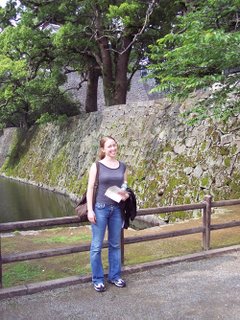 I went to pick her up in Fukuoka on May 22. I was nervous about driving directions and dealing with parking (I have a parking phobia, dunno why!), so I took the bus. Emiri met me at the International terminal, complete with gifts from Okinawa. It's the Japanese custom to always bring gifts when visiting, and to take gifts home to your friends when you return. Usually, the gifts are something to eat (yeah, just what I need!) and preferably something specific to the area. Em brought me wonderful pineapple pastries and purple sweet potato pastries (both pineapple and purple sweet potatoes are specific to Oki). She even had a gift for my friend Miyuki, as she knew we'd be seeing Miyuki at least once during Em's visit. We took the bus back to Sasebo in the rain, talking nonstop and catching up on life. That evening we spent at home, looking at photos Emiri brought of her birthday with her Japanese friends (amazing..check out her blog at http://emiriinoki.blogspot.com for more!), having a glass of wine, and generally getting to know one another again!
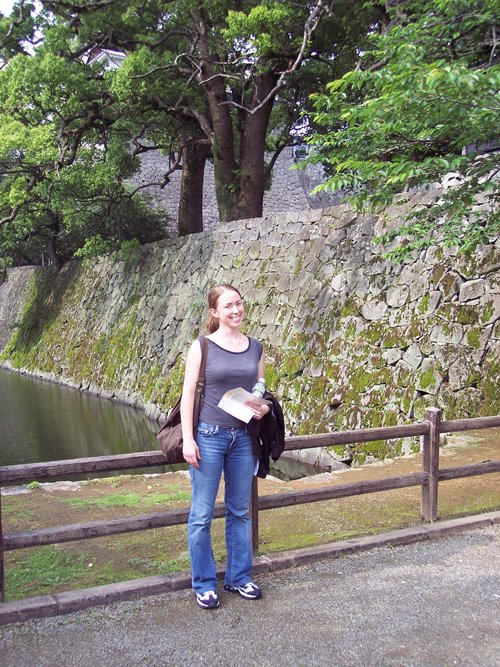
 The next day, we headed to Kumamoto by train. We got sort of a late start, but that's par for the course when you get women in our family together, I guess. We might have gotten to Kumamoto earlier, but we both panicked and got off the train one stop too early--I think the station before ours was called Kama-Kumamoto, and we should have waited for just plain Kumamoto. So we waited for the next train, and eventually got to the right place. Once in Kumamoto, we got on the streetcar and headed for Kumamoto Castle. We bought "day passes" on the street car, but it turned out we would've been better off to just get regular tickets, as we ended up not using the streetcar again until the end of the day to get back to the train station. Oh well...hindsight's 20/20!
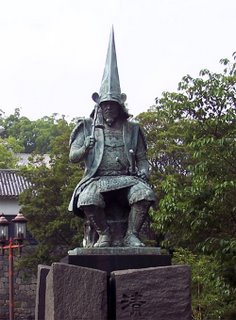
 We walked for a while, and I was beginning to regret the adventure, as it was very humid and sticky. But then the castle grounds and the statue of Kato Kiyomasa appeared ahead, and a cool breeze seemed to hurry us along. From a distance the statue made me smile. The tall commander's hat and bowed legs made the figure look a little like a garden gnome. When we got closer though, we read the plaque, and discovered the figure was the feudal lord who built Kumamoto Castle between 1600 and 1607 A.D. He is sculpted wearing snake-eye patterned armor, a battle surcoat, bellflower patterned footwear, and holding a fan. Nope, the fan isn't just a pretty accessory--it signifies battle command. Kiyomasa was equally famous for his prowess in war, castle construction and civil engineering (as we were about to witness!)
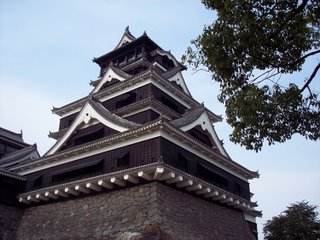
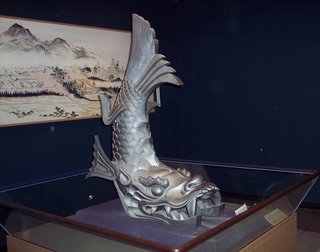
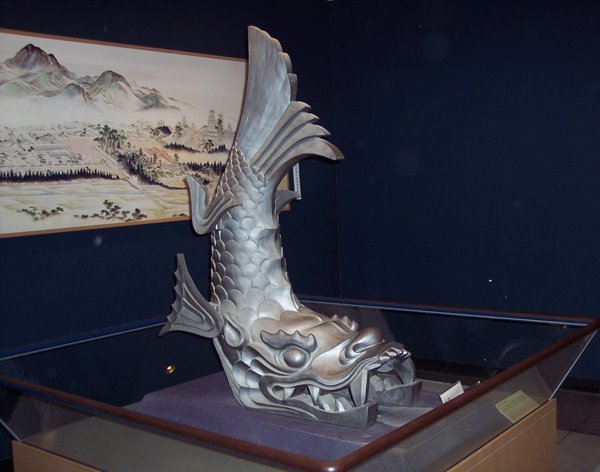
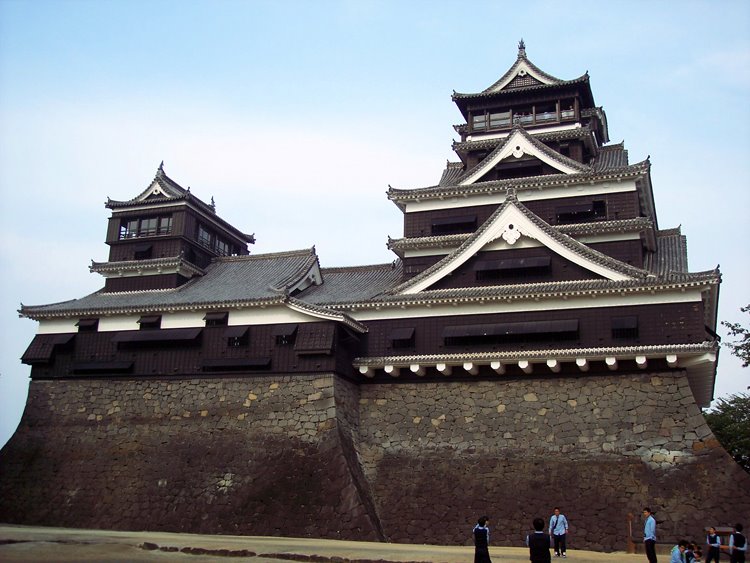
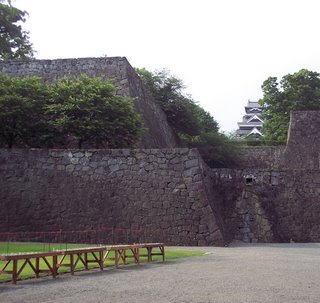 The castle and the castle walls were simply amazing. Kumamoto Castle is one of the "three great castles of Japan." The castle itself perched high on the hill (anything worthwhile in Japan is worth climbing to achieve...). It wasn't the fantasy Bavarian/Disney tower I always envision when I hear the word "castle", nor the heavy medieval fortress. Instead, it was a layer-cake of wood and plaster, with the ubiquitous upturned roof corners of Japan. On either end of the roof rested huge, curled fish decorations called shachihoko, which are legendary dolphin-like roof decorations throughout Japan. They ward off bad luck, especially fire (a big fear in a country of wooden structures!) But there was nothing flimsy or precious about the castle--the whole structure was definitely masculine, and though it was created with an eye for beauty, it was definitely a case of "form follows function." This was a FORTRESS. The stone walls are absolutely huge, and sharply sloped to repell invaders--and there is no mortar! The construction was fascinating, and beautiful.
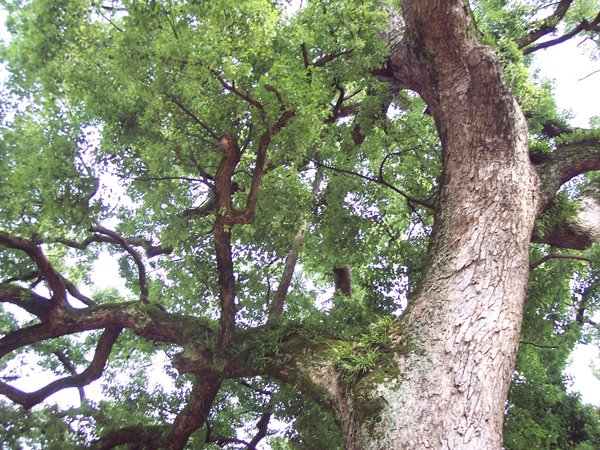
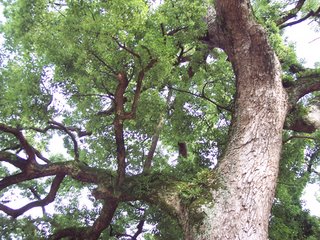 The plaques on the grounds were fascinating as well, explaining about the "Six Flowers of Kumamoto", the 600-year-old cinnamon camphora trees, and the samurai ideals that encouraged warriors to be as well versed in things such things as botany, poetry and the tea ceremony as they were in the art of warfare. The "Six Flowers" were developed in the 18th century, when the feudal lord Hosokawa Shigekata encouraged his retainers to take up gardening for their "spiritual education." A pursuit of the samurai, care and propagation methods for these flowers were handed down for generations, and several of the species in the garden have never been cross-bred, and remain genetically pure. (Sounds a little like Japanese isolationist politics to me!)
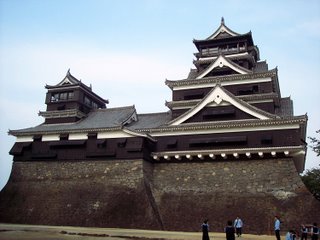 After exploring the grounds, we decided to go inside the castle itself. The courtyard was awash with school groups, each group in a different uniform. I've never seen so many variations on a navy blue school uniform! There was almost no male-female interaction though. The girls hung all over other girls, and the boys hung all over other boys, wrestling, hugging, standing with arms around each other--not at all in a sexual fashion, more uninhibited and innocent. It was the sort of behavior I expect to see in American kindergarteners, not in junior high school students. Some groups were waiting to go into the castle, others were waiting as small groups visited the souvenir shop, still others were making pyramids or careful sitting/kneeling/standing rows for class photographs, with the castle as the backdrop. They were boisterous and happy, giggling and hanging on one another, but exceedingly well-behaved. I flashed back to our flight into Japan, back in January. I can't imagine seeing that many American students in one place behave so well, with so few adults to hold order!
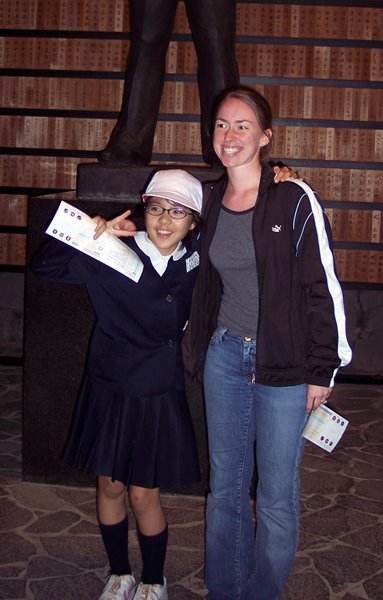
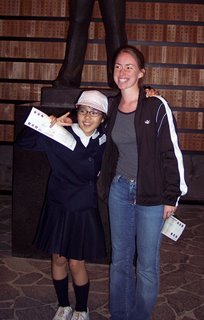 When M and I went into the castle to brave the steps, one skinny little girl elbowed her way through her classmates and spoke directly to M in Japanese. At first, M thought the child was asking for M to take a photograph of the child...then she realized the student wanted a photo taken of herself WITH the American tourist! We're in a relatively rural area of Japan, and M supposed the students don't see many Americans. How cool that M could communicate with the child--in Japanese! I think that student was the star of her class for the rest of the day! The stairs up to each level were divided into an "up" lane and a "down" lane, and for the rest of the afternoon, every time we passed this particular group of schoolgirls, they all shouted "Hello! Hello!" and waved at M and me.
 I didn't think the inside would be very interesting at first, as there are few windows, but the inside was made into a museum. We weren't sure how high we would climb, but we didn't have much choice..once one starts up, there is no way to get into the "down lane" of the stairs without going up at least four floors. Well, we could've crawled under the chains, but it would've been awkward, and who wants to disobey the rules in front of all those students? So up we went. There was a huge, scale model of the whole castle on display, and another larger model consisting of several rooms. A mirror was positioned so the viewer could see the hand-painted ceiling squares, each a different flower and beautifully executed. Unfortunately, my photo turned out badly.
Another level housed displays of samurai armor, and the insanely small, ornate gilded boxes that were the litters for the high-born ladies. They were about as big as my cat carrier, but much more beautiful. We peeked out an open window (more of a levered-out shutter) and the view was spectacular. When one spends so much time driving through the crowded, narrow streets, sometimes one forgets about the amazing vistas and views, with the lumpy volcanic mountains that are so very "Japanese".
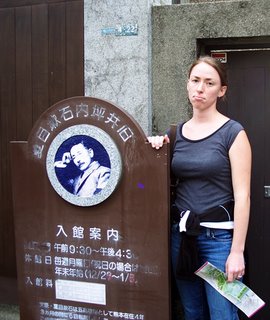 We finally climbed down from the tower and made our way back out to the street. It was pretty late, so we hurried to try to get to the Folk Art Museum and Natsume Soseki's house, which M really wanted to see, as she'd studied his writings in college. Unfortunately, both were already closed! I snapped a couple of shots of M looking despondent beside the house's sign, and we went in search of food, weary and footsore. A bowl of meat and rice helped immensely, and we wandered briefly through the big shopping arcade on our way back to the streetcar line. M decided she wanted something sweet, so she went off to hunt down a banana popsicle-type thing. I waited on a bench, and was approached by two Japanese women. I wasn't sure what they wanted, but one spoke English. She wanted to know if I had any pains or problems. How weird, I thought! My hesitation and apprehension must have shown in my face, so she tried to explain that she and her friend were providing a free service for anyone and everyone, where they would pray and send "positive energy and healing". They would not touch me. It was good for the person they were "healing" and I think it also was of some spiritual benefit for the two women--karma or merit or something. I wasn't sure what to say, so I cautiously admitted that yes, I had some issues with my shoulder.
 The first woman explained (I guess) to the second woman in Japanese. Then they both squatted down on either side of where I sat on the bench, bowed their heads, closed their eyes, spread their arms to encircle me without touching me, and began to chant very softly in Japanese. They did this for about two minutes, then got up, smiled sweetly, bowed in unison, and walked away before I could say a word. M arrived just as they left. What a strange and wonderful experience! I have no idea why these women were doing what they were doing, nor exactly what it was they were doing, but it made me think of Reiki. I don't know if they were Buddhist or Christian or what.
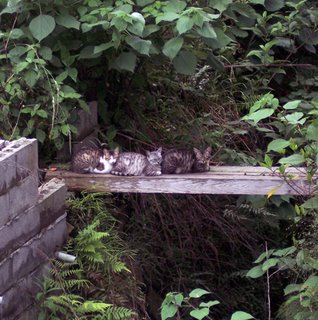
M and I made our way back to the train station in the twilight on a street car packed with schoolgirls, salarimen, shopping matrons and one adorable elderly couple, and from there back home to Sasebo. It was a long day, but certainly an interesting one! More soon, about the rest of our jam-packed mini-tour--two days for Arita, Kashimae Pier, an amazing dinner out with Miyuki, and Fukuoka City! (The cat photo is just a picture of three little cats happily snoozing on a plank across one of the city's canals...I couldn't help myself!)
 I'm sorry it's been so long between updates--it's been a busy few weeks! My trip to Yokosuka was a bigger deal than I anticpated, and I was a little sorry we hadn't taken the Navy up on their offer to let Fearless Husband come with me. However, we both decided it was better for his career for him to ship out at the beginning of May rather than have him stay home and travel to Yokosuka with me. So, off he went to Singapore and Thailand.
The Navy gave me a plane ticket to Haneda Airport outside Tokyo, and instructions on how to get a train ticket to Yokosuka once my plane landed. After some confusion and the help of the costumed "airport helpers"--I boarded the train. The airport helpers are a particularly Japanese custom...young women in their early 20s drift around the airport, wearing powder-blue skirts, jackets, cute little hats with ribbons, and dainty white gloves right out of the 1950s. They're paid to look pretty and seek out confused tourists to aid. The helper who approached me had very little English, but more English than I had Japanese! She called out in her high, clear voice, and two more dainty blue-wrapped girls came running to join us (working women in Japan seem to ALWAYS run with tightly clasped knees and teeny little steps, giving the impression of eagerness and hurry even when they don't move particularly fast!) Between the four of us, we managed to navigate the train ticket machine. I'd found the button to convert the screen text to English, but the train line name I was given was not on the screen, nor was the station name I'd been told. I kept repeating "Yokosuka! Yokosuka!" in desperation, and the three girls figured out how to get me there, pushed the right buttons, and handed me the ticket that the machine spit out. All three were eager to show me the right escalator to find my train, and I was escorted like royalty to the train platform.
 I struck up a conversation with a couple on the train--he was miltary, she was Japanese, and they were also on their way to the hospital at Yokosuka. I was grateful, as the wife was able to read the signs, of course, and told me I'd lucked out and gotten onto an express, and would not have to change trains. They showed me how to get to the base from the station, which saved me taxi fare, and I was grateful. Once on the base, I had to take a taxi though--it's a BIG base! The housing folks tried to put me in a shared room with a young female sailor, but I wasn't having any of that. I checked myself into the Navy Lodge (which is where I would've stayed if FH had come with me) and got permission for reimbursement afterwards.
The medical stuff went extremely well--I've never had such attentive, professional, courteous care in my life! I guess I expected the Navy hospital not to be on par with a private hospital, but I was proven wrong very quickly. I am so grateful to have such wonderful medical service available! I had a great time talking with the Lieutenant who was the head nurse. She and her husband have adopted two Japanese babies, and of course, I had lots of questions! The whole experience was great, despite being a lot more involved than I first thought. The doctor decided he didn't want me going home to Sasebo the day after the procedure, so my "orders" were extended several days. So...I decided that rather than make this a trip all about medical stuff, I would treat it as a mini-vacation and a chance to see a little more of Japan on the Navy's dime!
I arrived in Yokosuka on Wednesday afternoon. It poured rain on Thursday (and most of the day was taken up with medical stuff). My surgery was Friday, and then it poured all day Saturday. I was getting a little impatient! Luckily, Sunday was overcast but not rainy, so I headed back to the train station, armed with a photocopied map of Kamakura, directions to the Daibutsu (giant Buddha) and my meager handful of Japanese phrases. I got on the train to Kamakura (or so I thought!) A little worried that I couldn't find any signs on the train in Romanji (English alphabet), I spoke to a young man, pointing in the direction we were travelling and asking "Kamakura"? The answer was an emphatic NO! I'd gotten on the wrong train, going in the wrong direction!  So, I got off at the next stop, and figured I would just jump on the next train going in the opposite direction. While I waited, a little boy and his parents came onto the platform. He was running and laughing and jumping in puddles as his father chased after him, making sure he didn't overshoot and fall onto the tracks. The child's mother saw me watching her son, and smiled...and then spoke to me in great English. We talked, and I ruefully explained my mistake to her. I'm certainly glad I met Asoko! Turns out I could not just get on the train and go in the proper direction...I had to go back one stop, get off the train, and get on an entirely different train line! Oooops! So...this young family offered to escort me. It wasn't until we'd gone back one stop, changed trains, travelled several stops and changed trains again that I found out they had changed their plans entirely, just to make sure I got where I was going! They left me there at the Hase train station in Kamakura, and promptly got on a train going back to where they'd come from. They all three hustled down to the end car, and waved and beamed at me from the back window of the train until it was out of sight.
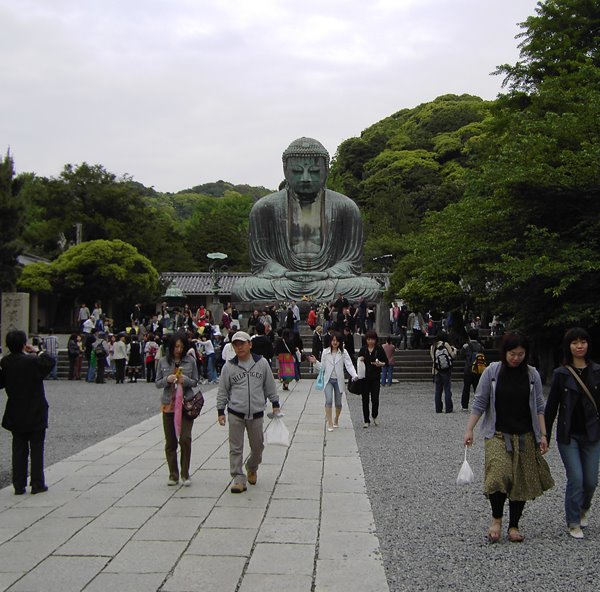
 Kamakura is a fascinating town. It's small--smaller than Sasebo--with lots of little restaurants and touristy shops. Their claim to fame is the plethora of shrines and temples, and the Daibutsu, which is the second largest Buddha statue in Japan. It's 13.35 meters high, of cast bronze, built in 1252. It was originally built inside a temple, but a tsunami washed away the temple walls and roof at the end of the 15th century, so now it stands in the open. Its official name is Taiisan Kotokuin Shojo Senji. One can pay to go inside it, but it was plenty hot enough without going into a giant metal windowless box, so I abstained.
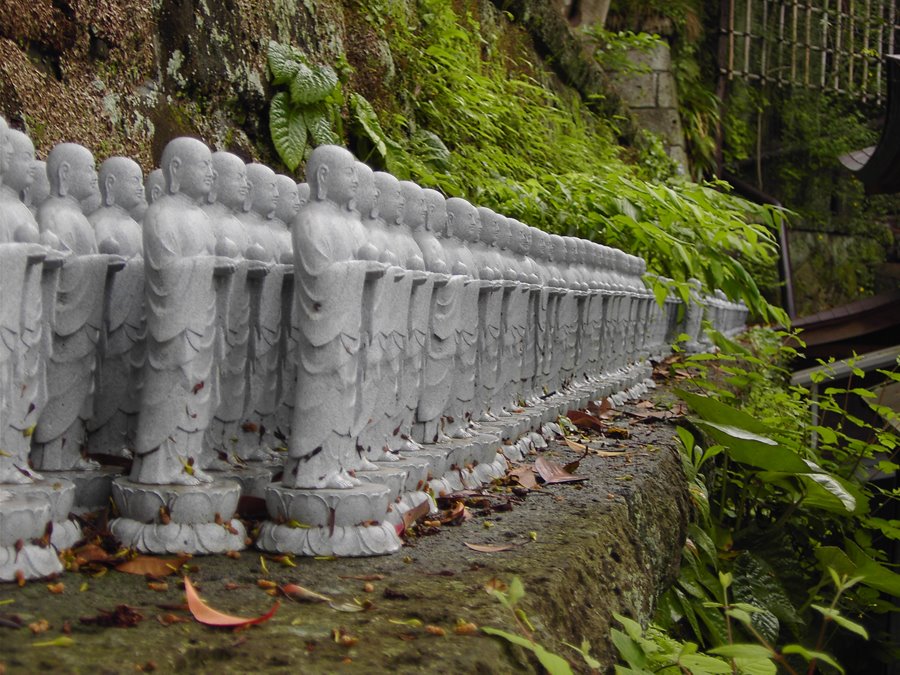
 My favorite part of Kamakura was not, surprisingly, the Daibutsu, but instead was the Hasadera Temple. Of course, one enters the temple grounds at the garden level, and begins to climb (anything worthwhile in Japan is worth climbing to reach...) On the first "level" there were literally hundreds and hundreds of little statues called sentai jizo, maybe 12 inches high. Each represents the soul of a child who was stillborn, miscarried or aborted. The men mostly kept moving up the stairs, but it seemed that every single woman had to stop here, to pour water with a bamboo dipper on the head of a child-like Buddha statue, and pray before the ranks and ranks of sentai jizo. Another, larger statue sat in the middle of them all, wearing a red cloth cap and cape on its stone head and shoulders. There were many candles being lit, and lots of incense, and more than one woman walked away weeping.
 There was a tiny little temple with a wooden statue of Buddha inside, with the usual grid-topped box for donations...but surrounding the box and the feet of the Buddha were piles of toys and candy and sodas. A woman saw my puzzled expression and whispered to me "for the children, because they never got to play and be happy on this earth." So much for no tears!
Once I got myself together and stopped sniffling, I made my way further up the hill to the main temple halls. The Hasedera temple is of the Jodo sect of Buddhism, and is famous for its statue of Kannon, the goddess of mercy. The statue shows Kannon with eleven heads, each representing a characteristic of the goddess. The gilded wooden statue is over 9 meters tall, and is regarded as the largest wooden sculpture in Japan. It was so serene and cool in the temple hall, and though there were plenty of tourists, almost all were Japanese, and everyone was very quiet and reverent. It was really beautiful! Go to http://www.asahi-net.or.jp/~qm9t-kndu/hasedera.htm for more info about the temple and the statue.
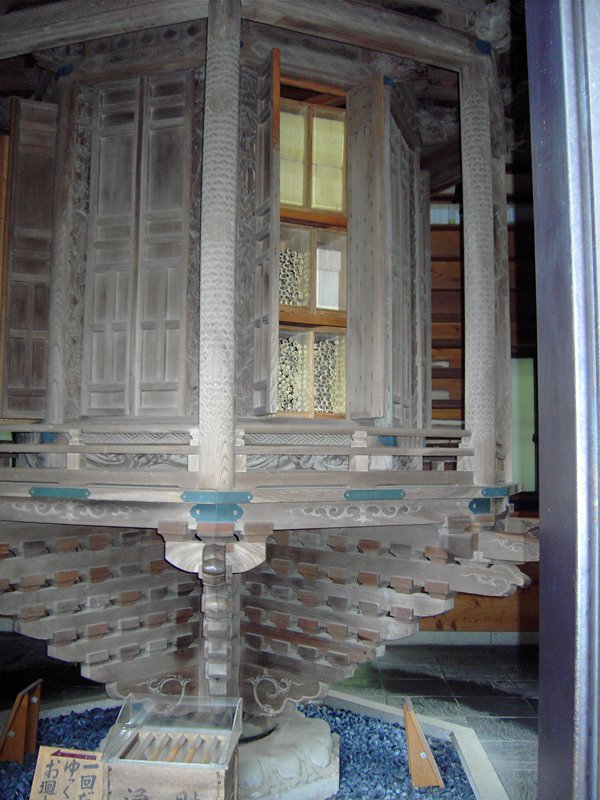
 I really wanted to take a photo of the statue of Kannon, and there were some tourists doing so, but there is a sign that specifically asks visitors NOT to take photos. I thought about how I'd feel if someone came into St. Peter's in the middle of a service and started snapping photos and talking, and I decided to respect the request. I did take a photo of the huge bell, and the giant tree trunk that is swung against it to ring it, and several photos of the gardens, the temple roof, the statues for the children, and of some of the toys and offerings for the souls of the children. I also took a photo of the revolving kyozo, which is a carved wooden storehouse for the sutras--the Issaikyo, which are all the scriptures of Mahayana Buddhism (100 volumes, 900 pages each!) The whole thing revolves on an axle, like a huge, ponderous top. There were several very solemn-faced people struggling to push it around one complete revolution--an elderly couple, then two plump housewife-types, then three teenagers. If a pilgrim pushes it around in a full circle, he or she gets the same spiritual benefit as reading all the scriptures!
 I really enjoyed the Daikokudo hall, the home of the Daikokuten. He's a fat, funny god with a huge smile, a bald head, and fat, pendulous earlobes. He stands on a sack of rice with a treasure bag over one shoulder and a mallet or mace over the other shoulder. He supposedly shakes his mace and treasure and goodies fall out, showering the good people. He used to be the god of grain, but is now considered one of the gods of good fortune--one of the seven lucky deities. In a little alcove off the Daikokudo sat a solemn priest. His job was to carefully paint beautiful calligraphy in the "pilgrimage books" of visitors, and to sell little trinkets. I bought a little Daikokuten charm, and he smiled and handed me a little tiny brass statue of the Daikokuten as a gift. While I was there, several people came in and rubbed the statue, including two very serious old ladies who approached the statue chanting something as they rubbed him all over, using both hands with great purpose, seriousness and intensity--his swollen earlobes, his knee, his fat cheeks, his eyebrows...and between his legs! I had a hard time keeping a straight face, especially as the fat statue was shorter than both women, but much wider, and his grin was so huge!
 On my way back down the hill, I followed two elderly women from New Zealand (mostly so I could listen to their Japanese guide/friend!) They passed a little tatami-matted, glass-walled building filled with people kneeling in front of low desks, busily writing. The guide/friend explained that they were copying from an ancient sutra, which gave them spiritual benefits. Past the building, there was a torii in front of a little tiny cave. The NZ ladies stooped over and went straight in, so of course I followed. Inside the cool, low-ceilinged cave carved out of the hillside, water dripped and shadows loomed. The one large Benten statue (goddess of eloquence, music & wisdom--of course she's female!) was followed by 16 relief carvings of her followers and messengers. I was confused...the torii is Shinto, but the Benten statue is Buddhist. The guide/friend explained that this was an example of the overlap of the two beliefs, but I'm not really sure I understand. More reading for me, I guess.
 The cave startled me, as it got so low at one point that we practically had to crawl to get through to the next part. There was a room with hundreds and hundreds of teeny tiny wooden Buddha figures about an inch and a half tall--tucked into nooks and crannies in the wall, on rock shelves, on the floor, teetering on the metal pipe through which the wires for the few electric bulbs run. The guide/friend said people bought these little figurines and left them, often with prayers written on the bottom. I asked her why these things were in a cave...was there persecution in the past? She smiled and said "it means more if your prayers are private and quiet, and not showing off for your neighbors." Made me think of "And when thou prayest, thou shalt not be as the hypocrites are: for they love to pray standing in the synagogues and in the corners of the streets, that they may be seen of men....when thou prayest, enter into thy closet and when thou has shut thy door, pray to thy Father which is in secret...." (no, I don't have it memorized--I had to look it up).
I was so glad I made the effort to go to Kamakura. I wish FH had been with me, but maybe we'll get a chance to head in that direction together at some point in the next two and a half years. If you're anywhere near Tokyo for any reason, don't miss the little town of Kamakura.More adventures to come. I still have to give you the lowdown on cousin M's visit...we went to Kumamoto, Arita, Fukuoka, Kashimae Pier...it was great! But it will be a day or two, as FH is home (YIPPEE!) Seems they got halfway to Indonesia, and Indonesia decided they didn't want help. So they headed home. His hours are truly crazy right now, as the ship is doing some sort of important excercise/qualification/I don't really understand it, and so even though he's in port, he's on the ship more often than not. Though I won't see much of him (and nothing at all during the week!) at least he's close, and he gets to be home a few evenings in the next two or three weeks. He's working insanely hard and I'm really in awe of him right now.

 We window-shopped (or would that be awning-shopped, when there are no windows?) our way through kitchenwares, fish so fresh it was still flapping, gorgeous vegetables and jewel-like fruit, organic chicken, various homemade condiments, and more. I ended up with some fresh yuzu-koshou (a paste of yuzu rind – a very aromatic citrus fruit – chilies and salt that’s delicious on fresh tofu), the prettiest turnips I’ve ever seen, a packet of sweet potato mochi, a bamboo spatula/spoon, several skeins of yarn from another teensy shop basically lined floor to ceiling with brightly colored balls of yarn, some traditional Japanese New Year decorations, and of course, FH's beef.
 The butcher laid out three different knives, and proceeded to lovingly separate the smaller chunk I’d indicated, then very carefully trim all the exterior fat, inspecting it and turning it and basically making a big production out of the whole thing. Yes, he used all three knives. The meat was then weighed (he was careful to point out that I was paying only for what we’d be eating, not for the trimmings!), then the chunk was carefully wrapped in a flexible, paper-thin piece of wood (yes, wood!), then white paper over that, then more white paper, then finally the swaddled bundle was put into a bag for me and placed on the counter *just* out of my reach.
 I also bought a traditional Japanese New Year’s decoration(shimekazari, which I can’t believe I forgot to photograph!), to go over our front door. It’s a fat, heavy twist of rice straw, with two sprays of rice straw sticking down to either side, a little fountain of rice kernels on their stem in the middle, various bits of folded and rolled special paper, and a sour orange skewered in the center. Most of the houses in our neighborhood already had similar decorations, and Hiroko encouraged me to get one, too.
 The morning of January 1, many Japanese get up very early to watch the first sunrise of the new year…this is considered a harbinger of the year to come, and one is supposed to be at peace, with a smile, to watch the sun rise. Unfortunately, we couldn’t see the sun rising here in Sasebo. Instead, we had fat flakes of snow!
 On the table were plates and plates of food (Chinese cooked pork, fresh mackerel sashimi, knots of savory seaweed, slabs of omelet and slices of ham, etc.) as well as the traditional osechi -- special large wooden divided boxes of very beautiful New Year's foods, each with its own meaning for the New Year (good fortune, money, happiness, fertility, etc.) Traditionally, nobody cooks on January 1, 2 and 3, so the three-layer boxes are all foods that will last. There were all sorts of things, from black beans decorated with gold leaf, to sea cucumber (neither of us liked that AT ALL, but of course had to eat it, as it was fancy and very, very expensive) to tiny carved squashes and pretty fish paste shapes. Champagne was served as well, and the other American couple brought brownies and vegetables with spinach dip. I felt bad that I hadn't contributed to the feast, but luckily, I'd brought gifts for Morinaga-san and her daughter, and a fancy bottle of French wine (regifting what the architect and his wife next door gave us!) and a container of homemade candies. The candies were the insanely simple ones... small pretzels with a Rolo chocolate-and-caramel candy put on top, the whole thing popped in the oven for three minutes, then a toasted pecan half pushed into the Rolo to make it smoosh down on the pretzel. VERY easy, and surprisingly delicious, like a chocolate/caramel/pecan turtle, but with the salty crunch of the pretzel. Luckily, the candies were a HUGE hit, and everyone ate them all up and argued over the last few.
 Over Christmas, FH and I enjoyed Norwegian meatballs and Norwegian Christmas cookies (thank you, Grandma!) from his family traditions. We spent our New Year’s morning quietly together, and had my family’s traditional New Year’s collard greens, black-eyed peas and ham for lunch. At Morinaga-san’s house that afternoon, we sat on tatami mats, with sliding rice-paper doors on two sides, and a painted scroll of cranes hanging in the special alcove, over the ancestor/God offerings of mochi and oranges and shiny wire decorations. It was pretty wonderful to sit in that beautiful and very foreign room, beside my familiar husband, making new Japanese and American friends, at a table covered with food from both cultures, with conversation and laughter flying. What a great way to start the New Year!


















 Posts


