Showing posts with label Emiri. Show all posts

Friday, September 07, 2007

Dragonfruit Season

Edited with a new image, below!
It's been far, far too long since I've managed to post here, and I apologize. Our unexpected trip to the US, my mother-in-law's passing, pneumonia, and simply having a husband at home again have all taken their toll. But...it's time to get back to adventures, and I'm still so very behind! Here's another grocery store story, to tide us all over until I can post more this weekend about my adventures with MM.

I was browsing through my favorite neighborhood grocery recently, examining the produce, which never fails to surprise me. There were the plump and lovely summer tomatoes (remember how that one turned out?) and deeply-pigmented bell peppers, shinier and smaller than the broad-shouldered monsters I'm used to. I edged along the aisle lined with careful rows of hideously expensive canteloupes and spherical watermelons, jewel-faceted plastic bowls of tiny tangerines and heaps of slender, purply-black eggplant. Ginger, cleaner and less wrinkly than the knobs in the commissary, sits beside something that looks like ginger, but isn't, with reddish bud shapes growing out of it like the buds of a waterlily. There are delicate stacks of toothy shiso leaves and several versions of scallions of varying thickness and straightness (the long onion I've read about in cookbooks?), beside obscenely thick and pale logs of daikon radish.

The boxes of perfect white button mushrooms are quite expensive, and each box contains perhaps ten small mushrooms...but as if to make up for it, there are so many other varieties of fungus. There are bunches of tiny, willowy enoki, like bleached dandelion stems after the fuzz has been blown away, and fresh, flat-capped shiitake piled like skipping stones. There are fat mushrooms, all thick stem with a little flare of cap at one end, and bouquets of brown-capped mushrooms that seem to be separate until one picks up a package and finds all the stems are fused at the bottom into one big clump, and one ruffly kind of mushroom that looks as if it's trying to pretend to be a head of lettuce.

One largeish refrigerated section of this tiny market is entirely filled with small plastic bags of pickles -- a huge variety of land and sea vegetables in brine or vinegar, with garlic, with sandy miso paste, with tiny red rings of chiles.

One of the things I like the most about Japanese markets is the seasonal availability of the produce. Sure, some things are available year-round, and that is the case more and more. But much more than in American markets, certain things are only available when they're in season...which means they're still being bred for taste and sweetness and succulence and aroma, not how well they'll travel or how long they'll last on the shelf. There's also a great reverence for produce from certain areas....mushrooms and potatoes from Hokkaido, gigantic, frosted-black-skinned clusters of grapes from Kyoto, peaches from this area and apples from that.

Yes, quite often the produce is insanely expensive by American standards, but to be honest, I think I'd rather have a single basket of strawberries so fragrant and sweet I'll remember them for months, than a basket every month of hard, green-tasting berries with no scent. Suddenly I can imagine spending two or three dollars on a single peach, when I'll only need the one, and it will be an experience of really savouring a single exquisite fruit. I finally truly, viscerally understand the concept of quality over quantity. Can you really remember the last bunch of grapes you ate? The last apple? The last time you closed your eyes and sighed with pleasure from the experience of eating one perfect tangerine? The memory of the peach I chose is going to stay with me for a long, long time...and I'd rather wait with anticipation for the next season than have a tasteless imitation out of season.

I chose an inexpensive (relatively -- less than $6) globe of a watermelon, and an intensely fragrant, Roald Dahl-style peach, almost half as big as the watermelon, and a clear plastic bowl of tiny tangerines. And then, I saw the oddest fruit I've ever seen. It was an oval fruit, larger than an apple, like something that ought to grow out of a cactus. The thick, smooth skin was bright fucshia studded with green-tipped...spines? Flippers? Protruding leaves? One was almost $3 (which I later discovered was insanely cheap...I found less attractive specimens for almost three times that price in another store!) and carefully nestled in a nest of styrofoam netting. I picked one up gingerly, afraid the spiny parts might stick or sting me, and found the sticking-out parts to be relatively soft and leathery, and the fruit itself to be heavy for its size.
Of course I bought one.
The cashier tried to tell me what it was, but it took several tries before I understood that she was trying to tell me in English -- it was a dragonfruit, which made total sense. Take a look. What else would you call it?
I took it home (took photos, of course), and looked it over. How to go about this? Well, there's sort of a hole at one end, where it was attached to its parent, I assume. I took hold of one edge of the hole and pulled. The skin peeled back easily, revealing a white oval of flesh the shape and size of a large goose egg. A knife blade slipped easily into the egg, and a wedge pulled out showed that the flesh was studded throughout with a galaxy of tiny black seeds. No pit, no core. Everything encased by the skin was edible. The taste and texture was much like a kiwi fruit, but without the kiwi's tartness, and the seeds were almost indiscernable, just adding a nice hint of crunch, again like a kiwi. It was pleasantly sweet and very moist, and I enjoyed it very much.

I've since learned from my more knowledgeable friend, D, that dragonfruit are native to Okinawa, there are two types of dragonfruit, and the second type has vivid fucshia flesh. I'll have to keep my eye out for the second kind! After the first one (and the squeal of delight from D when I told her about it!) I hurried back to buy more. I bought one for D, one for myself and Fearless Husband, and one for Miyuki's parents as a gift. That's all...there were no more, and I haven't found any in any store since.

I'll have to mark my calendar for next year, so I don't miss dragonfruit season!
Edited to add the photo of the dragonfruit growing from Emiri! Now I can really see why they call it dragonfruit! And I was sort of right...it looks like the fruit of a cactus/succulent. Thanks for the photo, Em!

Wednesday, November 22, 2006

Okinawan Hibiscus, Awamori & Shisa

(As always, click on the images for larger photos!)

I took the free shuttle from the base to the airport last Tuesday morning, and flew to Okinawa to visit my cousin Emily. Though I'd packed summer shirts and skirts, I was kind of stupid and wore a black tunic and dark pants for travelling. Okinawa was HOT! Em picked me up at the airport and immediately took me out sightseeing.

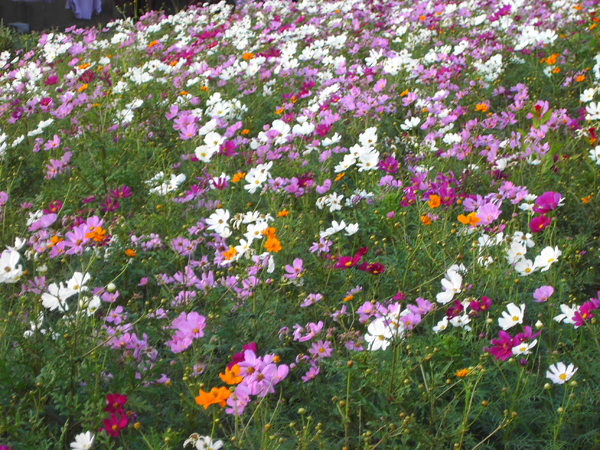
I was fascinated by the differences between Okinawa and the mainland. It's MUCH flatter, of course, and much warmer. The air is ocean-scented, and there are glimpses of incredibly beautiful turquoise water here and there. Flowers are EVERYWHERE, even though it's November. Em said that in the spring and summer, the flowers are astonishing. I was pretty astonished at the November abundance of vast masses of vividly-colored hibiscus, bouganvillea, cosmos, and many other flowers whose name I didn't know. The buildings are relatively low, and are boxy and square and mostly concrete. They're mostly painted in "Key West" colors -- lots of white trimmed in coral, peach, teal and pale turquoise. One reason there are so many concrete buildings (as opposed to the many wooden buildings in Sasebo) is due to the almost total razing of the island during WWII.

We went to a lacquerware factory first, which was totally cool. I had no idea what lacquerware really was until now. The various dishes, cups, platters and bowls are carved in single pieces from light, strong dried wood. Then the wood is coated with lacquer, which is made from several things, including powdered turban shells found in Okinawan waters. The lacquerware is almost all black and maroon -- very traditional. Some is left plain, some is painted, some has designs of mother-of-pearl inlaid into the lacquer, some has designs in relief on it. The relief pieces are made by rolling out a very thin "dough" of lacquer paste of a single color. The design is cut out of the "dough" and pressed onto the lacquerware piece. Details are pressed into the dough while it is still moist. Some designs are simple -- a red hibiscus blossom with green stem and leaves and a yellow stamen -- and other designs are really complex -- a landscape with trees, mountains, houses, etc. in many different colors. The design is pressed and rolled once it's put on the bowl or platter or whatever, so the edges are rounded and it seems part of the piece, not laid on afterwards. It was all really amazing, and now I'm really afraid I might have given away or thrown away good lacquerware, thinking it was plastic! I did buy two soup bowls (plain black with maroon interiors, no designs) and two pairs of chopsticks (both black with painted designs--Fearless Husband's with cranes, mine with wisteria blossoms). NOT cheap, but they are lovely artisanal pieces we'll use and treasure. I ACHED for a delicate lacquerware ceremonial tea set, and for an inlaid "family-sized" bento for picnicking...but both were FAR outside my price range.

Then Em took me to the Ryukyu Glass Factory. She sent me a clear oval glass plate with a swirl of cobalt and sky blue in it a couple of months ago from this particular factory, and I was really looking forward to seeing the place. The outside of the building, including the big support pillars and the wall along the walkway and stairs, was totally covered in vividly colored clear glass bricks. It was lovely! The glass blowing had stopped for the day, which was so very disappointing, but we did see some of the glass furnaces roaring away. Two of the artisans invited us into their work area so we could peer into the annealing kiln and see all the newly made vases and bowls slowly cooling down (if they cooled in the open air, the surface glass would cool faster than the inner glass, and the pieces would shatter). We had a great time in the huge shop, and I had to restrain myself from buying everything I saw! The glass industry in Okinawa started with Okinawans melting down the many, many soda bottles left by the American forces. At first, the pieces were utilitarian (like the well-known glass floats for fishing nets), but the craftsmen began to make pieces with vivid colors, and branched into more decorative work. Most of it is thick, and much of it has bubbles in the glass. It reminded me a little bit of Mexican glass, but with a much larger range of colors and shapes.


I bought a set of four coasters for me and FH, a lemon-yellow glass trimmed in bright green to add to my collection, and a couple of Christmas gifts. On our way out, we went to the "factory seconds" discount store, so Emily could play the "ping pong ball game." For 300 yen (about $2.50) one is given five ping pong balls to toss into a wooden pen filled with glass pieces. If a ping pong ball lands in a piece, you "win" that piece! Em claims to have "won" several pieces. Of course, I had to tease her about how "free" were the pieces -- how many times did she have to pay 300 yen to get all the "free" glass? While I was with her, she did win two pieces and spent only 600 yen, which pleased her very much. I tossed five ping pong balls of my own, but won nothing. As a consolation prize, one is given a little tube of clear glass with a flattened center, to use as a chopstick rest.

We headed for Emily and Dave's house after the glass factory. They have a darling little house with a tidy yard edged in tropical plants. The house has a living room/dining room/kitchen in one big room downstairs, along with a toilet room and a bathroom/laundry room. Upstairs they have three bedroooms, one with tatami flooring. It's a little smaller than our house, but it's nicely laid out and they've done a really nice job with it. The shelves along the stairway are lined with beautiful and unusual Okinawan pieces of pottery and carving, each of which was fascinating. I was exhausted, so we stayed in that night. Em made some rice, and served the curry she'd made during her "cooking lesson" a couple of days previously. It was delicious, and I enjoyed a huge big bowlful! Molly, their little dog, and I became great friends, once I scratched behind her ears. She was very pleased that I wanted to sit on the floor with her, and it wasn't long before she was pushing herself into my lap. I slept really, really well that night!

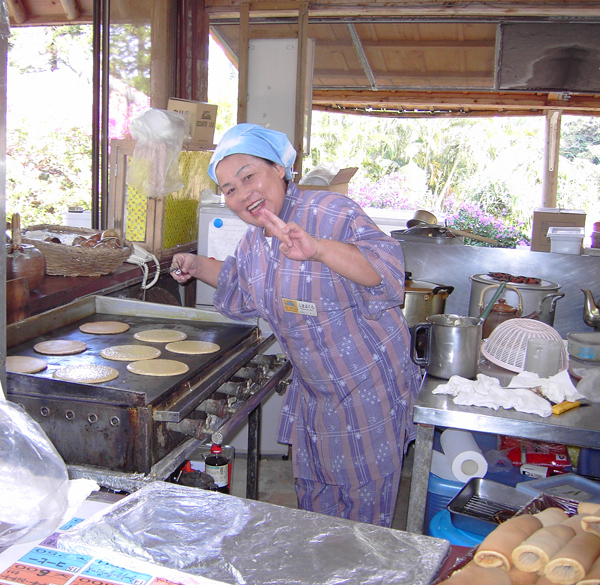
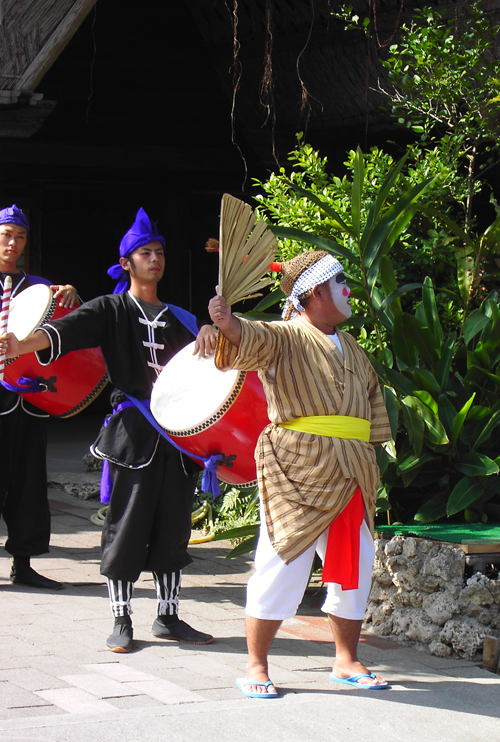
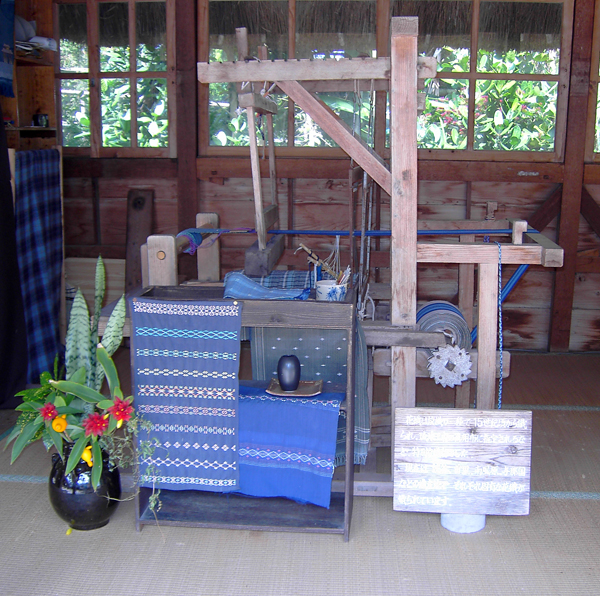
In the morning, we took our time getting going. I enjoyed puttering around, checking e-mail and drinking coffee. We finally got moving (poor Em, dealing with my slow start!) and we drove around looking at all the gorgeous flowers and getting glimpses of the turquoise waters. Em drove us by "Okinawan Hollywood" complete with a miniature "Hollywood" sign on the hillside and several big resort hotels. It seems one twenty-minute scene from an American movie was once filmed on that stretch of beach, thus it was considered "famous" by the locals! We then went to Ryukyu Mura, which is sort of a replica of a pre-war Okinawan village. There were thatched-roofed huts (including the Holy House, above, guarded by the clay shisa dogs, and covered in fluttering strips of paper upon which were written prayers), lively aisa dancing with drums (see the video at the bottom!), sanshen playing (a three-stringed instrument with the round "banjo-head" part made of snake skin--see the video at the bottom!), weaving demonstrations (one could pay to learn to weave their patterns if one wanted to), Okinawan tea, pancakes and doughnuts (tea = yum, pancakes = ok, doughnuts = greasy balls of sawdust -- YUCK!) a pottery factory, a water buffalo turning the crank of an old-fashioned sugar cane press, etc. I found it all fascinating! A couple of the actor-types had on makeup, including one in the photo with Emily to the right who had drawn lines on her face to indicate wrinkles, I guess. But there were also plenty of older folks with their own home-grown wrinkles!


The little old woman serving the tea was particularly adorable. Okinawans are some of the longest-lived people in the whole world, and this little granny was in her 80s, but spry and strong and cute as a button. I bought some of her tea, and she was thrilled! She stood up on the raised platform and stuck her hand straight out almost into Emily's sternum. Em was astonished, then realized the obachan (Japanese for old auntie -- literally "older sister") wanted to shake hands. Then the obachan turned to me--and suddenly grabbed me in one of the tightest hugs I've ever had! She kept giggling and hugging me really tightly. I have to admit, that it was my first human contact since I saw FH last, and I got a little teary-eyed! (And look at the strength in those arms around my neck!) The guy who'd been playing the sanshen came and took my camera out of Emily's hands, and snapped a photo of us. As we left, we saw some of the old "formal" dancing being performed. The women wear very vivid cotton kimono made of an Okinawan fabric called Bingata, and huge round red "lotus" hats. The two women move in unison in very, very slow, stylized movements, accompanied by sort of eerie singing and sanshen playing.

We got a bite to eat at a Mexican place (!!) and talked a bunch...then headed to the beach. Near the beach were two "croquet courts", both filled with elderly folks playing a game with mallets, wire hoops and hard wooden balls, on a neatly-trimmed, rolled-flat grassy expanse. The equipment and manner of play looked identical to the croquet game we know, but the wicket pattern was completely different, and I guess the rules are entirely different as well. Em said there were courts like this all over the island, and that several times a week, the elderly played this game. We nodded and smiled to several folks, and exchanged greetings with a few. One old man wanted to know if we were interested in croquet...then rather than accept our assurances that we did find it interesting, he shook his head and insisted we must like "baysu baru" instead! Em suspected he just wanted to say "baseball" to us, and thus the conversation. We walked down the steep steps to a little cove, and did some shell-hunting. I kept filling my hands, then having to drop some as I found even better ones! I could have beach-combed for hours! Unfortunately, I left my shells outside at Emily's, meaning to rinse them clean before packing them, and forgot them entirely! Oh well! I snapped a couple of good shots of the sunset, and we headed home to Em's house.


That evening, to celebrate Dave passing his PT test, we went out to a yakiniku -- a place where you order a platter of raw meat and veggies and cook them in a grill set into the middle of the table. It was a much bigger restaurant than the yakiniku I like in Sasebo, with LOTS more choices! We took off our shoes at the door, and sat in a booth that had tatami seats at floor level, but a deeper "pit" under the table for our legs. Dave ordered for us all -- two kinds of beef, some very thin pork (sort of like bacon), Japanese mushrooms, asparagus, tomatoes, long onions, a plate of mixed veggies, and a little pot of garlic cloves in oil that we simmered on the grill until soft and delicious! We talked about ordering some seafood as well, but decided to see how full we were...and we were very glad we hadn't ordered any more food! The grill in Sasebo is gas or propane, but the grill in Okinawa used long tubes of charcoal, so the grilled flavor was very different. Of course, we each had rice as well, and lots of water. Dave also got a bottle of awamori, which is an Okinawan rice liquor. It's a lot stronger than sake, but smoother...it's poured over ice, and is 60 proof I think. You can drink it straight or mix it with water...I mixed mine with LOTS of water. It was a fantastic meal, with great food and great conversation. We had a great time, but had to finally go, as they were closing the place!

Thursday, we got a relatively late start again -- Em thought she was waiting for me to be ready, I thought I was waiting for her. It was pretty funny! We got some Okinawan soba at Em's favorite place for breakfast/lunch. The thick soba noodles were served in a huge bowl of savory broth, with a slice of fish paste (fish sausage is what Em's Okinawan friends call it, whereas my Mainland friends call it fish paste), a slice of absolutely delicious red-cooked pork, a little lump of pork spare ribs, and a scattering of scallions. There were maybe five little bites of meat, but it was soooo good and very filling. One of the condiments on the table was a little bottle of awamori filled with tiny chiles. You add it to your soba for a kicked up flavor--it gave a strong hint of the liquor, and a LOT of heat! I loved it, and may have to order some to use at honme. Then we headed to a folk museum Em liked. Even though there wasn't a whole lot of English on the display tags, there was enough to get us through. Fascinating stuff about the old ways of the Okinawans--about their textiles and agricultural ways, about their tombs shaped like wombs (circle of life!) and sunk into hillsides,how the families, even to this day have a funeral picnic in front of the "womb" as if they were sitting between the implied thighs of the earth, about the spirit houses built to hold the remains of the dead (with windows for the spirits to come and go--ancient spirit houses very square and plain, more modern spirit houses made of glazed pottery and very elaborate), about their whole way of life--and both tragic information about the war, and interesting information about how innovative they were, learning to recycle and use the materials the Americans discarded, such as aluminum and glass.

After the museum, we went to a pottery village, where a whole group of potters have set up studios and shops, and share the one huge wood-fired step-kiln. We wandered into two of the shops, and I found several things that would have made great Christmas gifts (including a fantastic sake bottle with a dragon that FH would have LOVED--the head was the spout, and the body looked as if it writhed in and out of the body of the pitcher) but luckily for my finances, they didn't take plastic and I didn't have enough yen to get what I wanted. The pottery was COMPLETELY different from the porcelain in my area, much more rustic, much more "hand made", a lot like the Seagrove pottery FH and I saw on our honeymoon. I really loved it! Then we went to a store that specialized in shisa, the dogs that guard everything from homes to temples to hotels. The two dogs sit on either side of the entrance (they look a lot like temple dogs, but are not the same). The male has an open mouth to capture the good spirits, and the female has a closed mouth to hold the good spirits in and protect them. They have tons of versions of the shisa dogs, including a fat one with a jug of awamori and an awamori cup. Em really loved that one, so I bought it as a thank-you gift for her and Dave. I also bought a pair of shisas for our house--Em is going to mail them through the free MPS, as they were far too heavy to carry home!

We were going to go to a concert given by one of Emily's friends that evening, but it was an hour's drive away, and none of us really felt like going that far. So we walked to a neighborhood izakaya, which is a Japanese drinking establishment with a menu of small dishes, sort of like a Japanese version of a tapas bar. They often don't open until 9 or 10 at night, and stay open until 4 or 5 in the morning! There are cubby-holes along one wall, so one can buy a bottle of awamori, then put one's name on a tag around the bottle's neck and put it in a cubby until the next visit. We sat on benches and stools made from tree-trunks, at a table made from a slab of heartwood. It was quite brightly lit, and relatively small, with perhaps six tables, two little tatami booths in an alcove, and a bar that looked right into the tiny kitchen, with perhaps five tree-trunk stools. On one wall was a big salt-water aquarium, and on the other wall was a television showing a DVD of underwater scenes. The yukata-clad waitress took our order and brought us a bottle
of awamori, and an ice bucket, water pitcher and three glasses, all made at the Ryukyu glass factory. We shared little platters of various snacks--some seasoned fried potatoes, some chunks of fried chicken, some great fried squid, and a platter of tofu champuru -- stir-fried cabbage, carrots, onions, and the best tofu I've ever eaten. We talked on and on, about Dave and Emily's plans after they leave, Dave's various business ideas, the possibilities of the two of them opening an izakaya in the US, etc. It was another evening of good food and great conversation.

Had to get up really early Friday so Em could get me to the airport by 7:30am. On the way to the airport, we passed literally hundreds of people of all ages lining the streets and waving fans--teenagers, little old ladies, businessmen in suits, office ladies in tight little skirts, etc. Some had yellow headbands and yellow t-shirts, others had orange headbands and t-shirts. Each group held banners and placards proclaiming their candidate as the best...it was an election day! I've never seen so many people on the streets for an election! They streamed out of side streets, covered bridges and sidewalks, lined the overpasses, waving and smiling, exhorting voters to get out the vote! Even with all the campaigners, we got to the airport in plenty of time. Before I left, Em and Dave gave me a simply gorgeous little sake set--a pitcher and two little cups, made by one of the most famous of local potters. His kiln has been designated a national treasure, and the three ironstone pieces are simply gorgeous--rich chocolate brown with a design of leaves carved into the dark glaze to reveal the lighter clay beneath. The sake pitcher has a little pottery marble inside, which is supposed to make the sake taste better somehow, but we aren't sure exactly how!

I got back to Sasebo by 1pm, JUST in time to get picked up at the bus station by Miyuki to spend the afternoon at her school, carving Jack o' Lanterns with her ichinensei (seventh graders, literally "first year students"). Yes, Halloween was long past, but that didn't stop us! More on that interesting afternoon soon, I promise. Happy Thanksgiving to all of you...wishing you all the blessings and happiness you desire. FH should be home soon, and we hope to actually have some adventures TOGETHER for a change. Yippee!


Videos (the sound isn't great--the Aisa drums played havoc with my camera's microphone!):

Sunday, August 13, 2006

Floating Altars Everywhere

(Edited August 14 to add a few photos from Emiri!)

I know, I'm woefully behind! But FH is home, and the preparations for his return and the fact of his return do give me some leeway, I hope! Here is "the rest of the story" of Emiri's wonderful visit. Click on the images for larger versions.

On Thursday, Emiri still needed to find Sasebo City/Nagasaki Prefecture-specific gifts (preferably food) to take back to her friends in Okinawa. So, we headed out to Kashimae Pier and the Sea Pearl Resort. Kashimae Pier is the "jumping off point" for the 99 Islands (really there are 208, depending on the tides, but it's more poetic the other way, I guess!) If you've seen the opening 30 seconds of "The Last Samurai", you've seen the 99 Islands--they're really lovely.

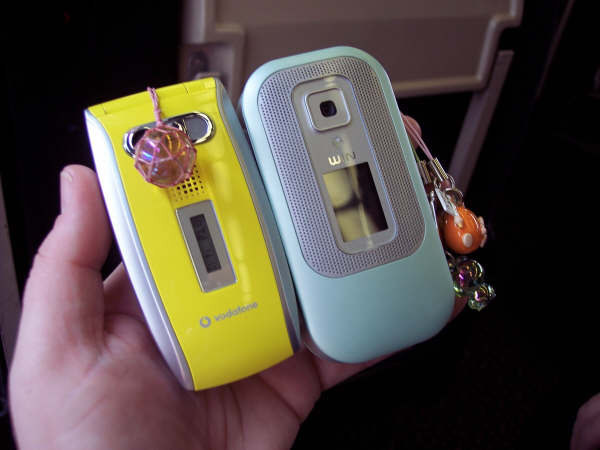
First, we wandered through the gift shops. We discovered that the area where I live is famous for loquats (also known as biwi), a small orange tropical fruit. To me, it tastes like a cross between apricot and mango. There were lots and lots of different loquat pastries, loquats in jelly, loquat mochi (rice paste balls), loquat caramels...even funny little plastic loquat charms with smiling faces on teeny leashes, to hang from one's cell phone! (Yes, I now have two fat, grinning little plastic loquats dangling from my mint-green phone, although you can only see one of them, along with my little transparent green frog. Em has a miniature version of the Japanese fishing floats, made by her friend in Okinawa.) Loquats are considered unusual, because they flower in the fall or early winter, and produce their fruit in late winter or early spring.

I find the selection of "gifts" in these little shops to be fascinating--pickles of all kinds, dried squid, raw squid, dried fish of all kinds, and lots and lots of cute but useless plastic "charms". Emiri got lots of special attention, due to her great skills with the Japanese language. I'm so in awe of her! Even before she speaks, she draws people to her, with her smile and her attitude. After a brief walk along the pier in the beautiful sunshine, we enjoyed lunch at an Italian restaurant (Japanicized, of course!) on the pier. I tried Calpis, a very lightly carbonated, opaque white soda. It's supposed to have a lot of calcium, and had a very mildly sweet, slightly chalky taste. It was interesting, and I rather liked it, despite the fact that the name sounds like something vulgar in English!

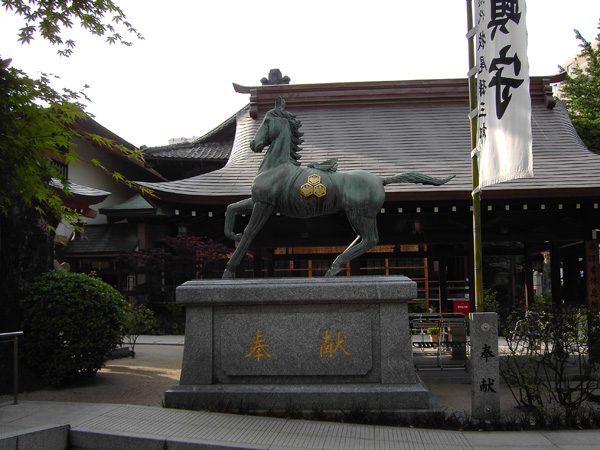
Then we parked the car, and headed for Fukuoka on the train. This time, we got off at the right station! We took a taxi to a part of Fukuoka called Hakata, to the Kushida Shrine (built in 757 AD), and enjoyed wandering around. Though most shrines have similar features, there is always something distinctive about each one, and this one was no exception!

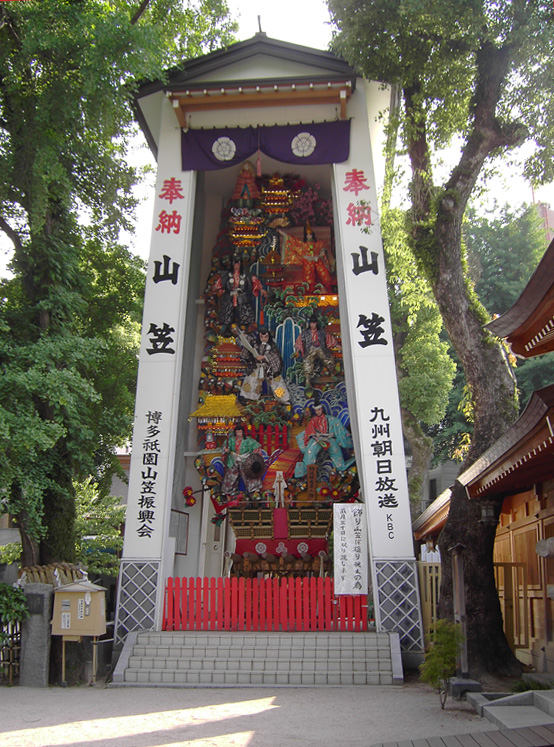
Kushida Shrine oversees the Hakata Yamakasa festival, which originated in 1241, when a Buddhist priest named Souichi Kokushi was carried through the town on a platform, from which he sprinkled holy water to eradicate evil spirits responsible for a plague that had struck the town. The festival takes place from July 1-15 every year, and the climax, Oiyama, begins at 4:59am on the last day. On Oiyama, a drum signals the start to the first kakiyama, a one-ton "race float" shouldered by a team sometimes numbering over a hundred men. The team carries the float, sort of like a giant portable altar, on a five kilometer route through the streets of Hakata. Six more kakiyama follow, each one hoping for the best time on the 5K route. The seven nagare (teams) are drawn from more than 10 areas within Hakata, and can be distinguished by the different patterns of cloth used to make their happi. Each team of bearers has special short coats (mizu happi) made of the team fabric, sort of like a team uniform to be worn while carrying the floats, and matching long robes (naga happi) that they wear at other times during the festival. The various team members have different roles and responsibilities, indicated by different colored head cloths.

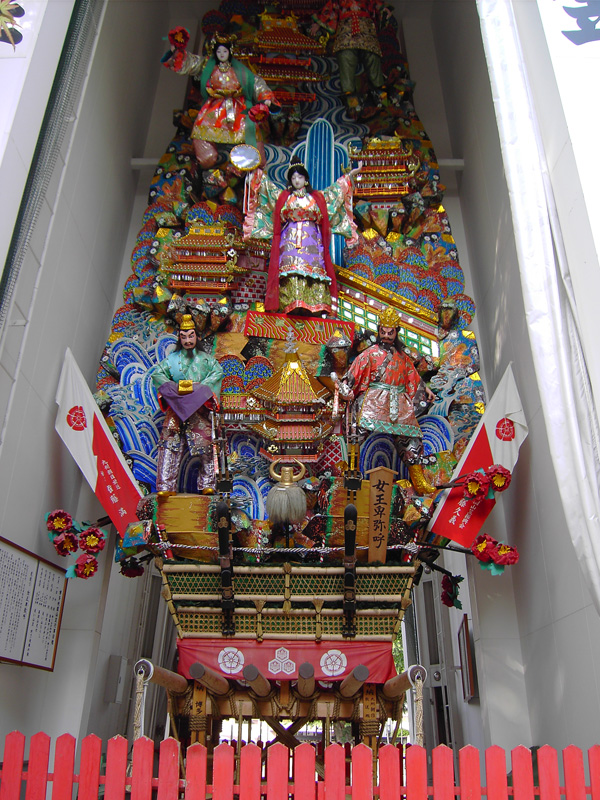
There are special traditions associated with Hakata Kamakasa. For example, participants must not eat cucumber during the entire festival period, becasue the Kushida Shrine crest resembles the cross-section of a cucumber. Also, all team members are forbidden from having sex during this time, so as to save their "life force" for carrying the one-ton kakiyama. It's considered an honor to be allowed to participate, and the participants take the various rituals and traditions very seriously. During the 15-day festival period, the whole Hakata district is the festival site, with the kakiyama on display, as well as the kazariyama, which are insanely tall "decorative" floats. The altar floats made to be carried are made of heavy wood hung all over with gleaming golden plaques and decorations. (Please forgive the bad photo of the kakiyama--they were in a dark "garage" and I could only take a photo through the glass, my camera was dying, and that was the only image that even came close to turning out. I'm sorry!) The decorative kazariyama are decorated with figures ranging from samurai warriors to cartoon characters. The one on display at the Kushida Shrine was fascinating, covered with lifesized figures, with vibrant colors and lots of sparkling silver and gold.

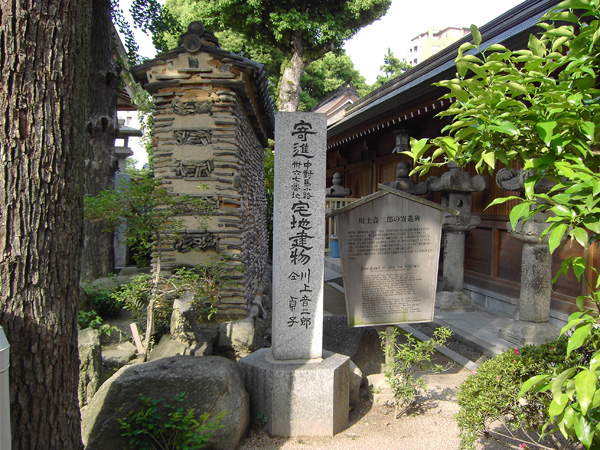
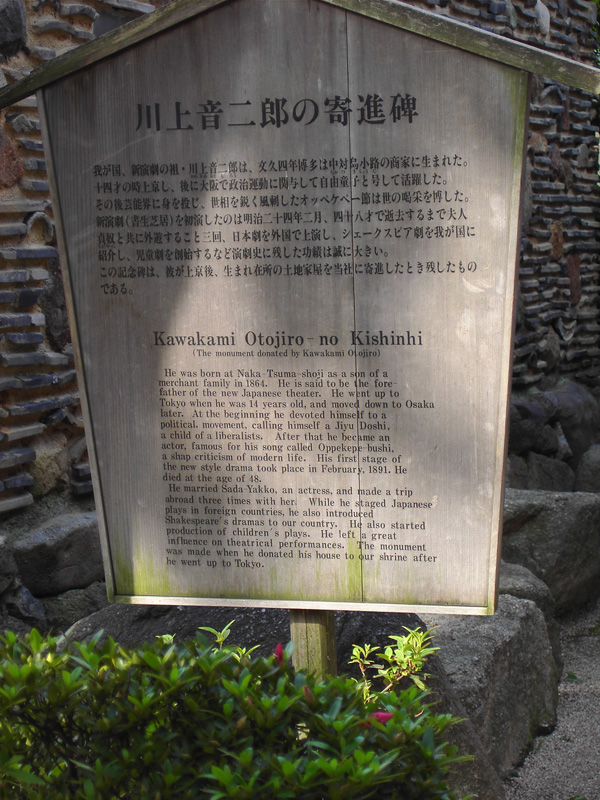
There was also a memorial to the forefather of modern Japanese theatre, Kawakami Otojiro-no Kishinhi (1864-1912). He was the first to bring Shakespeare to Japan, and the first to stage productions of plays for children. I was thrilled to find the little memorial plaque at the back of the shrine itself!

Then Em and I set out to find the Hakata Machiya Folk Museum, which was much easier said than done! We walked for a while in one direction...nothing. Consulting the little guidebook map and the very vaguely placed "this is it" red dot, we tried another direction. Nothing. We stopped a man about to get into his car, and Em asked directions. He offered to take us there in his car, but we demurred. So he grabbed a rock, squatted in the street, and drew a map for us on the pavement! Hurray, we've got it! So we head back in the direction from which we came. And walked. And walked. Arrgh--nothing! We stopped again, this time at a shop filled with American-style t-shirts and jeans, and Emiri worked her magic in Japanese again. Ok, back we go. Finally, we found it...about half a block from the Kushida Shrine! Our search was frustrating and sweaty, but ended up being worth the trouble, at least to me. If Em didn't think so, she was generous to keep it to herself.

The museum was small, but interesting. We wandered through the little exhibit building, where I learned much of the information about the Hakata Kamakasa festival and the floats we'd seen at the shrine! They had miniature dioramas, and a bank of old fashioned phones for visitors to listen to the "funny Hakata dialect." Of course, those didn't do anything for me, since I can't tell the difference between one Japanese dialect and another!

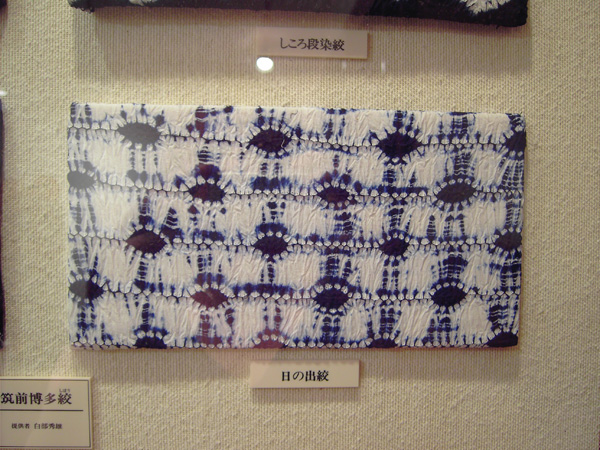
There were some absolutely amazing fabrics on display that looked sort of like batiks or tie-dye...the fabric of some looked as if it had been stitched very carefully in a specific gathered pattern, dyed with the deep indigo dye, and the stitches taken out once the fabric was dried. I could not read the Japanese that explained the exhibit, so my guess may be wrong. Regardless, they were really lovely. I believe these are the fabrics used for the naga happi and mizu happi of the altar float teams.


There was also a series of life-sized dioramas depicting a shop and a home at the turn of the century, complete with appropriately-dressed mannequins. There were displays of other local crafts as well, such as the Hakata dolls, Hakata-ori and Hakata shibori textiles, Hakata magemono (cylindrical boxes made from thin sheets of wood bent into shape), heisuke brushes (for calligraphy and painting), hariko (bobble-head animal figures made in a medium similar to paper maiche), multi-colored worked glass similar to Murano glass, fighting tops (a totally different shape than the tops Sasebo is famous for making), and famous Hakata scissors. Unfortunately, we were too late for any of the many demonstrations of these fascinating crafts, and for the chikusen-biwa Japanese lute playing.

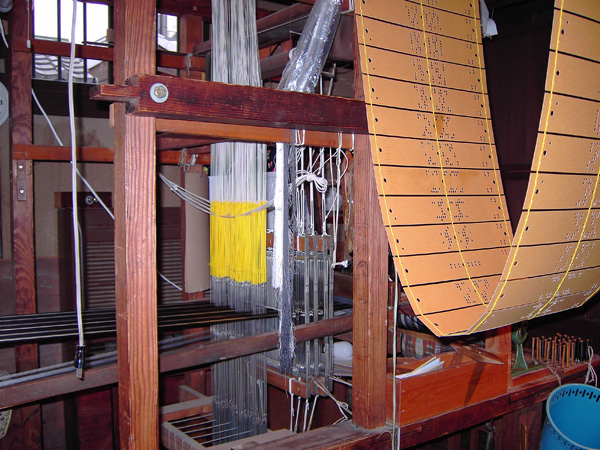
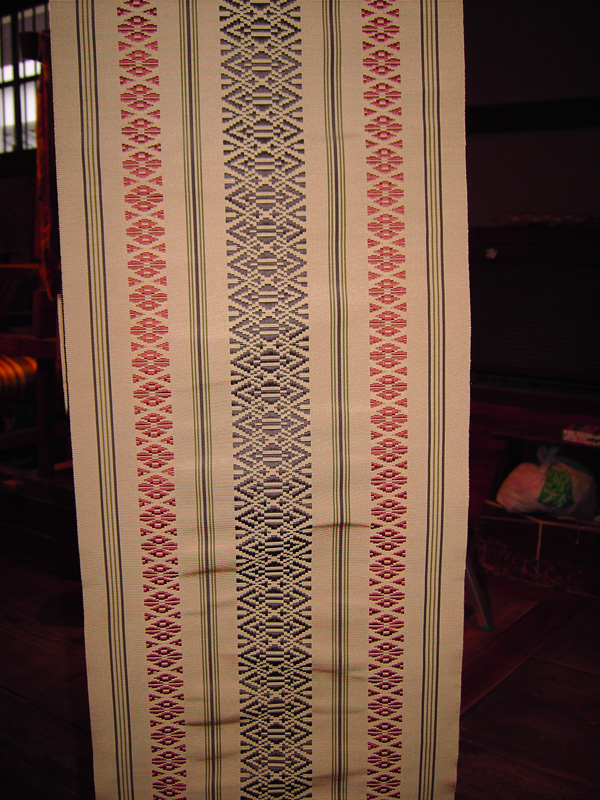
The other part of the museum (Maichiya Hall) was a relocated and restored Hakata-ori textile-weaver's house from the Meiji and Taisho eras (turn of the 20th century). The building itself is long and narrow, with the tatami rooms on either side of the central hallway built to become larger towards the back, in a fan shape for good luck. In the center of the main room, the ceiling opened up, giving a sudden impression of space and light. The main pillar of the house (the daikoku-bashira, representing the head of the household and his strength) was intricately carved, and soared up in the space. The hall was fascinating, with several very intricate looms and displays of astoundingly complex woven fabrics. I was so sad that we'd missed the demonstration, as I wanted to see how the big loom worked. There was a long loop like a conveyor belt of wooden plaques, each with a different pattern of holes. I think that somehow, the holes in each plaque help direct the heddles of the loom, each plaque moving into place for a different part of the pattern, kind of like a player piano's paper scroll. But I am not sure, and I want to see it in action! Unfortunately, they were closing, and so I snapped several photos, and we had to head out.

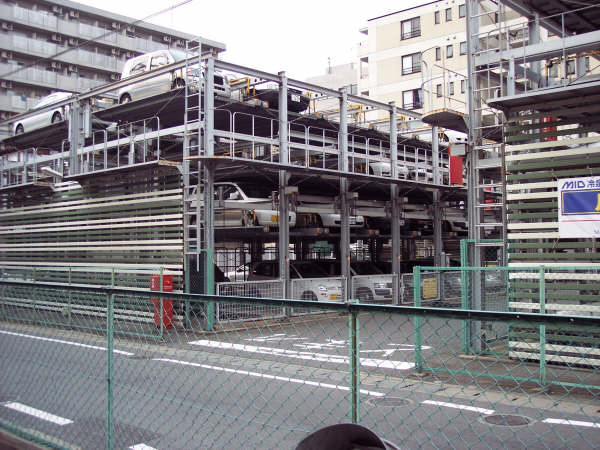
We headed back towards the train station, trying to catch a taxi as we walked (we were pretty far away!) Despite the humidity, I enjoyed the walk, looking in shop windows and people-watching. Though I thought Sasebo seemed like a pretty big city to me, I now understand why it's considered sort of small-town and rural, despite its 300,000 residents. Fukuoka is very much more "big city", with tall buildings and modern shops, and fewer old-fashioned Japanese storefronts. I got another sense of what a premium is put on space in this country, as I passed a parking lot. The lot consisted of a relatively small footprint, but had "racks" on which each car was driven. The rack was then raised until it was almost touching the rack holding the car above, and another car was driven in and raised. I've never seen so many vehicles crammed horizontally and vertically into such a small space! I guess that's another reason for the intense and very expensive car inspection required every two years...I sure wouldn't want the car above mine leaking oil or transmission fluid or whatever onto the roof or hood of my car! Thanks to Emiri for the photo.

We finally got a taxi, and got back to the train station. We grabbed a quick bite to eat in the station itself, which, like many Japanese train stations, was like a shopping mall, filled with stalls and shops and restaurants. Then Emiri headed on the short trip to the Fukuoka airport to fly back to Okinawa, and I headed for the train back home to Sasebo. Even that experience was interesting! The platforms were crowded with people headed home after the workday. In the US, the crowds would swarm towards the doors as the train pulled in, shoving and jockeying for position. Not so in Japan! Every few feet was a mark on the pavement to show where the doors would be when the train stopped . At each mark was a single line of people, snaking carefully so that no line intersected any other line, and no line blocked the pathway up and down the platform. It was amazing--everyone knew what to do and where to stand, no one was pushing, no one behaved as if he or she were more important than anyone else or in more of a hurry.


I didn't know where my particular mark was (some cars are "first come, first serve", other cars are "reserved seat only", and I had a reserved seat. So I excused myself and asked a fellow traveller where I needed to be, with my few words of Japanese, some charades, and my out-thrust ticket. She smiled, bowed, chattered in Japanese, and gestured down the platform. In the next line someone looked up and saw what was happening. She beckoned to me, smiling...so I went to her. She looked at my ticket, smiled, bowed, spoke to me in Japanese, and pointed me to the next line, where a young man beckoned me to come to him. This went on from line to line down the row, until I was at the appropriate mark...then I was handed down the line to my spot at the end. It was very funny! Rather than gesture to me to go down eight lines to find mine, my fellow passengers took the bakka gaijin (idiot foreigner) in hand and gently herded me to my place. I loved it!

Emiri's visit was quite short, but despite my propensity for running late, we still managed to cram an awful lot into three days! I hope she can come back again, and I hope to get a chance to visit her in Okinawa. In the meantime, she was a very tolerant guinea pig, as I discovered where I can take visitors to Sasebo. Thanks, Em, for being such a fantastic, easy-going and fun guest!

Sunday, July 30, 2006

Wandering with Emiri, Dinner with Miyuki

My favorite view on the drive homeSorry for the long delay! Life here is good, although I miss FH. He's in San Diego for school, returning sometime in August (he's top of his class so far!) Most recently, I've been working on the cover design and book layout for a really cool writer in New England. Her book is hysterically funny, and I'm having a blast putting it together. Dad did fantastic photography in North Carolina for the cover, and an illustrator in California is doing a couple of cartoons for inside the book. Thank goodness for the Internet--most of my freelance work would be impossible without it! I managed to catch a really rotten summer cold/flu thing as well, and that put me out of commission for about a week. So the past few days I've been scrambling to catch up.

Our street!The weather is hot, but looking at the weather sites on the web, it looks as if we haven't had the heat that the US has been experiencing! It rained heavily throughout June and July, with unbelievably thick, humid haze on the days it didn't rain. I've been battling mold and mildew as a result. But for the past week or so, it's been absolutely gorgeous! Yes, the temperature has been in the high 80s and low 90s, but it's been sunny, with bright blue skies and big puffy clouds, and nowhere near the humidity we've had. I've adopted the Japanese custom of carrying an umbrella in the sun, to avoid burning and hopefully avoid more skin cancer. Most women carry parasols in the sun, and most older folks either use parasols or floppy-brimmed hats. Makes sense to me! The photo is the view down my street. This is the wide part...it gets narrower!

I realize it's been two months now since Emiri's visit but I wanted to finish recounting our adventures while she was here. (I called her M before, but since she's blogging now as Emiri, I figure I can use that!) She arrived on a Monday, and Tuesday we spent in Kumamoto--which I already wrote about. Wednesday morning, we both slept in a little bit, exhausted from our long day and traveling to and from Kumamoto.

Once we got moving (late, of course), we drove to Arita, the porcelain capital of Japan. We found some "outlet" shops, and ended up splitting up, to look and shop each at our own speed. I found small chopstick rests in various animal shapes, and spent forever finding "just the right ones". When we got back together, Emiri had gotten a couple of small things...and had, of course, made friends! One of the shop proprietors had given her gifts of a t-shirt with the logo of one of the Arita kilns on it, and a small Chinese zodiac dish. Too cool! We drove around quite a bit more, and stopped once at a junk shop to poke around, and got a late lunch at one of the many ramen noodle shops. Basically, it was a pleasant, relaxed day, and we headed home to meet Miyuki, who was taking us to dinner.

Miyuki came in and met Emiri--and had gifts (of course!) for both of us! Miyuki's mother had gone to Kyoto, and brought back little rememberances. For me, there was a packet of fat little fan-shaped sachets that Miyuki told me were specifically to put in a woman's purse, so a whiff of sweet scent comes out when you open it. She'd also brought a little book printed with sakura flowers, for Emiri--who loves sakura flowers! (Em, I can't remember...it was a little book, wasn't it? Or was it a little purse? All I can remember is the sakura blossoms!) Emiri had brought pineapple pastries and purple sweet potato pastries for Miyuki, so we were very "Japanese" with our formal little gift exchange.

We headed out to a restaurant Miyuki had picked out for us. We drove for what seemed like miles and miles and miles, and finally pulled up at the Restaurant Dom Nisey. I'm not sure if it was supposed to be Italian or French or what, but Miyuki told us it was patronized mostly by women, as they served mostly organic, healthy, fresh foods, and "men don't like to eat what's good for them!"

The restaurant itself was quite a visual surprise. Outside was a plastic, lit-from-within Frosty the Snowman, a concrete statue of two children kissing (a la the Hummel figurines) and blue Christmas lights strung in the trees. At the front door, there was a little chair, a watering can, a bunch of lace, and tons of silk flowers...sort of an off-kilter, overdone Victorian tea room effect. It was very funny! Inside, it was sort of Italian, with creamy plaster walls, dark terra-cotta glazed tile floors, and lots of arched doorways and windows. Every table had a lacy table cloth, and mismatched floral placemats on top, and each window had different lace curtains. On the tables were little cutesy figurines of mice and swans and frogs in suits. It was all rather overwhelming!

It was a fantastic dinner though, with great conversation and really interesting food. I ordered iced coffee to drink, and it came in a globe-shaped glass, with ice piled high over the rim, and a long stirring stick of brass with a glass marble at the end. The sweetener was a clear syrup (don't know if it is cane or corn or what) and came in a round orange glass ball with a little hole in the top, and the creamer was in an orange and clear shot glass--with both creamer and sugar on a little square of mirrored glass. It was a striking presentation, but to be honest, the syrup ball and the creamer were both very awkward to pour from, and I dribbled both on the tablecloth.

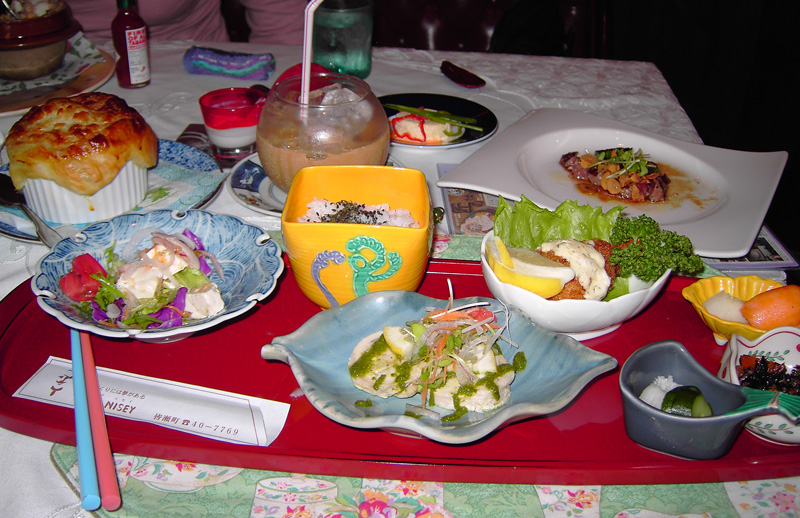
Miyuki got her favorite, doria, which is an "Italian" casserole of baked short grain rice and cheese and seafood, topped with sheets of nori (seaweed). Em got a macaroni and cheese dish, which turned out to be a huge tart dish with a thin layer of penne pasta and several cheeses and (I think) little bits of ham. Miyuki knows how much I enjoy trying new foods, so she insisted I try the "ladies menu" which turned out to be a HUGE meal of eleven different little dishes, plus dessert. I was STUFFED!

In the photo, in a spiral clockwise from the upper left:

  1. a tender beef and mushroom stew with a piece of puff pastry on top
  2. a savory seafood custard with sweet red pepper
  3. a dish of unbelievable rare beef and garlic chips, with radish sprouts
  4. a piece of loquat and a piece of melon
  5. a seaweed salad with carrots
  6. a little dish of pickled cucumber and daikon radish
  7. a dish of chicken with onions, sprouts and pesto
  8. a homemade tofu salad with a very light vinaigrette
  9. Japanese rice with furikake (a sprinkle of sesame seeds, seaweed, salt and seasoning), and
  10. a single shrimp, stuffed with a seafood mousse, fried and topped with a Japanese tartar sauce.
Each dish was only about three bites, but there were so many of them! Oh, and it all began with a very fresh puree of pea soup. Whew!!! I think my favorite was the beef with the crispy garlic chips, and the homemade tofu, which did not have the chalky taste I associate with the hermetically sealed tofu one finds in American grocery stores!
Dessert was gorgeous as well. Mine came as part of the "ladies menu" I'd ordered, a little selection of different things...in this case, a little sliver of delicately sweet sesame cheesecake, and a teeny container of kiwi sorbet, all set on a drizzle of strawberry syrup. Emiri got a dish of ice cream with fruit and a mango (or loquat??) syrup, with two tiny pink carnations as garnish. Of course, we all three shared. There was a dessert on the menu that was very specifically "For Men Only", which cracked me up! Miyuki said it was a parfait with all sorts of stuff on top, served in a big beer mug...but the chocolate was very dark and bittersweet, and "too strong for women"! The couple behind us came in just to order dessert, and the man, of course, ordered that particular dessert. So I asked (via charades) if I could take a photo. His dessert looks good, but her dessert (with the shimmery tangle of sugar threads) looks more interesting! All in all, we had a really great day.

I can't seem to ever write a short and sweet account of anything! Sorry for the hugely long letters. I'll stop here, and finish with the last day of Emiri's trip in a couple of days. (Don't worry...I've already written half of it! I just realized that this was getting really long, and I should post it now, along with photos.) To be continued!