
Happy New Year… Happy Year of the Ox… Omedetou gozaimasu! Wishing you all peace, health and joy in the New Year. (Yes, I began this in January, but since the Chinese New Year was just a couple of days ago, let’s pretend, shall we?)
Fearless Husband came home from deployment at the beginning of December, so we were able to have Christmas and New Year’s together (hurray!) Between Christmas and New Year’s, my friend Hiroko took me to a little neighborhood shopping area to get some wagyu beef (what Americans refer to as Kobe, but this was from Hirado Island) for FH. Before buying the beef, we walked around, peering into the little shops lining the road. One shop was the smallest I think I’ve ever seen. I’ve had bigger closets! A teeny, tiny old lady with radiant skin and a lovely smile sat inside, surrounded by bottles of a golden oil, and pamphlets with photos of camellia flowers. Turns out the oil was camellia oil! It’s supposedly very good for both the skin and the hair, and can even be used for cooking! The little old lady was quite a good advertisement for her own product..her skin was that of a woman MUCH younger, though she was in her 80s!
 We window-shopped (or would that be awning-shopped, when there are no windows?) our way through kitchenwares, fish so fresh it was still flapping, gorgeous vegetables and jewel-like fruit, organic chicken, various homemade condiments, and more. I ended up with some fresh yuzu-koshou (a paste of yuzu rind – a very aromatic citrus fruit – chilies and salt that’s delicious on fresh tofu), the prettiest turnips I’ve ever seen, a packet of sweet potato mochi, a bamboo spatula/spoon, several skeins of yarn from another teensy shop basically lined floor to ceiling with brightly colored balls of yarn, some traditional Japanese New Year decorations, and of course, FH's beef.
The butcher shop was on a corner, as such shops often are, and the shop itself was open to the outside air – no windows, no door. There were refrigerated display cases filled with meats, but Hiroko ignored it all. Instead, she spoke at length to the butcher, who then straightened his apron and disappeared into the back. A minute later, he emerged, carrying a chunk of beef as if it was a velvet cushion holding the crown of the realm or something. He walked slowly, with dignity and reverence, presenting the piece of meat as if waiting for me to admire his newborn son. I’ve never seen a butcher so proud of his own product! More negotiation, in English and Japanese, about how much of the beef I wanted (though money was NEVER mentioned, not once – I guess if you have to ask, you can’t afford it!) and then the “baby” was transferred to the cutting table.
 The butcher laid out three different knives, and proceeded to lovingly separate the smaller chunk I’d indicated, then very carefully trim all the exterior fat, inspecting it and turning it and basically making a big production out of the whole thing. Yes, he used all three knives. The meat was then weighed (he was careful to point out that I was paying only for what we’d be eating, not for the trimmings!), then the chunk was carefully wrapped in a flexible, paper-thin piece of wood (yes, wood!), then white paper over that, then more white paper, then finally the swaddled bundle was put into a bag for me and placed on the counter *just* out of my reach.
Oh, right. Gotta pay for it. *gulp* Imagine an eye of round roast just over a pound and a quarter, but prettier and marbled to such an extent that it looks like a mosaic on the cut end. Now imagine paying $35 for it. Now imagine being absolutely thrilled at the incredible deal you just got! Ok, enough about the beef. Suffice to say I cooked it with nothing else but a bare sprinkling of salt, stretched it to serve the two of us for three meals, and was the most amazing, tender, savory beef either of us have ever eaten. Ever. In our entire lives. Period.
 I also bought a traditional Japanese New Year’s decoration(shimekazari, which I can’t believe I forgot to photograph!), to go over our front door. It’s a fat, heavy twist of rice straw, with two sprays of rice straw sticking down to either side, a little fountain of rice kernels on their stem in the middle, various bits of folded and rolled special paper, and a sour orange skewered in the center. Most of the houses in our neighborhood already had similar decorations, and Hiroko encouraged me to get one, too.
Hiroko explained further about the various New Year decorations:
 The morning of January 1, many Japanese get up very early to watch the first sunrise of the new year…this is considered a harbinger of the year to come, and one is supposed to be at peace, with a smile, to watch the sun rise. Unfortunately, we couldn’t see the sun rising here in Sasebo. Instead, we had fat flakes of snow!
In the afternoon, FH and I were invited to join my friend Morinaga-san at her house for a traditional Japanese New Year’s meal. There was another American couple there, as well as Morinaga's sister and daughter (we met Morinaga's mother on the way out of the warren of houses/rooms...she was sitting in a kitchen of another house, watching TV by herself and grinning. She may be slightly demented, or just happy to be alone, not sure!)
We had special sacred sake, poured into special sake saucers (the large one had Mt. Fuji painted/embossed in gold into the red lacquerware, the medium-sized one had a hawk, and the small one had an eggplant -- all traditional decorations for the various sizes). One by one, we each were served the special sake in our choice of the three dishes. We were to sip it three times, finishing the sake on the third sip. After drinking, we were given a tiny handful of dried squid (though I don't remember the meaning). There was a solemnity to the ritual, and it made me think of Holy Communion.
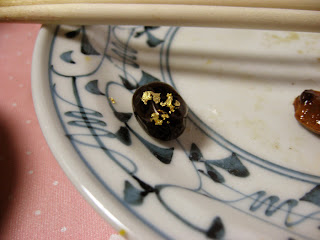
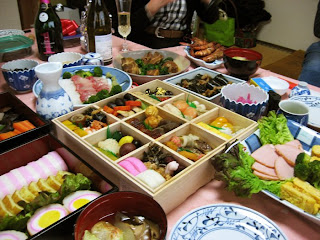
 On the table were plates and plates of food (Chinese cooked pork, fresh mackerel sashimi, knots of savory seaweed, slabs of omelet and slices of ham, etc.) as well as the traditional osechi -- special large wooden divided boxes of very beautiful New Year's foods, each with its own meaning for the New Year (good fortune, money, happiness, fertility, etc.) Traditionally, nobody cooks on January 1, 2 and 3, so the three-layer boxes are all foods that will last. There were all sorts of things, from black beans decorated with gold leaf, to sea cucumber (neither of us liked that AT ALL, but of course had to eat it, as it was fancy and very, very expensive) to tiny carved squashes and pretty fish paste shapes. Champagne was served as well, and the other American couple brought brownies and vegetables with spinach dip. I felt bad that I hadn't contributed to the feast, but luckily, I'd brought gifts for Morinaga-san and her daughter, and a fancy bottle of French wine (regifting what the architect and his wife next door gave us!) and a container of homemade candies. The candies were the insanely simple ones... small pretzels with a Rolo chocolate-and-caramel candy put on top, the whole thing popped in the oven for three minutes, then a toasted pecan half pushed into the Rolo to make it smoosh down on the pretzel. VERY easy, and surprisingly delicious, like a chocolate/caramel/pecan turtle, but with the salty crunch of the pretzel. Luckily, the candies were a HUGE hit, and everyone ate them all up and argued over the last few.
On the way out, through the warren of the three homes perched on the hillside (all owned by Morinaga-san, or possibly communally owned by the women of the family), Morinaga-san pointed out a single tatami room with a fancy lacquerware altar. She said it was the family altar to their ancestors, and they all prayed there every single morning. That was fascinating to me, as I had not thought of Morinaga-san, with her girlish curled ponytail and blue eye-shadow and talk of "fashion" as a particularly spiritual person. Teach me not to judge!
 Over Christmas, FH and I enjoyed Norwegian meatballs and Norwegian Christmas cookies (thank you, Grandma!) from his family traditions. We spent our New Year’s morning quietly together, and had my family’s traditional New Year’s collard greens, black-eyed peas and ham for lunch. At Morinaga-san’s house that afternoon, we sat on tatami mats, with sliding rice-paper doors on two sides, and a painted scroll of cranes hanging in the special alcove, over the ancestor/God offerings of mochi and oranges and shiny wire decorations. It was pretty wonderful to sit in that beautiful and very foreign room, beside my familiar husband, making new Japanese and American friends, at a table covered with food from both cultures, with conversation and laughter flying. What a great way to start the New Year!
Fearless Husband came home from deployment at the beginning of December, so we were able to have Christmas and New Year’s together (hurray!) Between Christmas and New Year’s, my friend Hiroko took me to a little neighborhood shopping area to get some wagyu beef (what Americans refer to as Kobe, but this was from Hirado Island) for FH. Before buying the beef, we walked around, peering into the little shops lining the road. One shop was the smallest I think I’ve ever seen. I’ve had bigger closets! A teeny, tiny old lady with radiant skin and a lovely smile sat inside, surrounded by bottles of a golden oil, and pamphlets with photos of camellia flowers. Turns out the oil was camellia oil! It’s supposedly very good for both the skin and the hair, and can even be used for cooking! The little old lady was quite a good advertisement for her own product..her skin was that of a woman MUCH younger, though she was in her 80s!
 We window-shopped (or would that be awning-shopped, when there are no windows?) our way through kitchenwares, fish so fresh it was still flapping, gorgeous vegetables and jewel-like fruit, organic chicken, various homemade condiments, and more. I ended up with some fresh yuzu-koshou (a paste of yuzu rind – a very aromatic citrus fruit – chilies and salt that’s delicious on fresh tofu), the prettiest turnips I’ve ever seen, a packet of sweet potato mochi, a bamboo spatula/spoon, several skeins of yarn from another teensy shop basically lined floor to ceiling with brightly colored balls of yarn, some traditional Japanese New Year decorations, and of course, FH's beef.
The butcher shop was on a corner, as such shops often are, and the shop itself was open to the outside air – no windows, no door. There were refrigerated display cases filled with meats, but Hiroko ignored it all. Instead, she spoke at length to the butcher, who then straightened his apron and disappeared into the back. A minute later, he emerged, carrying a chunk of beef as if it was a velvet cushion holding the crown of the realm or something. He walked slowly, with dignity and reverence, presenting the piece of meat as if waiting for me to admire his newborn son. I’ve never seen a butcher so proud of his own product! More negotiation, in English and Japanese, about how much of the beef I wanted (though money was NEVER mentioned, not once – I guess if you have to ask, you can’t afford it!) and then the “baby” was transferred to the cutting table.
 The butcher laid out three different knives, and proceeded to lovingly separate the smaller chunk I’d indicated, then very carefully trim all the exterior fat, inspecting it and turning it and basically making a big production out of the whole thing. Yes, he used all three knives. The meat was then weighed (he was careful to point out that I was paying only for what we’d be eating, not for the trimmings!), then the chunk was carefully wrapped in a flexible, paper-thin piece of wood (yes, wood!), then white paper over that, then more white paper, then finally the swaddled bundle was put into a bag for me and placed on the counter *just* out of my reach.
Oh, right. Gotta pay for it. *gulp* Imagine an eye of round roast just over a pound and a quarter, but prettier and marbled to such an extent that it looks like a mosaic on the cut end. Now imagine paying $35 for it. Now imagine being absolutely thrilled at the incredible deal you just got! Ok, enough about the beef. Suffice to say I cooked it with nothing else but a bare sprinkling of salt, stretched it to serve the two of us for three meals, and was the most amazing, tender, savory beef either of us have ever eaten. Ever. In our entire lives. Period.
 I also bought a traditional Japanese New Year’s decoration(shimekazari, which I can’t believe I forgot to photograph!), to go over our front door. It’s a fat, heavy twist of rice straw, with two sprays of rice straw sticking down to either side, a little fountain of rice kernels on their stem in the middle, various bits of folded and rolled special paper, and a sour orange skewered in the center. Most of the houses in our neighborhood already had similar decorations, and Hiroko encouraged me to get one, too.
Hiroko explained further about the various New Year decorations:
“As for the door decoration, we decorate today until 7th or 10th of January when depends on the area or family. Please do not decorate tomorrow (the 31st). Since this is the pray to gods for the new year, we don't decorate on 31st of December. Gods may think that we haven't prepared enough for gods. You'll see the twisted straw of rice stem at the shrine and the paper. Rice is Japanese main food and we pray for good or better harvest for the new year to the god using rice stem straw and the twisted means pray. When we pray something, we sometimes twist something such as a small sheet of paper which we call Koyori or O-hineri (which includes money inside). The paper means gods. The orange, which we call daidai, shows to refresh for new year and another words play that daidai term itself means from generation to generation. Dai means one generation. Daidai orange juice can be eaten with fish or scallop etc. As a whole the decoration shows the pray to gods for the better harvest and prosperity. Please hang above and middle of the entrance door not on the entrance door. Probably your next neighbors will hang today. We will burn it 7th or 10th of January and we say the smoke will avoid decease the rest of the year.New Year’s eve itself was pretty quiet – we stayed in, and listened as various solemn processions wound through the streets throughout the night, ringing a gong or clacking some sort of wooden clapper as they chanted and walked. At midnight, temple bells all over Japan rang 108 times, to release people from the “108 worldly sins.”
In the Japanese guest room there is alcove which we call Toko-no-ma. I saw you had one at your home. We decorate a several things to pretend for gods to eat. They are 2 double omochi (smooth, chewy cakes made from pounded sticky rice), orange, dried squid, dried persimmon, yuzuri-ha (a kind of evergreen shrub) which means generation change, i.e. prosperity, because a yuzui-ha leaf falls down when a next new leaf grows up, on urajiro (a kind of fern) which is just like words play as ura means backside and jiro means white, accordingly urajiro means that we show gods that we have nothing bad to hide. Japanese men tends not to do housework but the above decorations are for the work of a father. Even my father is willing to do.
I forgot to tell you about the leaves that my mother gave you. They were called "Sen ryo." Sen means million and ryo is old Japanese currency unit in Edo period. At the beginning of the year we pray so many wishes such as happiness, prosperity, longevity, peace, richness etc. For each wish, we have each god and each shrine. For each wish, we eat the represented things as osechi and display the ornament. Sen ryo mean that we pray for millionaire.”
 The morning of January 1, many Japanese get up very early to watch the first sunrise of the new year…this is considered a harbinger of the year to come, and one is supposed to be at peace, with a smile, to watch the sun rise. Unfortunately, we couldn’t see the sun rising here in Sasebo. Instead, we had fat flakes of snow!
In the afternoon, FH and I were invited to join my friend Morinaga-san at her house for a traditional Japanese New Year’s meal. There was another American couple there, as well as Morinaga's sister and daughter (we met Morinaga's mother on the way out of the warren of houses/rooms...she was sitting in a kitchen of another house, watching TV by herself and grinning. She may be slightly demented, or just happy to be alone, not sure!)
We had special sacred sake, poured into special sake saucers (the large one had Mt. Fuji painted/embossed in gold into the red lacquerware, the medium-sized one had a hawk, and the small one had an eggplant -- all traditional decorations for the various sizes). One by one, we each were served the special sake in our choice of the three dishes. We were to sip it three times, finishing the sake on the third sip. After drinking, we were given a tiny handful of dried squid (though I don't remember the meaning). There was a solemnity to the ritual, and it made me think of Holy Communion.
 On the table were plates and plates of food (Chinese cooked pork, fresh mackerel sashimi, knots of savory seaweed, slabs of omelet and slices of ham, etc.) as well as the traditional osechi -- special large wooden divided boxes of very beautiful New Year's foods, each with its own meaning for the New Year (good fortune, money, happiness, fertility, etc.) Traditionally, nobody cooks on January 1, 2 and 3, so the three-layer boxes are all foods that will last. There were all sorts of things, from black beans decorated with gold leaf, to sea cucumber (neither of us liked that AT ALL, but of course had to eat it, as it was fancy and very, very expensive) to tiny carved squashes and pretty fish paste shapes. Champagne was served as well, and the other American couple brought brownies and vegetables with spinach dip. I felt bad that I hadn't contributed to the feast, but luckily, I'd brought gifts for Morinaga-san and her daughter, and a fancy bottle of French wine (regifting what the architect and his wife next door gave us!) and a container of homemade candies. The candies were the insanely simple ones... small pretzels with a Rolo chocolate-and-caramel candy put on top, the whole thing popped in the oven for three minutes, then a toasted pecan half pushed into the Rolo to make it smoosh down on the pretzel. VERY easy, and surprisingly delicious, like a chocolate/caramel/pecan turtle, but with the salty crunch of the pretzel. Luckily, the candies were a HUGE hit, and everyone ate them all up and argued over the last few.
On the way out, through the warren of the three homes perched on the hillside (all owned by Morinaga-san, or possibly communally owned by the women of the family), Morinaga-san pointed out a single tatami room with a fancy lacquerware altar. She said it was the family altar to their ancestors, and they all prayed there every single morning. That was fascinating to me, as I had not thought of Morinaga-san, with her girlish curled ponytail and blue eye-shadow and talk of "fashion" as a particularly spiritual person. Teach me not to judge!
 Over Christmas, FH and I enjoyed Norwegian meatballs and Norwegian Christmas cookies (thank you, Grandma!) from his family traditions. We spent our New Year’s morning quietly together, and had my family’s traditional New Year’s collard greens, black-eyed peas and ham for lunch. At Morinaga-san’s house that afternoon, we sat on tatami mats, with sliding rice-paper doors on two sides, and a painted scroll of cranes hanging in the special alcove, over the ancestor/God offerings of mochi and oranges and shiny wire decorations. It was pretty wonderful to sit in that beautiful and very foreign room, beside my familiar husband, making new Japanese and American friends, at a table covered with food from both cultures, with conversation and laughter flying. What a great way to start the New Year!













 Posts
Posts


