Showing posts with label Japanese cuteness. Show all posts

Monday, September 01, 2008

Silent Auction of Japanese "Sweetness"

**We have a winner!** Thanks to carliches for a winning bid of $45! Carliches, please e-mail me at carolie (at) wordmagix (dot) com and attach a copy of your paypal donation receipt. We can discuss what kind of bento you'd like, and then I'll send out your Japanese goodies. Thank you all for participating! (And anyone interested in Japanese candy or bento, please feel free to e-mail, and I'd be happy to work something out for you -- no profit to me, of course!) Please check out other auctions, still going on, by visiting Design Mom's blog.

Every day, wonderful things happen on this planet. And every day, tragedies happen. We can't stop either one. But we often have the opportunity to make a difference, even if it's a small one. Here's a chance for me -- and by extension, a chance for you -- to make one small difference.

A small private plane crashed in Utah on August 16, 2008, seriously injuring a young married couple. They're both in the hospital (and will be for quite some time). Their four small children are with relatives for the moment. Their medical bills will be HUGE. You can read more about the Nie family
here. Click on the "about Nie" link on the banner to read what happened.

Here's the helping part. Across the Internet, auctions are being held to benefit the Nie family. For my silent auction contribution, I'm offering a Japanese "Sweetness" (and more!) package, shipped directly to you from Sasebo, Japan (click on each photo for a larger image.) Included in the package will be:

  • A small Hello Kitty plushie for a keychain or for hanging from a schoolbag or handbag -- she's dressed in a panda bear costume and holds a pink heart
  • Two boxes of Pocky (chocolate and strawberry-dipped cookie/pretzel sticks)
  • One box of Toppo (thin cookie sticks filled with green tea cheesecake cream)
  • Panda bear cookies with white and milk chocolate
  • A smll bottle of shoyu, aka soy sauce, especially for sashimi/sushi (this ain't Kikkoman's!)
  • A packe of toasted white sesame seeds, great for baking, or for grinding over noodles
  • A packet of toasted black sesame seeds, ditto
  • Spicy rice crackers with peanuts
  • Lychee hard candies (with a magic "cool" center!)
  • Green tea hard candies
  • Peach hard candies
  • A box of "do it yourself fondant", with four colored soft candies and a little wooden tool so you (or your kids) can make adorable shapes and squeal at all the cuteness before eating it all up (this is not a cake decorating kit, it's an interactive candy)
  • An oshibori (handcloth) to pack with any bento or lunchbox (moisten the cloth, tuck it in the little carrying case, use it to wipe hands before lunchtime -- much better for the environment than paper napkins or wet-wipes!)
  • The most darling little bear heads, used to protect and decorate cherry tomatoes, hard-boiled eggs, whatever you want to cute-i-fy in your lunch!
  • SPECIAL BONUS! I will select and include a small, two-tiered bento box, perfect for lunch for you or your child! The winning bidder will be able to choose from plain (green, pink, blue, silver, black, faux wood), decorated (bunnies, flowers, bees, etc.) or character (Dragonball-Z, Hello Kitty, Cinnamaroll, etc.)
  • Retail value of the package: approximately $40-60, depending on the bento box selected -- bidding to begin at $20
To quote DesignMom, who is heading up all this auction wonderfulness:

I'm hoping people are in a public radio mindset. Like when you hear the NPR commentators say: "pledge your membership of only $75.00 and we'll send you this canvas tote bag with our logo on it." You know the tote bag is worth maybe $5. But it's not about that. You're looking for a way to be generous and supportive. And the tote bag is just a bonus.

Please visit DesignMom's site for more auctions!

How this silent auction works:


  1. Please place your bid by leaving a comment with your bid amount in the comments section. Check the comments to see the most recent high bid.
  2. Following the close of the auction,
    • I will contact the winner (make sure your comment bid includes an e-mail address or link to your blog or some way to contact you).
    • The winner will pay the amount of their winning bid to the Stephanie and Christian PayPal account.
    • The winner will then forward the PayPal receipt to me at carolie@wordmagix.com.
    • I will send your package (I'll pay the postage!)
  3. Please bid in increments of whole dollars. The auction will end at midnight EST on Friday, September 5, 2008.
  4. Thank you for participating!

Sunday, June 24, 2007

Dutch Tulips & Japanese Porcelain

(As always, click on the images for larger versions.) MM and I headed out on Friday, March 23 to Huis Ten Bosch (click to visit their website), a huge, local amusemsent park. Unlike American amusement parks, there are no roller coasters, no "rides" (except a single, gorgeous merry-go-round), no midway games. Instead, Huis Ten Bosch is a huge Dutch village set incongruously on the coast of Japan, surrounded by typical Japanese mountains. I'd say it's a model of a city, but the owners are selling "canal-side housing" and hope to make it a viable community of 10,000 eventually (as well as an admission-charging place of entertainment).

There are museums, several shows, hundreds of thousands of tulips, windmills, restaurants, canals and shops. There are boat rides along the canals and out into the harbor, photo opportunities with costumed characters (think "Hello Kitty" as a giant cartoon tulip), and a huge fireworks and laser show every night. From what I understand, Huis Ten Bosch also has wine tastings and cheese festivals. (Click here for a .pdf brochure detailing current events at Huis Ten Bosch.) It really isn't a place I thought I'd visit, as I'm here to see Japan, not a reproduction of The Netherlands...but I was very pleasantly surprised.

Our first stop was the Teddy Bear Museum (see the giant floral teddy bear topiary beside MM's head!) I figured it would be cheesy and cutesy, but it was fascinating, with teddy bears and toys from all over the world, from the 1800s to the present, from simple children's toys to artistic concepts never meant to be played with. The first stairway was lined with bear-themed antique postcards, and the hallways between the various exhibits held framed photographs of the teddies of famous people. Though MM and I often enjoy some of the same things, we also often have very different ideas about what is "interesting"...and we each found much to hold our interest.

The flowers that day were really spectacular -- huge blocks of astonishing color, the banks of tulips much as I'd always imagined them to look like in The Netherlands (though of course on a smaller scale!) MM and I wandered slowly, stopping for a "cheese shake" (a tangy blend of fruit and some sort of cream cheese...rich but not cloying). MM explored the first big windmill we came to, as it's been outfitted as a windmill museum (he explored several spots without me, as my knee was really giving me fits that day).


I didn't realize M.C. Escher was Dutch, but he was...and there was a fascinating building filled with Escher-esqe paintings, mirrors and architecture. Pretty mind-bending! We stopped in to watch a short Escher movie, which was very interesting. It was written and produced by a Japanese film studio, and was a very Japanese story called "The Legend of the Waterfall." The story seemed to revolve around a little Dutch girl with blonde braids overcoming all sorts of Escher-type obstacles to find her dog and find her way home. I'm not really positive, as the whole thing was in Japanese. Oh, and it was a 3-D movie, complete with 3-D glasses, so the Escher-type creatures flew at the viewer, and water flowed into our laps, and a glowing sphere of water began and ended the movie. (???) For example, one of Escher's black and white woodcuts (?) is a series of black and white blocks that "morph" into different shapes. At one point in this piece of art, the black shapes are demon/bat creatures and the white shapes are angels. So...in the movie, there is a black and white tile floor that begins to morph into the different Escher creatures...and the demon bat creatures fly out to attack the child. Her ingenuity somehow helps her fend them off, and the glowing angel creatures come to help her and bestow blessings upon her. The angels are complete with wings and halos, yet are somehow "spirit creatures" rather than Christian angels, even though they look like the angels on a Christmas tree...after all, Japan is not a Christian country. At the end, the child makes it to the magical city in the clouds, with Escher's impossible waterfalls flowing all around it. She gets her dog back, and flies home to live happily ever after. It was a very bizarre movie, very confusing...and lots of fun!! The whole experience was very Japanese...when the movie ended, everyone got up and politely and quietly filed out the doors at the bottom of the theatre, carefully depositing their 3-D glasses in recycling bins beside bowing attendants.

MM and I continued to explore, walking around the stables to look at the HUGE black draft horses, posing with the fluffy giant tulip mascot, pausing for a panini lunch (panini, in a Dutch amusement park, in Japan...talk about a cultural mix!), peering through a big freestanding, empty gilded frame that looked out over the flower gardens spread out in a riot of color -- seems one can take a photo of the frame and flower gardens, so it looks like a framed painting of the flowers. We stopped at the carillon museum, which was astonishing, with an absolutely amazing holographic video of little bell-crafting gnomes explaining the history of carillon bells (in Japanese). There were carillon bells from around the world, including several from the 12th century! They were not behind glass, and were within inches of us...we were simply admonished not to touch by discreet signs in several languages, and trusted to obey. It was a struggle, but I managed to keep my fingers off the bells! There was a huge working replica of a giant carillon there in the museum, standing two stories high, along with various "keyboards" like an organ, with each key and pedal connected by a cable to a bell. It was incredibly intricate, and incredibly interesting! MM enjoyed the music box "Fantasia" museum and show, which he said was fascinating. I skipped it due to lots of steps and the knee issue again, but next time, I'll have to check it out.

We enjoyed a porcelain museum, displaying some of the most highly-respected Japanese porcelain work and discussing the history of the Dutch influence and Dutch trade. The glass museum was an almost overwhelming display of mirrors and chandeliers and cut glass pieces, complete with a small, dimly lit "wedding chapel" on the top floor, with really amazing individual pieces glittering and glowing in the darkness from their solitary displays around the circumference of the room. We stopped in a gift shop that seemed to have half dedicated to Escher memorabilia, souvenirs and toys, and the other half dedicated to a men's clothing shop. I stumbled upon some really wonderful t-shirts celebrating the anniversary of Commodore Perry's visit to Japan, complete with a sketch of Perry's unsmiling face, and a cartoon speech balloon emanating from his mouth, printed with a cheery "Hello!" It made me laugh, imagining the imposing Black Ships steaming into Tokyo harbor, a somber Perry coming out onto the deck...and suddenly waving and shouting out a high pitched "Hello! Hello! Hello!" the way the Japanese schoolchildren shout it at me when they see me. With MM's urging, I shamefacedly explained to the saleswoman through charades and a few words of English that I was a direct descendant of Perry. She got so excited she was practically in tears, and insisted on taking several photographs of me with her cell phone!

MM and I enjoyed a wonderful Japanese meal in one of Huis Ten Bosch's many restaurants -- we each had a beautiful lacquerware compartmentalized box filled with beautifully presented eel, sashimi, pickle, egg custard, squid, tempura and spring vegetables. I'm so sorry my camera battery died early in the day, as the presentation was really lovely. After enjoying our leisurely meal, we strolled a little longer, ending up at the docks in the dark admiring the strings of tiny twinkling lights on the rigging of the reproduction sailing ships. I ended up not being able to resist temptation, and bought some mouth-blown, locally-made glass sake cups while MM perused the glassware, porcelain and many bottles of shochu on display. We'd hoped to stay for the nightly fireworks display, but the cool air and our aching feet dictated we head back to the car. Neither of us realized how far we'd walked from the entrance, and making our way back through the rapidly emptying streets became a real test! I was worried that we were headed for a "closed" entrance, as towards the end, we were the ONLY people visible...but MM's optimism kept us going, and we finally made our way out. Just before we reached the car, the fireworks began, and we were able to see a little bit of them through the trees before retrieving my car and heading home.

The next morning, after an omelette breakfast, we headed to the NEX on the base to get some good walking shoes for MM before pointing the car towards the Arita porcelain area. We paused for a lunch of deliciously garlicky ramen and another (failed) attempt to teach MM to overcome his American good manners and slurp his noodles properly. I can slurp them now with gusto, but still haven't mastered how to slurp without flicking the tip of my nose with the end of the drippy noodles!

We spent a lovely afternoon in Arita. We stopped at the Gen-emon kiln and showroom, which has been running for over 400 years, owned by the same family for all that time. We drove through the twisty main street of old Arita itself. I parked the car, and despite the rain, MM donned his rain suit and went out into the wet, looking like a skinny Michelin Man (no, that's not what MM stands for!), with a gleam in his eye to explore, finding the various shrines and temples built by the porcelain artists and potters and poking his head into various shops while I caught up on some paperwork in the car. (I know, I'm boring! But more about Arita later, as I have photos from my trip there with Mom and Bro!)

After MM returned from exploring in the rain, we headed back to Sasebo. Even though it was rainy, the long shopping arcade is roofed, so I knew we could walk around without dealing with the wet. We walked for a while, glancing into several shops and pausing at my favorite fruit vendor's stall for some fresh loquats, fragrant strawberries, and an odd, small, oval, yellow melon with a floral fragrance (it turned out to be sweet like a honeydew, but rather bland...not as delicately perfumed inside as it seemed from the outside).

Dinner was at my favorite tempura place, which is a tiny little room up steep wooden stairs, containing a horseshoe-shaped wooden bar surrounding the cook's station, and not much else. It's run by an elegant, silver-haired gentleman, a pretty middle-aged woman, and a young woman who runs out with rice, miso soup, pickles and drinks. I think the three of them are a family, but I'm not sure. We enjoyed various pieces of tempura made right there on the spot in front of us -- shrimp, squid, various vegetables -- incredibly light and delicious, dipped in lemon salt, green tea (matcha) salt, or a light sweet/salty tempura sauce. My favorite is the lemon salt...it's amazing! MM decided he wanted to try the potato shochu. We were both surprised when he was brought a very large pottery tumbler full of ice and potent shochu! I had a small sip, and it tasted to me like a mellow, slightly less strong version of vodka, but with that same metallic/organic aftertaste that sake always seems to have on my palate. That night, MM wanted to watch "Crouching Tiger, Hidden Dragon" but after the first thirty minutes, I think our adventures caught up with him, and he decided he was too tired to watch it all (it's a pretty involved movie, and you have to pay close attention!) so he headed to bed. I headed to sleep myself not too long after he did!

The next day after breakfast, I took MM to the train station so he could head to Nagasaki for an overnight on his own. He'll have to write his own adventure about his time there! Monday evening, I picked him up from the station, and took him to tonkatsu dinner (I've written before about tonkatsu, which is the breaded, fried pork cutlet that one dips in a sauce one makes from ground sesame seeds and a fruity sauce similiar to A-1). Tuesday we were off again, early for me (ha!) to head to Hirado Island and Ikitsuki Island.

Our adventures of Tuesday, Wednesday and Thursday (3/27 - 3/29) to come in the next day or two...Hirado Island, Ikitsuki Island, Senryu Falls, the amazing Unzen, Shimabara Castle...and more!

Friday, December 22, 2006

Ichinensei Jack O'Lanterns

Hope everyone is enjoying the holiday season! I'm a very happy camper, as Fearless Husband is home safe and sound.

I'll go back and do some catch-up later, but for now, here's an adventure following the Okinawa journey. Maybe I can get Thanksgiving posted before Christmas...we'll see!

When I got home from Okinawa, I was in a huge hurry. Miyuki had asked me, months ago, to visit her school and carve pumpkins with the "culture class." I'd said yes, of course, but when Halloween came and went, I figured it just wasn't going to happen. I was wrong. Miyuki wanted me to come on Friday, November 17th. When I told her I might be late, or might not make it due to my trip to visit Emily -- but perhaps I could find another Navy spouse to go instead -- Miyuki blanched. Turns out teachers must get permission at City Hall to have a "guest teacher" (I thought I was just going to be a class visitor!) and Miyuki had gotten permission for me specifically to come to the class on Friday, November 17th. The parents all knew I was coming, and would blame Miyuki if I didn't show. Miyuki could even lose her job if parents complained! The way the flight/bus schedule worked coming home from Okinawa, I could get back to Sasebo, but just BARELY in time for the planned class visit. Barring a flight delay, I was going to make it -- and Miyuki's relief was HUGE.

Miyuki picked me up at the bus station that afternoon, and took me straight to Hiu Junior High School. The school is very large, with perhaps 3,000 students. There is virtually no parking -- all students walk to school (no school buses), and teachers jockey for the few tiny spaces. Since Miyuki had me with her, she was allowed to park right in front of the school, a privilege which thrilled her. From the outside, the two wide four-story buildings one in front of the other, backed up against the mountainside, are pretty impressive. There is a gym building off to one side and a large, fenced, packed-dirt space spanning the entire building front for various sports. Except for the big, bare sports space, it might be any kind of structure, from a not-very-pretty old hospital to a government administration building. However, once inside the big double doors, it's obviously a school. There is the international school smell of chalk, old linoleum, and sweat, and kids' voices echoing faintly down the halls.

Just inside the door are hundreds of approximately 18 x 18" cubby holes lining the walls. The first set of cubbies have no doors, and hold generic, "one-size-fits-all" rubber slippers, the rest of the cubbies belong to the students and teachers, for their shoes. Yes folks, it's a Japanese school, and EVERYONE changes into slippers to walk around inside. The floors are all wood or linoleum -- no tatami mats here -- but "outside shoes" and their attendant bits of dirt and mud are not allowed into the school. All Japanese school children wear uniforms in junior high and high school. Some elementary schools and kindergartens have uniforms, and even the ones with no uniform require the students to wear little hats in the school color. Normally, the boys at Hui Junior High would be in mandarin-collared black jackets with brass buttons and matching black pants, and the girls would be in navy blue pleated knee-length skirts, navy blue vests and white shirts with Peter Pan collars buttoned right up to the top (this is a little more modern than most schools, where girls usually wear a classic Victorian sailor blouse with the bib on the back and the knotted kerchief in front!) However, this particular day was a special sports day of some sort, so the students were allowed a huge treat--which meant they could wear their matching red, white and blue track suits and blue-trimmed white t-shirts from gym class if they chose to do so.

We went to the teacher's room, where all the teachers have their desks. Other than a hot plate and a small fridge in one corner, the room was wall-to-wall desks. Miyuki is lucky, as she has her desk at one corner of a desk block, so she has a desk to her right and one directly facing, but the aisle on her left. Miyuki has a "homeroom" of about 35 seventh grade students ("ichinensei" -- literally "first year students"), but she is not to keep anything in that room. She has no desk in the classroom, and is expected to stand at a podium all day as she teaches, and not to ever sit except at lunch--something we might expect of college professors, but not usually of American junior high school teachers! Miyuki teaches English, Morals and "International Cultures" class, in addition to her homeroom class. I was introduced to Miyuki's head teacher, a kind gentleman who nevertheless did not rise to meet me, but nodded regally from behind his desk as Miyuki bowed low (as did I, only half a beat behind).

Miyuki took me through the hallways and up several flights of stairs (one building is four stories, one is three, and there are no elevators) and down a breezeway. As we walked, the students we met were obviously very curious about me, and they were all eager to say "Hello! Hello! HELLO!!" and giggle behind their hands when I answered them. Two young women came bounding up to us as we walked, darting in front of us and walking backwards so they could talk to me. "Hello! My name is JUDY!" exclaimed one. "Hello, hello! MY name is Judy!" insisted the other. Miyuki laughed and told me that in English class, she let them pick American names, much as American students have French or Spanish names in their language classes. Our destination was a classroom that was obviously used as some sort of woodworking shop. There were banks of windows on the two long sides of the room, with scarred wooden worktables and wooden stools. Band saws and other power equipment were clustered to one side ,and there was a big trough-style sink.

I'd purchased seven big American-style pumpkins at the base for Miyuki back in October, and she had them waiting in bags. I'd also bought six of the cheap little "pumpkin carving kits" for her, but had told her I would need a bigger knife for cutting the tops off. She'd provided me with a 3" fruit knife...not exactly what I had in mind, but I made it work. The children came in, and automatically divided themselves into six groups at the worktables, a few of them donning aprons brought from home to avoid staining their school clothes -- even a couple of the boys donned aprons, and no one seemed to think twice about a young man in red and white gingham. It surprised me a little, as so much here, especially clothing and toys, is so very gender-specific. Most of the girls clustered at the front table, greeting me over and over ("Hello! Hello! Hello! Hello!") while a few told me their names, and asked me slowly "what is your name?" This is their first year of English instruction, and they don't know many phrases beyond "What is your name?" The boys were more aloof. At one point, there was a knock on the window, and we all turned to look. It was Rumi, the young woman who introduced me to her dead parents! I recognized her, thank goodness, and made a big deal of greeting her by name and talking to her. If she'd had a tail, she would have been wagging it. The whole class looked at her with a new awe and respect, as she not only KNEW the Americaijin, but seemed to be FRIENDS with her! Rumi walked off to class with a little swagger in her step that was lacking before. Hurray, Rumi!!

Miyuki had printed some "classic" Jack o'Lantern faces on white paper, and briefly told the class that they could, if they chose, hold the paper against the pumpkin as a template. I remembered that several times in the past, Miyuki has complained that Japanese students strive so hard for perfection, but often miss out on creativity and experimentation, so when she introduced me, and then translated my simple speech of welcome and instruction, I made sure to tell them that in America, there were many different ways to carve a pumpkin, and they could use the templates or not...and they could come look at the pumpkin I would be carving at the front of the class if they chose. Then I began slicing the tops off the pumpkins and setting the students to scraping the insides clean.

Let me tell you, I've never in my life seen such clean pumpkin hollows. They were so very serious about getting the pumpkin shell as clean and tidy as possible, to please me! The various groups kept bringing me their pumpkins to show me the insides. After the first group was sent back to scrape more, the rest waited to come up to me until they'd scraped the shell smooth and clean as a glass bowl! With each clean, smooth shell, I said "Good job!" or something similar, and the entire group would BEAM, and repeat "goo-du jobu!" to each other on their way back to their seats.

One group was very serious about trying to match one of Miyuki's templates, but the other groups were amazing, trying all sorts of things. Two groups realized I'd finished one face on my pumpkin, and decided to carve a second face on the other side...so they emulated me, but to an extreme! The boys who did multiple faces on one pumpkin made two "right side up" and two "upside down". I'm not sure if that was on purpose or by accident! When I asked them about it, they looked at one another for a moment, then one boy grabbed the pumpkin and showed me one face. "HA!" he cried, as he twisted it to show me another face, right side up. "HA!" a toss and a twist, and another face revealed. A rhythm developed, and his whole group chanted as he twisted and tossed the Jack o'Lantern. I had them repeat it so I could film it. Too funny! The girls' pumpkin with multiple faces included a cut out "ghost" that could be removed or replaced from the pumpkin, and a "panel" on which they each signed their names in romanji. One girl from this group took the shreddy pumpkin guts and some of the trimmings from carving the various faces, and made me a "pretend" o-nigiri (rice ball) in the shape of a kitty cat, and brought it to me on a tray of newspaper for me. After the pumpkins were carved, we played "Halloween Bingo" where I held up big laminated cards with drawings of witches, ghosts, etc. and called out "three witches" or "one haunted house!" The students repeated each phrase in English as they marked the various images on their photocopied "bingo cards". Then they lined up in front of me, each one saying solemnly "Tu-ri-ku Tu-ree-to!" in exchange for a piece of Halloween candy from the big bag of American chocolates.

A bell rang, and after a chorus of bows, "arigatou gosaimasu" and "bye-bye, bye-bye!" the students scattered. Miyuki asked me to wait while she left briefly, and so I sat. As I waited, students converged on the classroom -- not for a class, but to clean! Japanese schools don't have janitors. Instead, at a certain time each afternoon, the entire student body stops and cleans the school from top to bottom. Students put chairs on desks, others sweep, still others mop, some dust, some use squeegies to clean the windows...it was astonishing! And, they were unsupervised, but still were diligent and hard working!

Afterwards, Miyuki took me to meet her homeroom class, which includes all sorts of activities, such as singing instruction, preparation for various class competitions, and helping students "rate" themselves on how they've done each day and what they should prepare for the next day. Each student has a special notebook in which they write the homework expected for each class each day, upcoming tests, etc. They also rate themselves on how they've done in various areas, such as class participation, discussion, citizenship, teamwork, etc. The rating is not for a grade or for anyone else's eyes, it's completely for personal reasons, to help keep track of where one needs to concentrate and improve -- a circle means "adequate," a circle within the circle means "good," and an X means "needs improvement!" I was fascinated with the books, and asked if I could take a photo of one young lady's pages. An indignant boy immediately insisted to Miyuki that I take a photo of his book as well, as his was "much tidier than hers, and a better example!"

Miyuki offered my pumpkin to the class, for one "lucky student" to take home. Before I could ask how she would decide who got it, she shouted in Japanese, and threw her right hand into the air. The whole class rose as one when she shouted, their right hands flying into the air as well. Several sat down immediately, and Miyuki shouted again, flinging her hand. This happened several times, lightning-fast, with a wave of kids sitting down each time, before I realized what they were doing. It was Ro-Cham-Bo, or "Rock, Paper, Scissors"! When Miyuki tossed a sign into the air, the students who were beaten sat down. The students whose symbols tied or beat Miyuki's continued the game. No one tried to cheat. No one looked to see what others were doing. There were no pauses in the intense rhythm, as kids immediately sat upon losing, disappointed but not angry, eager to see who would win. Very quickly the contestants were narrowed to two besides Miyuki, and she bowed out, allowing the two to "shoot it out" to find the winner. At the end, the whole class applauded, and the two final contestants bowed to one another before sitting, with the winner beaming happily. I wish I'd realized what was happening fast enough to make a video!

I loved every minute of my day with Miyuki at school, and hope to do it again soon. Miyuki gave me a quick ride home, before returning to school to grade papers and work up the next day's lessons. At least this year she is not also coaching badminton after school for two to four hours every evening, and also on Saturday and Sunday--Japanese school is seven days a week! Miyuki gets two Saturdays and two Sundays off each month, and as a result, the other teachers consider her selfish and "not a team player". And parents can call her and ask her to come in early or stay late, or come in on a day off or a holiday, if they don't want their kids at home and underfoot, and Miyuki can't say no. Can you imagine? I hope to have more Japanese school adventures for you this winter.


More soon...as always, click on the photos for more. Here are a couple of bad but funny video clips:


Sunday, August 13, 2006

Floating Altars Everywhere

(Edited August 14 to add a few photos from Emiri!)

I know, I'm woefully behind! But FH is home, and the preparations for his return and the fact of his return do give me some leeway, I hope! Here is "the rest of the story" of Emiri's wonderful visit. Click on the images for larger versions.

On Thursday, Emiri still needed to find Sasebo City/Nagasaki Prefecture-specific gifts (preferably food) to take back to her friends in Okinawa. So, we headed out to Kashimae Pier and the Sea Pearl Resort. Kashimae Pier is the "jumping off point" for the 99 Islands (really there are 208, depending on the tides, but it's more poetic the other way, I guess!) If you've seen the opening 30 seconds of "The Last Samurai", you've seen the 99 Islands--they're really lovely.

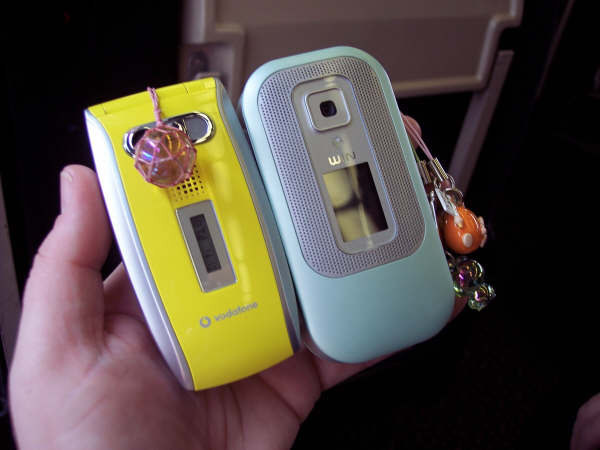
First, we wandered through the gift shops. We discovered that the area where I live is famous for loquats (also known as biwi), a small orange tropical fruit. To me, it tastes like a cross between apricot and mango. There were lots and lots of different loquat pastries, loquats in jelly, loquat mochi (rice paste balls), loquat caramels...even funny little plastic loquat charms with smiling faces on teeny leashes, to hang from one's cell phone! (Yes, I now have two fat, grinning little plastic loquats dangling from my mint-green phone, although you can only see one of them, along with my little transparent green frog. Em has a miniature version of the Japanese fishing floats, made by her friend in Okinawa.) Loquats are considered unusual, because they flower in the fall or early winter, and produce their fruit in late winter or early spring.

I find the selection of "gifts" in these little shops to be fascinating--pickles of all kinds, dried squid, raw squid, dried fish of all kinds, and lots and lots of cute but useless plastic "charms". Emiri got lots of special attention, due to her great skills with the Japanese language. I'm so in awe of her! Even before she speaks, she draws people to her, with her smile and her attitude. After a brief walk along the pier in the beautiful sunshine, we enjoyed lunch at an Italian restaurant (Japanicized, of course!) on the pier. I tried Calpis, a very lightly carbonated, opaque white soda. It's supposed to have a lot of calcium, and had a very mildly sweet, slightly chalky taste. It was interesting, and I rather liked it, despite the fact that the name sounds like something vulgar in English!

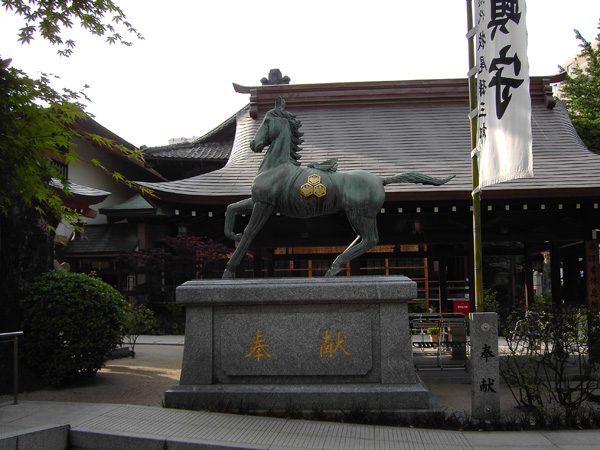
Then we parked the car, and headed for Fukuoka on the train. This time, we got off at the right station! We took a taxi to a part of Fukuoka called Hakata, to the Kushida Shrine (built in 757 AD), and enjoyed wandering around. Though most shrines have similar features, there is always something distinctive about each one, and this one was no exception!

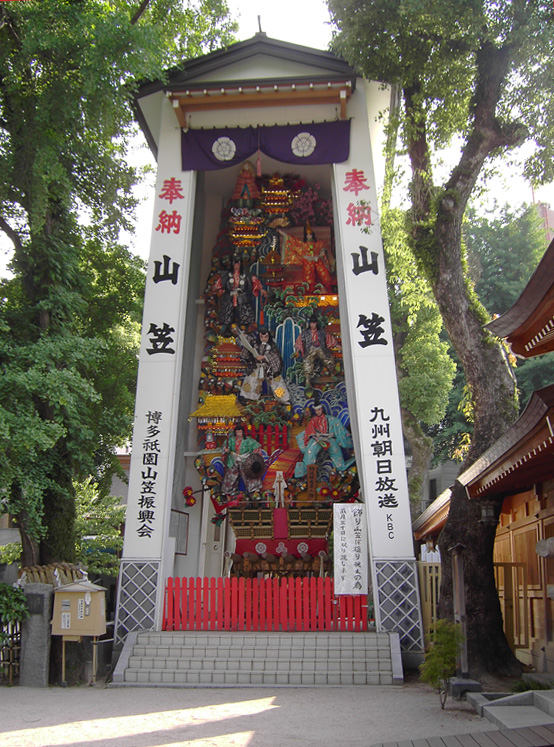
Kushida Shrine oversees the Hakata Yamakasa festival, which originated in 1241, when a Buddhist priest named Souichi Kokushi was carried through the town on a platform, from which he sprinkled holy water to eradicate evil spirits responsible for a plague that had struck the town. The festival takes place from July 1-15 every year, and the climax, Oiyama, begins at 4:59am on the last day. On Oiyama, a drum signals the start to the first kakiyama, a one-ton "race float" shouldered by a team sometimes numbering over a hundred men. The team carries the float, sort of like a giant portable altar, on a five kilometer route through the streets of Hakata. Six more kakiyama follow, each one hoping for the best time on the 5K route. The seven nagare (teams) are drawn from more than 10 areas within Hakata, and can be distinguished by the different patterns of cloth used to make their happi. Each team of bearers has special short coats (mizu happi) made of the team fabric, sort of like a team uniform to be worn while carrying the floats, and matching long robes (naga happi) that they wear at other times during the festival. The various team members have different roles and responsibilities, indicated by different colored head cloths.

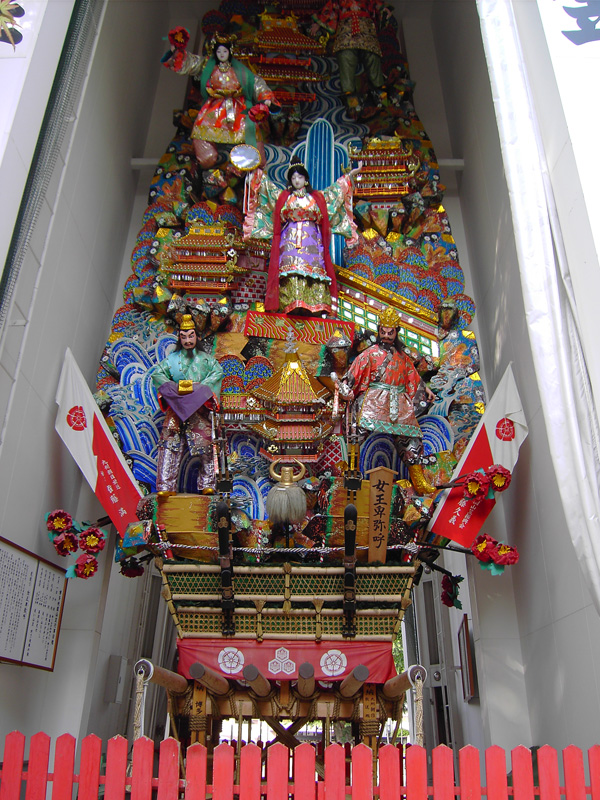
There are special traditions associated with Hakata Kamakasa. For example, participants must not eat cucumber during the entire festival period, becasue the Kushida Shrine crest resembles the cross-section of a cucumber. Also, all team members are forbidden from having sex during this time, so as to save their "life force" for carrying the one-ton kakiyama. It's considered an honor to be allowed to participate, and the participants take the various rituals and traditions very seriously. During the 15-day festival period, the whole Hakata district is the festival site, with the kakiyama on display, as well as the kazariyama, which are insanely tall "decorative" floats. The altar floats made to be carried are made of heavy wood hung all over with gleaming golden plaques and decorations. (Please forgive the bad photo of the kakiyama--they were in a dark "garage" and I could only take a photo through the glass, my camera was dying, and that was the only image that even came close to turning out. I'm sorry!) The decorative kazariyama are decorated with figures ranging from samurai warriors to cartoon characters. The one on display at the Kushida Shrine was fascinating, covered with lifesized figures, with vibrant colors and lots of sparkling silver and gold.

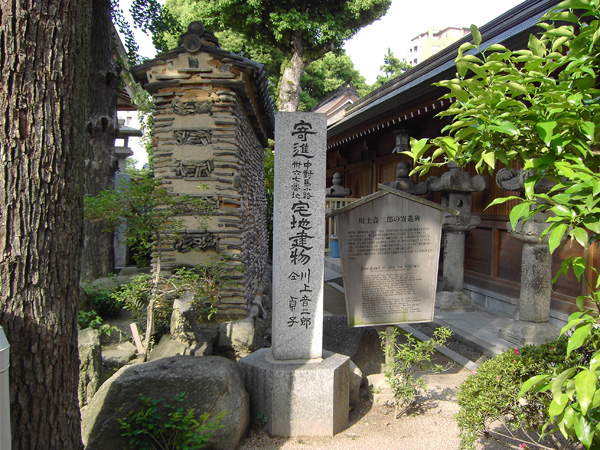
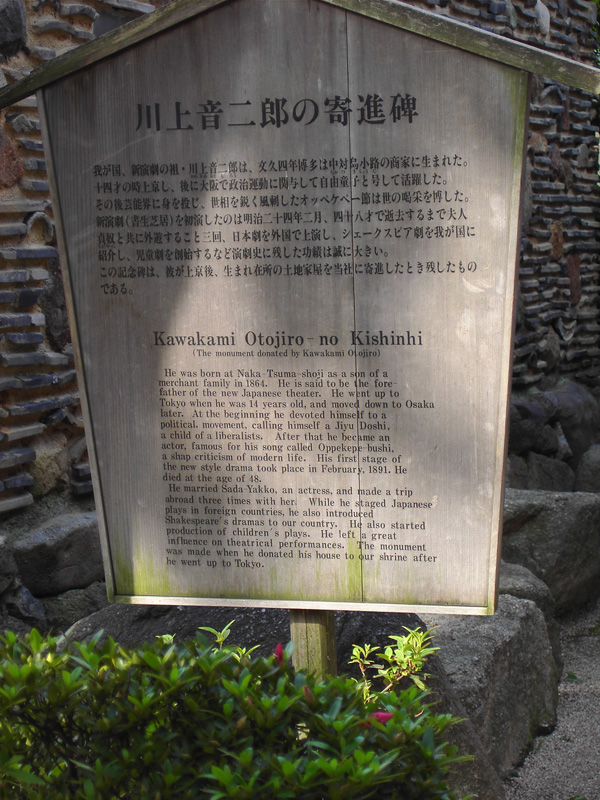
There was also a memorial to the forefather of modern Japanese theatre, Kawakami Otojiro-no Kishinhi (1864-1912). He was the first to bring Shakespeare to Japan, and the first to stage productions of plays for children. I was thrilled to find the little memorial plaque at the back of the shrine itself!

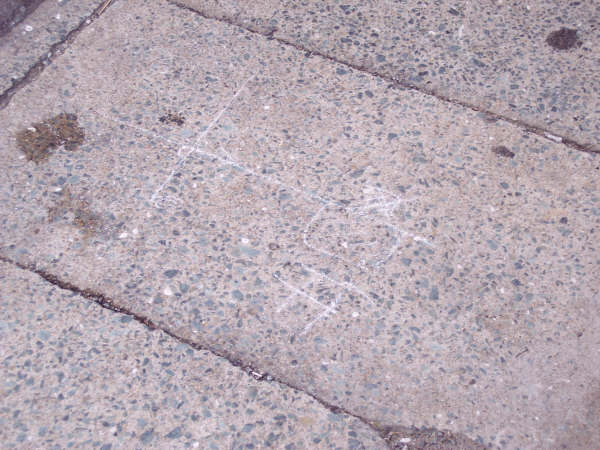
Then Em and I set out to find the Hakata Machiya Folk Museum, which was much easier said than done! We walked for a while in one direction...nothing. Consulting the little guidebook map and the very vaguely placed "this is it" red dot, we tried another direction. Nothing. We stopped a man about to get into his car, and Em asked directions. He offered to take us there in his car, but we demurred. So he grabbed a rock, squatted in the street, and drew a map for us on the pavement! Hurray, we've got it! So we head back in the direction from which we came. And walked. And walked. Arrgh--nothing! We stopped again, this time at a shop filled with American-style t-shirts and jeans, and Emiri worked her magic in Japanese again. Ok, back we go. Finally, we found it...about half a block from the Kushida Shrine! Our search was frustrating and sweaty, but ended up being worth the trouble, at least to me. If Em didn't think so, she was generous to keep it to herself.

The museum was small, but interesting. We wandered through the little exhibit building, where I learned much of the information about the Hakata Kamakasa festival and the floats we'd seen at the shrine! They had miniature dioramas, and a bank of old fashioned phones for visitors to listen to the "funny Hakata dialect." Of course, those didn't do anything for me, since I can't tell the difference between one Japanese dialect and another!

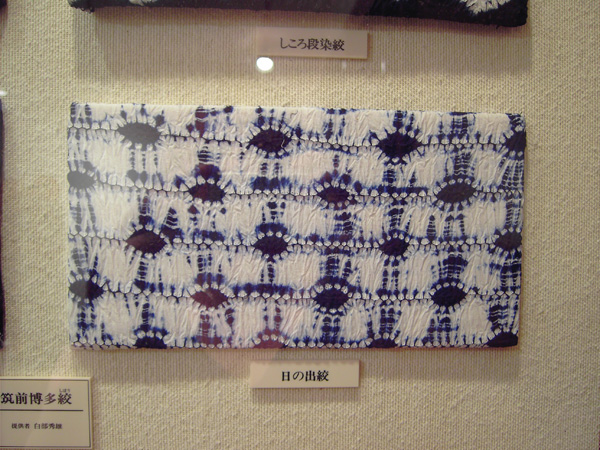
There were some absolutely amazing fabrics on display that looked sort of like batiks or tie-dye...the fabric of some looked as if it had been stitched very carefully in a specific gathered pattern, dyed with the deep indigo dye, and the stitches taken out once the fabric was dried. I could not read the Japanese that explained the exhibit, so my guess may be wrong. Regardless, they were really lovely. I believe these are the fabrics used for the naga happi and mizu happi of the altar float teams.


There was also a series of life-sized dioramas depicting a shop and a home at the turn of the century, complete with appropriately-dressed mannequins. There were displays of other local crafts as well, such as the Hakata dolls, Hakata-ori and Hakata shibori textiles, Hakata magemono (cylindrical boxes made from thin sheets of wood bent into shape), heisuke brushes (for calligraphy and painting), hariko (bobble-head animal figures made in a medium similar to paper maiche), multi-colored worked glass similar to Murano glass, fighting tops (a totally different shape than the tops Sasebo is famous for making), and famous Hakata scissors. Unfortunately, we were too late for any of the many demonstrations of these fascinating crafts, and for the chikusen-biwa Japanese lute playing.

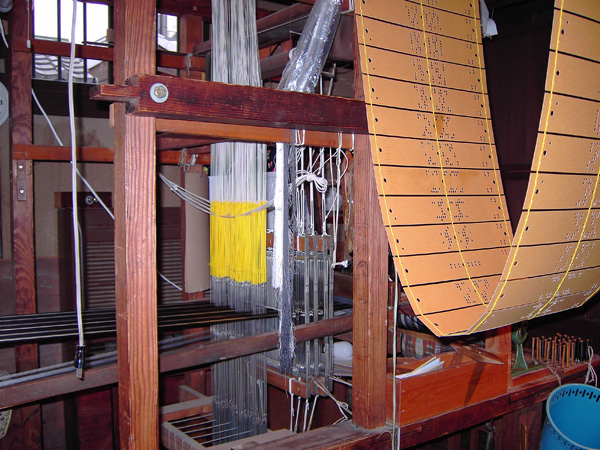
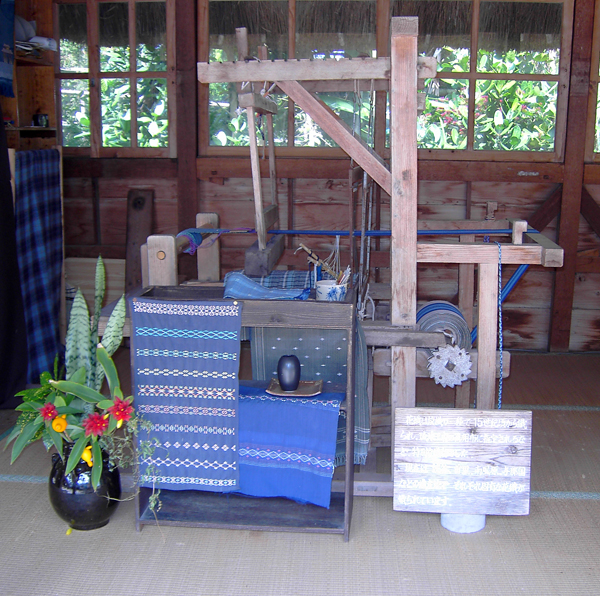
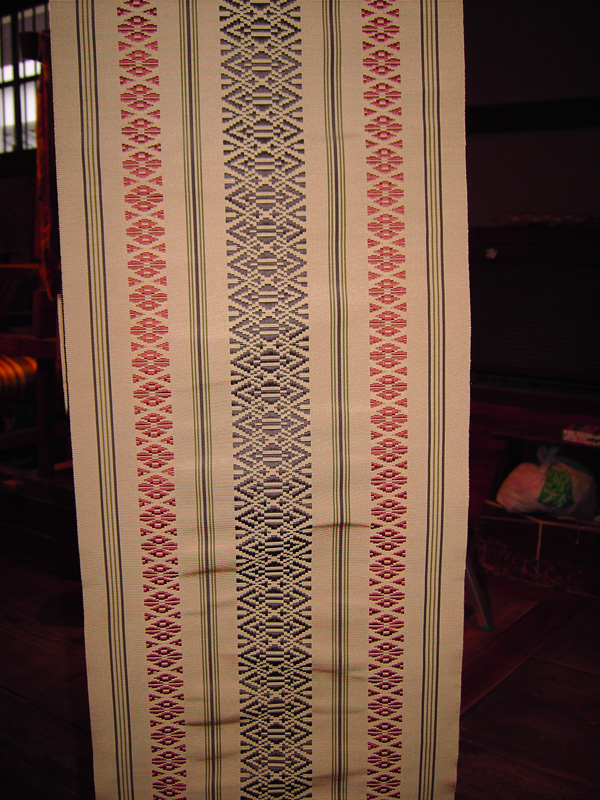
The other part of the museum (Maichiya Hall) was a relocated and restored Hakata-ori textile-weaver's house from the Meiji and Taisho eras (turn of the 20th century). The building itself is long and narrow, with the tatami rooms on either side of the central hallway built to become larger towards the back, in a fan shape for good luck. In the center of the main room, the ceiling opened up, giving a sudden impression of space and light. The main pillar of the house (the daikoku-bashira, representing the head of the household and his strength) was intricately carved, and soared up in the space. The hall was fascinating, with several very intricate looms and displays of astoundingly complex woven fabrics. I was so sad that we'd missed the demonstration, as I wanted to see how the big loom worked. There was a long loop like a conveyor belt of wooden plaques, each with a different pattern of holes. I think that somehow, the holes in each plaque help direct the heddles of the loom, each plaque moving into place for a different part of the pattern, kind of like a player piano's paper scroll. But I am not sure, and I want to see it in action! Unfortunately, they were closing, and so I snapped several photos, and we had to head out.

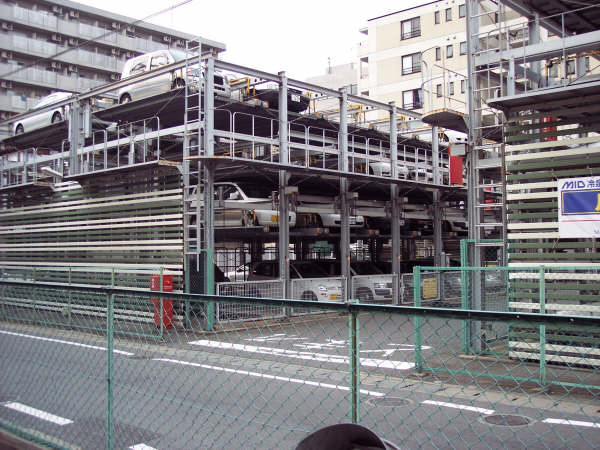
We headed back towards the train station, trying to catch a taxi as we walked (we were pretty far away!) Despite the humidity, I enjoyed the walk, looking in shop windows and people-watching. Though I thought Sasebo seemed like a pretty big city to me, I now understand why it's considered sort of small-town and rural, despite its 300,000 residents. Fukuoka is very much more "big city", with tall buildings and modern shops, and fewer old-fashioned Japanese storefronts. I got another sense of what a premium is put on space in this country, as I passed a parking lot. The lot consisted of a relatively small footprint, but had "racks" on which each car was driven. The rack was then raised until it was almost touching the rack holding the car above, and another car was driven in and raised. I've never seen so many vehicles crammed horizontally and vertically into such a small space! I guess that's another reason for the intense and very expensive car inspection required every two years...I sure wouldn't want the car above mine leaking oil or transmission fluid or whatever onto the roof or hood of my car! Thanks to Emiri for the photo.

We finally got a taxi, and got back to the train station. We grabbed a quick bite to eat in the station itself, which, like many Japanese train stations, was like a shopping mall, filled with stalls and shops and restaurants. Then Emiri headed on the short trip to the Fukuoka airport to fly back to Okinawa, and I headed for the train back home to Sasebo. Even that experience was interesting! The platforms were crowded with people headed home after the workday. In the US, the crowds would swarm towards the doors as the train pulled in, shoving and jockeying for position. Not so in Japan! Every few feet was a mark on the pavement to show where the doors would be when the train stopped . At each mark was a single line of people, snaking carefully so that no line intersected any other line, and no line blocked the pathway up and down the platform. It was amazing--everyone knew what to do and where to stand, no one was pushing, no one behaved as if he or she were more important than anyone else or in more of a hurry.


I didn't know where my particular mark was (some cars are "first come, first serve", other cars are "reserved seat only", and I had a reserved seat. So I excused myself and asked a fellow traveller where I needed to be, with my few words of Japanese, some charades, and my out-thrust ticket. She smiled, bowed, chattered in Japanese, and gestured down the platform. In the next line someone looked up and saw what was happening. She beckoned to me, smiling...so I went to her. She looked at my ticket, smiled, bowed, spoke to me in Japanese, and pointed me to the next line, where a young man beckoned me to come to him. This went on from line to line down the row, until I was at the appropriate mark...then I was handed down the line to my spot at the end. It was very funny! Rather than gesture to me to go down eight lines to find mine, my fellow passengers took the bakka gaijin (idiot foreigner) in hand and gently herded me to my place. I loved it!

Emiri's visit was quite short, but despite my propensity for running late, we still managed to cram an awful lot into three days! I hope she can come back again, and I hope to get a chance to visit her in Okinawa. In the meantime, she was a very tolerant guinea pig, as I discovered where I can take visitors to Sasebo. Thanks, Em, for being such a fantastic, easy-going and fun guest!

Sunday, July 30, 2006

Wandering with Emiri, Dinner with Miyuki

My favorite view on the drive homeSorry for the long delay! Life here is good, although I miss FH. He's in San Diego for school, returning sometime in August (he's top of his class so far!) Most recently, I've been working on the cover design and book layout for a really cool writer in New England. Her book is hysterically funny, and I'm having a blast putting it together. Dad did fantastic photography in North Carolina for the cover, and an illustrator in California is doing a couple of cartoons for inside the book. Thank goodness for the Internet--most of my freelance work would be impossible without it! I managed to catch a really rotten summer cold/flu thing as well, and that put me out of commission for about a week. So the past few days I've been scrambling to catch up.

Our street!The weather is hot, but looking at the weather sites on the web, it looks as if we haven't had the heat that the US has been experiencing! It rained heavily throughout June and July, with unbelievably thick, humid haze on the days it didn't rain. I've been battling mold and mildew as a result. But for the past week or so, it's been absolutely gorgeous! Yes, the temperature has been in the high 80s and low 90s, but it's been sunny, with bright blue skies and big puffy clouds, and nowhere near the humidity we've had. I've adopted the Japanese custom of carrying an umbrella in the sun, to avoid burning and hopefully avoid more skin cancer. Most women carry parasols in the sun, and most older folks either use parasols or floppy-brimmed hats. Makes sense to me! The photo is the view down my street. This is the wide part...it gets narrower!

I realize it's been two months now since Emiri's visit but I wanted to finish recounting our adventures while she was here. (I called her M before, but since she's blogging now as Emiri, I figure I can use that!) She arrived on a Monday, and Tuesday we spent in Kumamoto--which I already wrote about. Wednesday morning, we both slept in a little bit, exhausted from our long day and traveling to and from Kumamoto.

Once we got moving (late, of course), we drove to Arita, the porcelain capital of Japan. We found some "outlet" shops, and ended up splitting up, to look and shop each at our own speed. I found small chopstick rests in various animal shapes, and spent forever finding "just the right ones". When we got back together, Emiri had gotten a couple of small things...and had, of course, made friends! One of the shop proprietors had given her gifts of a t-shirt with the logo of one of the Arita kilns on it, and a small Chinese zodiac dish. Too cool! We drove around quite a bit more, and stopped once at a junk shop to poke around, and got a late lunch at one of the many ramen noodle shops. Basically, it was a pleasant, relaxed day, and we headed home to meet Miyuki, who was taking us to dinner.

Miyuki came in and met Emiri--and had gifts (of course!) for both of us! Miyuki's mother had gone to Kyoto, and brought back little rememberances. For me, there was a packet of fat little fan-shaped sachets that Miyuki told me were specifically to put in a woman's purse, so a whiff of sweet scent comes out when you open it. She'd also brought a little book printed with sakura flowers, for Emiri--who loves sakura flowers! (Em, I can't remember...it was a little book, wasn't it? Or was it a little purse? All I can remember is the sakura blossoms!) Emiri had brought pineapple pastries and purple sweet potato pastries for Miyuki, so we were very "Japanese" with our formal little gift exchange.

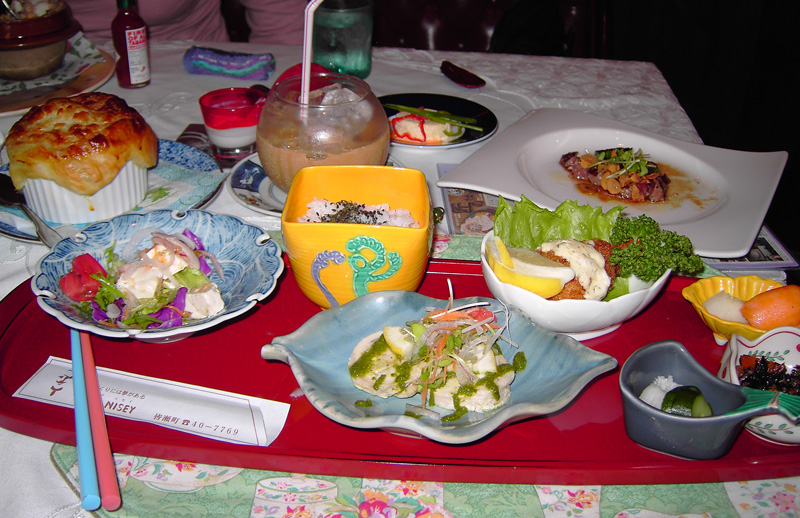
We headed out to a restaurant Miyuki had picked out for us. We drove for what seemed like miles and miles and miles, and finally pulled up at the Restaurant Dom Nisey. I'm not sure if it was supposed to be Italian or French or what, but Miyuki told us it was patronized mostly by women, as they served mostly organic, healthy, fresh foods, and "men don't like to eat what's good for them!"

The restaurant itself was quite a visual surprise. Outside was a plastic, lit-from-within Frosty the Snowman, a concrete statue of two children kissing (a la the Hummel figurines) and blue Christmas lights strung in the trees. At the front door, there was a little chair, a watering can, a bunch of lace, and tons of silk flowers...sort of an off-kilter, overdone Victorian tea room effect. It was very funny! Inside, it was sort of Italian, with creamy plaster walls, dark terra-cotta glazed tile floors, and lots of arched doorways and windows. Every table had a lacy table cloth, and mismatched floral placemats on top, and each window had different lace curtains. On the tables were little cutesy figurines of mice and swans and frogs in suits. It was all rather overwhelming!

It was a fantastic dinner though, with great conversation and really interesting food. I ordered iced coffee to drink, and it came in a globe-shaped glass, with ice piled high over the rim, and a long stirring stick of brass with a glass marble at the end. The sweetener was a clear syrup (don't know if it is cane or corn or what) and came in a round orange glass ball with a little hole in the top, and the creamer was in an orange and clear shot glass--with both creamer and sugar on a little square of mirrored glass. It was a striking presentation, but to be honest, the syrup ball and the creamer were both very awkward to pour from, and I dribbled both on the tablecloth.

Miyuki got her favorite, doria, which is an "Italian" casserole of baked short grain rice and cheese and seafood, topped with sheets of nori (seaweed). Em got a macaroni and cheese dish, which turned out to be a huge tart dish with a thin layer of penne pasta and several cheeses and (I think) little bits of ham. Miyuki knows how much I enjoy trying new foods, so she insisted I try the "ladies menu" which turned out to be a HUGE meal of eleven different little dishes, plus dessert. I was STUFFED!

In the photo, in a spiral clockwise from the upper left:

  1. a tender beef and mushroom stew with a piece of puff pastry on top
  2. a savory seafood custard with sweet red pepper
  3. a dish of unbelievable rare beef and garlic chips, with radish sprouts
  4. a piece of loquat and a piece of melon
  5. a seaweed salad with carrots
  6. a little dish of pickled cucumber and daikon radish
  7. a dish of chicken with onions, sprouts and pesto
  8. a homemade tofu salad with a very light vinaigrette
  9. Japanese rice with furikake (a sprinkle of sesame seeds, seaweed, salt and seasoning), and
  10. a single shrimp, stuffed with a seafood mousse, fried and topped with a Japanese tartar sauce.
Each dish was only about three bites, but there were so many of them! Oh, and it all began with a very fresh puree of pea soup. Whew!!! I think my favorite was the beef with the crispy garlic chips, and the homemade tofu, which did not have the chalky taste I associate with the hermetically sealed tofu one finds in American grocery stores!

Dessert was gorgeous as well. Mine came as part of the "ladies menu" I'd ordered, a little selection of different things...in this case, a little sliver of delicately sweet sesame cheesecake, and a teeny container of kiwi sorbet, all set on a drizzle of strawberry syrup. Emiri got a dish of ice cream with fruit and a mango (or loquat??) syrup, with two tiny pink carnations as garnish. Of course, we all three shared. There was a dessert on the menu that was very specifically "For Men Only", which cracked me up! Miyuki said it was a parfait with all sorts of stuff on top, served in a big beer mug...but the chocolate was very dark and bittersweet, and "too strong for women"! The couple behind us came in just to order dessert, and the man, of course, ordered that particular dessert. So I asked (via charades) if I could take a photo. His dessert looks good, but her dessert (with the shimmery tangle of sugar threads) looks more interesting! All in all, we had a really great day.

I can't seem to ever write a short and sweet account of anything! Sorry for the hugely long letters. I'll stop here, and finish with the last day of Emiri's trip in a couple of days. (Don't worry...I've already written half of it! I just realized that this was getting really long, and I should post it now, along with photos.) To be continued!

    Wednesday, June 14, 2006

    The Big Buddha, the Lucky God & the Goddess of Eloquence, Beauty & Wisdom


    I'm sorry it's been so long between updates--it's been a busy few weeks! My trip to Yokosuka was a bigger deal than I anticpated, and I was a little sorry we hadn't taken the Navy up on their offer to let Fearless Husband come with me. However, we both decided it was better for his career for him to ship out at the beginning of May rather than have him stay home and travel to Yokosuka with me. So, off he went to Singapore and Thailand.

    The Navy gave me a plane ticket to Haneda Airport outside Tokyo, and instructions on how to get a train ticket to Yokosuka once my plane landed. After some confusion and the help of the costumed "airport helpers"--I boarded the train. The airport helpers are a particularly Japanese custom...young women in their early 20s drift around the airport, wearing powder-blue skirts, jackets, cute little hats with ribbons, and dainty white gloves right out of the 1950s. They're paid to look pretty and seek out confused tourists to aid. The helper who approached me had very little English, but more English than I had Japanese! She called out in her high, clear voice, and two more dainty blue-wrapped girls came running to join us (working women in Japan seem to ALWAYS run with tightly clasped knees and teeny little steps, giving the impression of eagerness and hurry even when they don't move particularly fast!) Between the four of us, we managed to navigate the train ticket machine. I'd found the button to convert the screen text to English, but the train line name I was given was not on the screen, nor was the station name I'd been told. I kept repeating "Yokosuka! Yokosuka!" in desperation, and the three girls figured out how to get me there, pushed the right buttons, and handed me the ticket that the machine spit out. All three were eager to show me the right escalator to find my train, and I was escorted like royalty to the train platform.

    I struck up a conversation with a couple on the train--he was miltary, she was Japanese, and they were also on their way to the hospital at Yokosuka. I was grateful, as the wife was able to read the signs, of course, and told me I'd lucked out and gotten onto an express, and would not have to change trains. They showed me how to get to the base from the station, which saved me taxi fare, and I was grateful. Once on the base, I had to take a taxi though--it's a BIG base! The housing folks tried to put me in a shared room with a young female sailor, but I wasn't having any of that. I checked myself into the Navy Lodge (which is where I would've stayed if FH had come with me) and got permission for reimbursement afterwards.

    The medical stuff went extremely well--I've never had such attentive, professional, courteous care in my life! I guess I expected the Navy hospital not to be on par with a private hospital, but I was proven wrong very quickly. I am so grateful to have such wonderful medical service available! I had a great time talking with the Lieutenant who was the head nurse. She and her husband have adopted two Japanese babies, and of course, I had lots of questions! The whole experience was great, despite being a lot more involved than I first thought. The doctor decided he didn't want me going home to Sasebo the day after the procedure, so my "orders" were extended several days. So...I decided that rather than make this a trip all about medical stuff, I would treat it as a mini-vacation and a chance to see a little more of Japan on the Navy's dime!

    I arrived in Yokosuka on Wednesday afternoon. It poured rain on Thursday (and most of the day was taken up with medical stuff). My surgery was Friday, and then it poured all day Saturday. I was getting a little impatient! Luckily, Sunday was overcast but not rainy, so I headed back to the train station, armed with a photocopied map of Kamakura, directions to the Daibutsu (giant Buddha) and my meager handful of Japanese phrases. I got on the train to Kamakura (or so I thought!) A little worried that I couldn't find any signs on the train in Romanji (English alphabet), I spoke to a young man, pointing in the direction we were travelling and asking "Kamakura"? The answer was an emphatic NO! I'd gotten on the wrong train, going in the wrong direction!


    So, I got off at the next stop, and figured I would just jump on the next train going in the opposite direction. While I waited, a little boy and his parents came onto the platform. He was running and laughing and jumping in puddles as his father chased after him, making sure he didn't overshoot and fall onto the tracks. The child's mother saw me watching her son, and smiled...and then spoke to me in great English. We talked, and I ruefully explained my mistake to her. I'm certainly glad I met Asoko! Turns out I could not just get on the train and go in the proper direction...I had to go back one stop, get off the train, and get on an entirely different train line! Oooops!

    So...this young family offered to escort me. It wasn't until we'd gone back one stop, changed trains, travelled several stops and changed trains again that I found out they had changed their plans entirely, just to make sure I got where I was going! They left me there at the Hase train station in Kamakura, and promptly got on a train going back to where they'd come from. They all three hustled down to the end car, and waved and beamed at me from the back window of the train until it was out of sight.

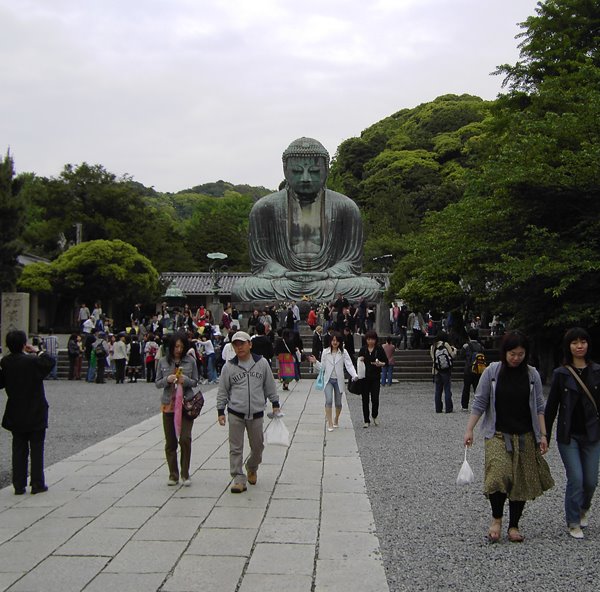
    Kamakura is a fascinating town. It's small--smaller than Sasebo--with lots of little restaurants and touristy shops. Their claim to fame is the plethora of shrines and temples, and the Daibutsu, which is the second largest Buddha statue in Japan. It's 13.35 meters high, of cast bronze, built in 1252. It was originally built inside a temple, but a tsunami washed away the temple walls and roof at the end of the 15th century, so now it stands in the open. Its official name is Taiisan Kotokuin Shojo Senji. One can pay to go inside it, but it was plenty hot enough without going into a giant metal windowless box, so I abstained.

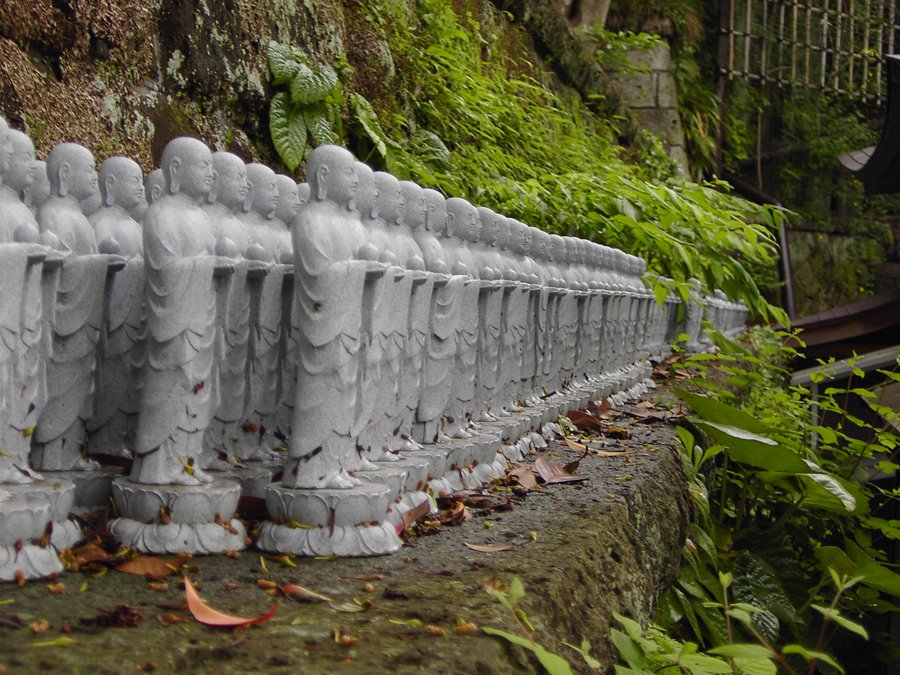
    My favorite part of Kamakura was not, surprisingly, the Daibutsu, but instead was the Hasadera Temple. Of course, one enters the temple grounds at the garden level, and begins to climb (anything worthwhile in Japan is worth climbing to reach...) On the first "level" there were literally hundreds and hundreds of little statues called sentai jizo, maybe 12 inches high. Each represents the soul of a child who was stillborn, miscarried or aborted. The men mostly kept moving up the stairs, but it seemed that every single woman had to stop here, to pour water with a bamboo dipper on the head of a child-like Buddha statue, and pray before the ranks and ranks of sentai jizo. Another, larger statue sat in the middle of them all, wearing a red cloth cap and cape on its stone head and shoulders. There were many candles being lit, and lots of incense, and more than one woman walked away weeping.


    There was a tiny little temple with a wooden statue of Buddha inside, with the usual grid-topped box for donations...but surrounding the box and the feet of the Buddha were piles of toys and candy and sodas. A woman saw my puzzled expression and whispered to me "for the children, because they never got to play and be happy on this earth." So much for no tears!

    Once I got myself together and stopped sniffling, I made my way further up the hill to the main temple halls. The Hasedera temple is of the Jodo sect of Buddhism, and is famous for its statue of Kannon, the goddess of mercy. The statue shows Kannon with eleven heads, each representing a characteristic of the goddess. The gilded wooden statue is over 9 meters tall, and is regarded as the largest wooden sculpture in Japan. It was so serene and cool in the temple hall, and though there were plenty of tourists, almost all were Japanese, and everyone was very quiet and reverent. It was really beautiful! Go to
    http://www.asahi-net.or.jp/~qm9t-kndu/hasedera.htm for more info about the temple and the statue.

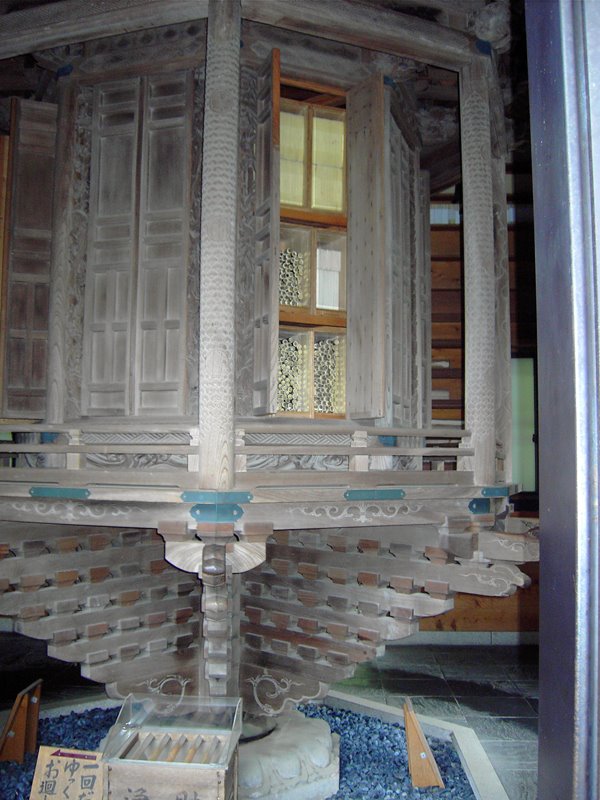
    I really wanted to take a photo of the statue of Kannon, and there were some tourists doing so, but there is a sign that specifically asks visitors NOT to take photos. I thought about how I'd feel if someone came into St. Peter's in the middle of a service and started snapping photos and talking, and I decided to respect the request. I did take a photo of the huge bell, and the giant tree trunk that is swung against it to ring it, and several photos of the gardens, the temple roof, the statues for the children, and of some of the toys and offerings for the souls of the children. I also took a photo of the revolving kyozo, which is a carved wooden storehouse for the sutras--the Issaikyo, which are all the scriptures of Mahayana Buddhism (100 volumes, 900 pages each!) The whole thing revolves on an axle, like a huge, ponderous top. There were several very solemn-faced people struggling to push it around one complete revolution--an elderly couple, then two plump housewife-types, then three teenagers. If a pilgrim pushes it around in a full circle, he or she gets the same spiritual benefit as reading all the scriptures!

    I really enjoyed the Daikokudo hall, the home of the Daikokuten. He's a fat, funny god with a huge smile, a bald head, and fat, pendulous earlobes. He stands on a sack of rice with a treasure bag over one shoulder and a mallet or mace over the other shoulder. He supposedly shakes his mace and treasure and goodies fall out, showering the good people. He used to be the god of grain, but is now considered one of the gods of good fortune--one of the seven lucky deities. In a little alcove off the Daikokudo sat a solemn priest. His job was to carefully paint beautiful calligraphy in the "pilgrimage books" of visitors, and to sell little trinkets. I bought a little Daikokuten charm, and he smiled and handed me a little tiny brass statue of the Daikokuten as a gift. While I was there, several people came in and rubbed the statue, including two very serious old ladies who approached the statue chanting something as they rubbed him all over, using both hands with great purpose, seriousness and intensity--his swollen earlobes, his knee, his fat cheeks, his eyebrows...and between his legs! I had a hard time keeping a straight face, especially as the fat statue was shorter than both women, but much wider, and his grin was so huge!

    On my way back down the hill, I followed two elderly women from New Zealand (mostly so I could listen to their Japanese guide/friend!) They passed a little tatami-matted, glass-walled building filled with people kneeling in front of low desks, busily writing. The guide/friend explained that they were copying from an ancient sutra, which gave them spiritual benefits. Past the building, there was a torii in front of a little tiny cave. The NZ ladies stooped over and went straight in, so of course I followed. Inside the cool, low-ceilinged cave carved out of the hillside, water dripped and shadows loomed. The one large Benten statue (goddess of eloquence, music & wisdom--of course she's female!) was followed by 16 relief carvings of her followers and messengers. I was confused...the torii is Shinto, but the Benten statue is Buddhist. The guide/friend explained that this was an example of the overlap of the two beliefs, but I'm not really sure I understand. More reading for me, I guess.


    The cave startled me, as it got so low at one point that we practically had to crawl to get through to the next part. There was a room with hundreds and hundreds of teeny tiny wooden Buddha figures about an inch and a half tall--tucked into nooks and crannies in the wall, on rock shelves, on the floor, teetering on the metal pipe through which the wires for the few electric bulbs run. The guide/friend said people bought these little figurines and left them, often with prayers written on the bottom. I asked her why these things were in a cave...was there persecution in the past? She smiled and said "it means more if your prayers are private and quiet, and not showing off for your neighbors." Made me think of "And when thou prayest, thou shalt not be as the hypocrites are: for they love to pray standing in the synagogues and in the corners of the streets, that they may be seen of men....when thou prayest, enter into thy closet and when thou has shut thy door, pray to thy Father which is in secret...." (no, I don't have it memorized--I had to look it up).

    I was so glad I made the effort to go to Kamakura. I wish FH had been with me, but maybe we'll get a chance to head in that direction together at some point in the next two and a half years. If you're anywhere near Tokyo for any reason, don't miss the little town of Kamakura.

    More adventures to come. I still have to give you the lowdown on cousin M's visit...we went to Kumamoto, Arita, Fukuoka, Kashimae Pier...it was great! But it will be a day or two, as FH is home (YIPPEE!) Seems they got halfway to Indonesia, and Indonesia decided they didn't want help. So they headed home. His hours are truly crazy right now, as the ship is doing some sort of important excercise/qualification/I don't really understand it, and so even though he's in port, he's on the ship more often than not. Though I won't see much of him (and nothing at all during the week!) at least he's close, and he gets to be home a few evenings in the next two or three weeks. He's working insanely hard and I'm really in awe of him right now.