skip to main |
skip to sidebar

Happy New Year… Happy Year of the Ox… Omedetou gozaimasu! Wishing you all peace, health and joy in the New Year. (Yes, I began this in January, but since the Chinese New Year was just a couple of days ago, let’s pretend, shall we?)
Fearless Husband came home from deployment at the beginning of December, so we were able to have Christmas and New Year’s together (hurray!) Between Christmas and New Year’s, my friend Hiroko took me to a little neighborhood shopping area to get some wagyu beef (what Americans refer to as Kobe, but this was from Hirado Island) for FH. Before buying the beef, we walked around, peering into the little shops lining the road. One shop was the smallest I think I’ve ever seen. I’ve had bigger closets! A teeny, tiny old lady with radiant skin and a lovely smile sat inside, surrounded by bottles of a golden oil, and pamphlets with photos of camellia flowers. Turns out the oil was camellia oil! It’s supposedly very good for both the skin and the hair, and can even be used for cooking! The little old lady was quite a good advertisement for her own product..her skin was that of a woman MUCH younger, though she was in her 80s!
 We window-shopped (or would that be awning-shopped, when there are no windows?) our way through kitchenwares, fish so fresh it was still flapping, gorgeous vegetables and jewel-like fruit, organic chicken, various homemade condiments, and more. I ended up with some fresh yuzu-koshou (a paste of yuzu rind – a very aromatic citrus fruit – chilies and salt that’s delicious on fresh tofu), the prettiest turnips I’ve ever seen, a packet of sweet potato mochi, a bamboo spatula/spoon, several skeins of yarn from another teensy shop basically lined floor to ceiling with brightly colored balls of yarn, some traditional Japanese New Year decorations, and of course, FH's beef.
The butcher shop was on a corner, as such shops often are, and the shop itself was open to the outside air – no windows, no door. There were refrigerated display cases filled with meats, but Hiroko ignored it all. Instead, she spoke at length to the butcher, who then straightened his apron and disappeared into the back. A minute later, he emerged, carrying a chunk of beef as if it was a velvet cushion holding the crown of the realm or something. He walked slowly, with dignity and reverence, presenting the piece of meat as if waiting for me to admire his newborn son. I’ve never seen a butcher so proud of his own product! More negotiation, in English and Japanese, about how much of the beef I wanted (though money was NEVER mentioned, not once – I guess if you have to ask, you can’t afford it!) and then the “baby” was transferred to the cutting table.
 The butcher laid out three different knives, and proceeded to lovingly separate the smaller chunk I’d indicated, then very carefully trim all the exterior fat, inspecting it and turning it and basically making a big production out of the whole thing. Yes, he used all three knives. The meat was then weighed (he was careful to point out that I was paying only for what we’d be eating, not for the trimmings!), then the chunk was carefully wrapped in a flexible, paper-thin piece of wood (yes, wood!), then white paper over that, then more white paper, then finally the swaddled bundle was put into a bag for me and placed on the counter *just* out of my reach.Oh, right. Gotta pay for it. *gulp* Imagine an eye of round roast just over a pound and a quarter, but prettier and marbled to such an extent that it looks like a mosaic on the cut end. Now imagine paying $35 for it. Now imagine being absolutely thrilled at the incredible deal you just got! Ok, enough about the beef. Suffice to say I cooked it with nothing else but a bare sprinkling of salt, stretched it to serve the two of us for three meals, and was the most amazing, tender, savory beef either of us have ever eaten. Ever. In our entire lives. Period.
 I also bought a traditional Japanese New Year’s decoration(shimekazari, which I can’t believe I forgot to photograph!), to go over our front door. It’s a fat, heavy twist of rice straw, with two sprays of rice straw sticking down to either side, a little fountain of rice kernels on their stem in the middle, various bits of folded and rolled special paper, and a sour orange skewered in the center. Most of the houses in our neighborhood already had similar decorations, and Hiroko encouraged me to get one, too.
Hiroko explained further about the various New Year decorations:
“As for the door decoration, we decorate today until 7th or 10th of January when depends on the area or family. Please do not decorate tomorrow (the 31st). Since this is the pray to gods for the new year, we don't decorate on 31st of December. Gods may think that we haven't prepared enough for gods. You'll see the twisted straw of rice stem at the shrine and the paper. Rice is Japanese main food and we pray for good or better harvest for the new year to the god using rice stem straw and the twisted means pray. When we pray something, we sometimes twist something such as a small sheet of paper which we call Koyori or O-hineri (which includes money inside). The paper means gods. The orange, which we call daidai, shows to refresh for new year and another words play that daidai term itself means from generation to generation. Dai means one generation. Daidai orange juice can be eaten with fish or scallop etc. As a whole the decoration shows the pray to gods for the better harvest and prosperity. Please hang above and middle of the entrance door not on the entrance door. Probably your next neighbors will hang today. We will burn it 7th or 10th of January and we say the smoke will avoid decease the rest of the year.
In the Japanese guest room there is alcove which we call Toko-no-ma. I saw you had one at your home. We decorate a several things to pretend for gods to eat. They are 2 double omochi (smooth, chewy cakes made from pounded sticky rice), orange, dried squid, dried persimmon, yuzuri-ha (a kind of evergreen shrub) which means generation change, i.e. prosperity, because a yuzui-ha leaf falls down when a next new leaf grows up, on urajiro (a kind of fern) which is just like words play as ura means backside and jiro means white, accordingly urajiro means that we show gods that we have nothing bad to hide. Japanese men tends not to do housework but the above decorations are for the work of a father. Even my father is willing to do.
I forgot to tell you about the leaves that my mother gave you. They were called "Sen ryo." Sen means million and ryo is old Japanese currency unit in Edo period. At the beginning of the year we pray so many wishes such as happiness, prosperity, longevity, peace, richness etc. For each wish, we have each god and each shrine. For each wish, we eat the represented things as osechi and display the ornament. Sen ryo mean that we pray for millionaire.”
New Year’s eve itself was pretty quiet – we stayed in, and listened as various solemn processions wound through the streets throughout the night, ringing a gong or clacking some sort of wooden clapper as they chanted and walked. At midnight, temple bells all over Japan rang 108 times, to release people from the “108 worldly sins.”
 The morning of January 1, many Japanese get up very early to watch the first sunrise of the new year…this is considered a harbinger of the year to come, and one is supposed to be at peace, with a smile, to watch the sun rise. Unfortunately, we couldn’t see the sun rising here in Sasebo. Instead, we had fat flakes of snow!
In the afternoon, FH and I were invited to join my friend Morinaga-san at her house for a traditional Japanese New Year’s meal. There was another American couple there, as well as Morinaga's sister and daughter (we met Morinaga's mother on the way out of the warren of houses/rooms...she was sitting in a kitchen of another house, watching TV by herself and grinning. She may be slightly demented, or just happy to be alone, not sure!)
We had special sacred sake, poured into special sake saucers (the large one had Mt. Fuji painted/embossed in gold into the red lacquerware, the medium-sized one had a hawk, and the small one had an eggplant -- all traditional decorations for the various sizes). One by one, we each were served the special sake in our choice of the three dishes. We were to sip it three times, finishing the sake on the third sip. After drinking, we were given a tiny handful of dried squid (though I don't remember the meaning). There was a solemnity to the ritual, and it made me think of Holy Communion.
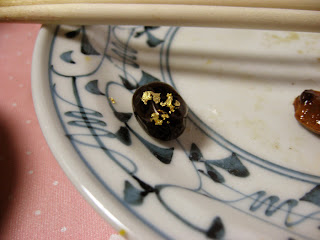
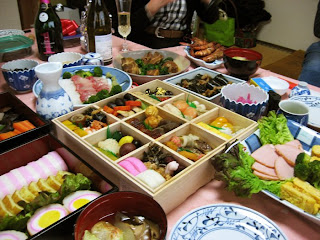
 On the table were plates and plates of food (Chinese cooked pork, fresh mackerel sashimi, knots of savory seaweed, slabs of omelet and slices of ham, etc.) as well as the traditional osechi -- special large wooden divided boxes of very beautiful New Year's foods, each with its own meaning for the New Year (good fortune, money, happiness, fertility, etc.) Traditionally, nobody cooks on January 1, 2 and 3, so the three-layer boxes are all foods that will last. There were all sorts of things, from black beans decorated with gold leaf, to sea cucumber (neither of us liked that AT ALL, but of course had to eat it, as it was fancy and very, very expensive) to tiny carved squashes and pretty fish paste shapes. Champagne was served as well, and the other American couple brought brownies and vegetables with spinach dip. I felt bad that I hadn't contributed to the feast, but luckily, I'd brought gifts for Morinaga-san and her daughter, and a fancy bottle of French wine (regifting what the architect and his wife next door gave us!) and a container of homemade candies. The candies were the insanely simple ones... small pretzels with a Rolo chocolate-and-caramel candy put on top, the whole thing popped in the oven for three minutes, then a toasted pecan half pushed into the Rolo to make it smoosh down on the pretzel. VERY easy, and surprisingly delicious, like a chocolate/caramel/pecan turtle, but with the salty crunch of the pretzel. Luckily, the candies were a HUGE hit, and everyone ate them all up and argued over the last few.
On the way out, through the warren of the three homes perched on the hillside (all owned by Morinaga-san, or possibly communally owned by the women of the family), Morinaga-san pointed out a single tatami room with a fancy lacquerware altar. She said it was the family altar to their ancestors, and they all prayed there every single morning. That was fascinating to me, as I had not thought of Morinaga-san, with her girlish curled ponytail and blue eye-shadow and talk of "fashion" as a particularly spiritual person. Teach me not to judge!
 Over Christmas, FH and I enjoyed Norwegian meatballs and Norwegian Christmas cookies (thank you, Grandma!) from his family traditions. We spent our New Year’s morning quietly together, and had my family’s traditional New Year’s collard greens, black-eyed peas and ham for lunch. At Morinaga-san’s house that afternoon, we sat on tatami mats, with sliding rice-paper doors on two sides, and a painted scroll of cranes hanging in the special alcove, over the ancestor/God offerings of mochi and oranges and shiny wire decorations. It was pretty wonderful to sit in that beautiful and very foreign room, beside my familiar husband, making new Japanese and American friends, at a table covered with food from both cultures, with conversation and laughter flying. What a great way to start the New Year!
 Here is another vignette from our lives here in Japan. There is so much more to tell you, but not enough time to tell it in! More to come, of course. Please forgive the blurry photos, as I was dealing with the dark, and my camera was NOT behaving. (Of course, I felt flash photography would not be appropriate in the least!) As always, click on the photos for larger images.
Last summer, when we got back to Japan after Annette's funeral, my Japanese friend Miyuki felt it was imperative to take Fearless Husband to the Obon festival. She was very serious about it, and insisted that we join her. For three days every summer, the Japanese believe the spirits of family and friends who have passed on come to visit for a time, especially those who have departed in the past year. In other parts of Japan, Obon is in July, but in a few towns, Sasebo included, Obon is always in August.
 Family members put out special sugar cakes molded into beautiful flower shapes, rice cakes, various fruits, and liquor for the visiting spirits. On the third night, there is a HUGE festival downtown. One particular part of the festival is specific to Nagasaki prefecture (of which we are a part) and is a tradition that comes from China. One may pay a token amount to purchase a paper lantern to honor the spirit of the deceased. The lanterns are square, and delicate, in white and yellow and pink with lotus flower blossoms and messages for world peace printed on them.
 One buys a lantern, writes messages to the departed on the lantern (in past days, I'm sure elegant calligraphy brushes were used, but in this case, there was a multitude of Sharpies available). The lantern is handed to the first in a line of twelve Buddhist monk apprentices in black pants, white dress shirts and sober ties, lined up on a floating dock that juts out into the river. The apprentices pass the lantern down the line, and the last man in line carefully sets the lantern onto the river to float away to the nearby ocean, using a long pole to ensure they don't clump up, or drift back to shore. The view of hundreds and hundreds of flickering paper lanterns drifting down the winding river to the sea in the gathering darkness is both poignant and beautiful.
 Miyuki purchased a lantern for Annette, as her tribute to the mother of her friend, and FH wrote messages to his mother before handing it to the acolytes to set adrift. We stood together, watching the lantern join hundreds of others on its journey to the sea, and I think we both felt a sense of closure within our sorrow. We watched until Annette's lantern was out of sight.
Many of the Japanese around us were dressed in traditional kimono, including the children. Others were in very casual clothes. There is sorrow, and some people and children are quietly crying as they prepare their lanterns...others are purchasing and eating street food like chicken skewers, squid-on-a-stick, roasted ears of corn, and snow-cones from the various vendors lined up along the riverside, and laughter drifts through the crowds. It's a celebration of both life and death, of honoring family, and of letting go. For many, it seems to bring closure -- a final goodbye.
After the lanterns are set afloat, people make their way to the main streets, to watch the "floats" go by. The floats are large platforms carried by teams of men and women in matching happi coats, with a roofed structure on top, and many large lanterns hanging under the roof. From what I understood at the time, most of the floats are specifically  dedicated to the owners of various corporations who have passed away in the past year (or years?), and the bearers are workers from the companies. Glittering signs are carried on poles to escort each float, and Miyuki told us the signs specify the name of the company. She explained that years ago, the wealthy and powerful (the elite, the movers and shakers, etc.) were able to pay for such tribute, but now only corporations can afford to have the floats and bearers, signs and fireworks. Each float is carried (sometimes for miles) through the streets of Sasebo, to come together in a large municipal sports field next to the city library.
 There, under brilliant floodlights (think night baseball game), each incredibly heavy platform is brought to the center, one at a time, and then jerked and turned and "danced" in circles as the teams shout and yell, firecrackers explode and columns of heavy smoke rise to the skies. This supposedly scares away any evil spirits who might be hanging around the spirit of the executive. The various teams vie to dance the fastest, shake their float the hardest, and make the most noise. A small but steady stream of townspeople come, each delivering a football-shaped straw package containing the various offerings (rice cakes, fruits, etc.) that have been sitting out for three days for the ancestral spirits. The pile of straw bundles grows and grows, to epic proportions as each family brings their offerings. These "footballs" will be burned in a HUGE bonfire after the event itself, to send the offerings up in smoke to heaven, carrying the offerings back to the spirit world.
 As one enters the field, whether carrying a float, bearing a straw bundle, or just coming to see the spectacle, one may stop at a white tent canopy with roof and three walls, to pray. Under the canopy are many bouquets of flowers and various offerings, and a lovely statue of Buddha. Three priests kneel and bow, chanting and swaying without cease, and the public may pause outside the encircling fence to pray and to light incense and candles and place them in the sand-filled troughs on the fence top.
Though the entire thing was very foreign to our eyes, it was also very beautiful. There was a sense of kinship, of universal humanity as people recognized the inevitability of death, the pain of loss, the joy of living, and the hope of the world to come.
 I'm so sorry for the long delay between posting adventures. I've been having them, and am so behind in writing them all down, but it's just been hard to actually sit down and do it! So...you may get several adventures in a row, out of chronological order. My apologies, but when motivation strikes, and opportunity presents itself, I have to get to writing! Current happenings below, catch-up stuff shortly. No, really, I promise!
It's been a chaotic few weeks. We got home from our 13 days in the US (three of them spent simply traveling!) in mid-January, and began gearing up to get Fearless Husband packed and ready for heading out to sea. Then, on January 20, FH's maternal grandfather, who lived with FH's grandmother and parents, died unexpectedly. So, instead of getting on the ship on January 24, FH headed home to help and support his family. We couldn't afford for me to go too, and it was a good thing, as it freed him up to be a support and a comfort to his grandmother, mom and sister, and not worry about me. Then, on February 4th, my step-grandmother died. It was not unexpected, as she'd gone severely downhill for the past couple of months and it was a relief in so many ways...but it is still sad,and I will miss her. She was a truly great lady.
But...enough of the sad news. Life is good here. I have my husband home briefly, at least until they fly him out to meet the ship next week. The big news is that the base has decided to hire me as a part-time contractor for the next 6 months! Basically, I'll continue to do what I've been volunteering to do at the base newspaper, but I'll also redesign the online newspaper, the base website, and the "welcome aboard" CD that newcomers are given. The contract is task-driven, with a list of projects, and suggested deadlines. The money will certainly come in handy, and it feels really good to have this validation of the value of my work for the base.
 I have found a small group of women with whom I like to do things. We've decided to get together every Friday night, alternating adventurous meals in Japanese restaurants with making dinner in our own homes for the rest of the group, taking turns. We're a diverse group, ranging in age from 22 to 41, and coming from Kentucky, Pennsylvania, North Carolina and Illinois (so far!). We enjoy one another's company, and have fun talking and playing various card and board games and exploring Japan. It's great to have a group of intelligent, interesting women with whom to interact...and they understand when I need to be by myself and don't want to join them for an adventure. We had our first Supper Club gathering (three of us) at a tonkatsu (basically a fried pork cutlet, but with a whole "ritual presentation" deal..more on this later!) restaurant last Friday, and four of us gathered at K's house this evening for a wonderful meal of homemade rotisserie chicken breasts with herbes de Provence and a caramelized onion cream sauce, and a dish of julienned peppers and eggplant with herbs and olive oil. Yum! We got to enjoy a slightly abbreviated version of the nightly fireworks from Huis Ten Bosch from K's balcony, and then we played a great card game I'd never played before called "Phase 10" and simply enjoyed laughter and camaraderie. Next week, there should be at least five of us, and when B comes back from visiting the US, she'll be our sixth.
My birthday was quiet, but fun. FH wasn't able to be here, but we talked on his birthday and again on mine, and that was good. On the sixth, I worked during the day, then met Miyuki and her friend Yuri, a concert pianist who's married to a doctor and has two children. Miyuki gave me a packet of ebi wasabi rice chips that her mother picked out especially for me, as she knows I LOVE both ebi (shrimp) and wasabi (very hot green horseradish). She also gave me a stoneware bottle of shochu (a liquor made from rice, wheat or potatoes that is similar to vodka and WAAAAY stronger than sake). She said it was 200 years old, but I can't figure out if she means the actual beverage, or just the company. Regardless, I won't be opening it until a special occasion...and the grey stoneware bottle, with its painted blue kanji, is so very cool!
 Yuri is really pretty and delicate, and speaks very little English. She really wants to learn more of the language, and is eager to learn to cook American dishes. We made a deal...she'd help me with my Japanese language and cooking, and I'd help her with English language and American cooking! She wants to get together to do something together quite often, which makes Miyuki a little nervous...Yuri can afford to do FAR more than Miyuki and I (she wants to go to a place that serves lunch for about $100 a person, for example!!) She also has a son who is one of Miyuki's students, and that gives her a certain power over Miyuki...on one hand, Miyuki can't gracefully (or politically) refuse Yuri's requests, but she also can't afford financially to go out so often, nor can she afford for Yuri to think she is not a dedicated teacher. The other teachers already think Miyuki is a slacker because she only works 7am to 6pm (though sometimes until 10pm!) six days a week, and there are some teachers who work 7am to 10pm seven days a week! I have to walk a tightrope, as I am eager to do things with Yuri, but don't want Miyuki put in a difficult position -- and Yuri wants Miyuki to go with us every time to translate. It is VERY hard for a Japanese person to say no, especially to a percieved superior.
(I actually met Yuri the night of the Bean Throwing Festival on the previous Saturday, and we went to an izakaya near the train station...more about that, including the fish head soup, complete with giant fish head staring at me, and the fried fish-bone "crackers" soon, honestly! I even have photos! But for now, this is the more recent adventure.)
For my birthday, we went to a local izakaya (sort of a Japanese tapas bar -- small, local and relatively traditional) and it was really fantastic. We walked in the (sliding, of course) front door, pushing through head-sized flaps of dark blue cotton fabric at the doorway. To the right was a very cramped bar stretching the length of the equally cramped, but impeccably clean, kitchen. The bar had maybe seven seats, specifically for single men. We turned sharply to the left, kicked off our shoes in a 24" x 24" square of tile, then stepped up into a narrow tatami room with three very low, relatively small tables. Other than a kerosene heater, that was it for furniture! The walls were hung with painted, dusty paper kites, an odd print of a fish, and some dusty wooden shelves holding various vases, knick-knacks, and a clock. It didn't feel like a restaurant or bar to me at all!
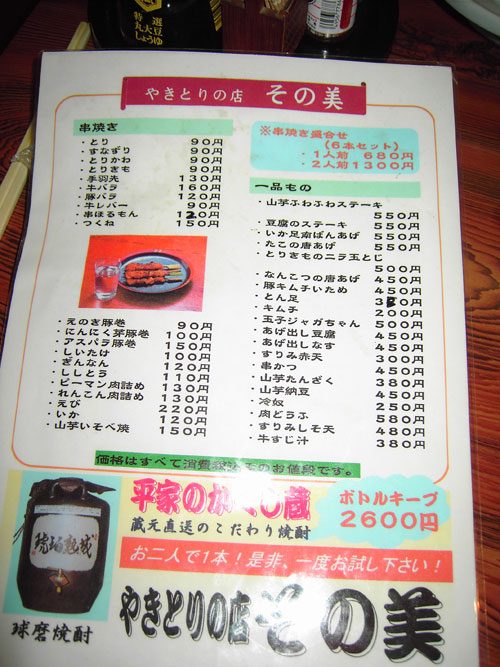
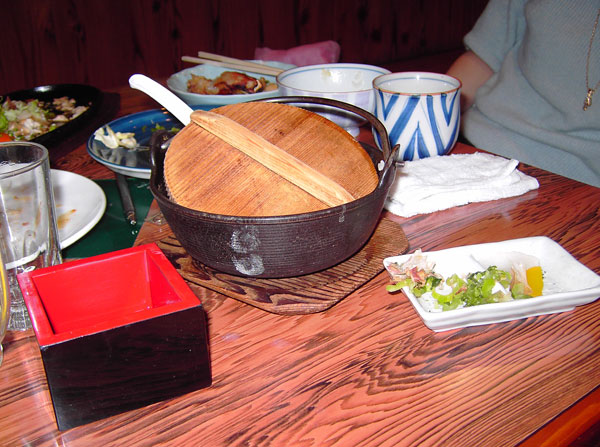
 There were a couple of laminated menus on the tables, entirely in Japanese, with no photos, and no rubber food in evidence anywhere. Luckily, the menu was pretty simple, as most izakayas specialize in one or two types of food. I was able to slowly spell out a little of what was on the menu, which thrilled me to pieces! I felt like a little kid, so proud of myself for stumbling through "Yaaaaaa... maaaaaaaaa... eeeee... mohh..., yama imo! Sweet potato! Suu.... tehhh... ki.... Steak! Sweet potato steak?? What the...?" Turns out they were well known for their sweet potato steak, which ended up coming in a small, rounded, rectangular cast iron dish. It was soft, and a little glutinous, and yellow...it looked like a plate of melted cheese, but it was mountain potato (sweet potato) mashed and cooked into a flat serving. It was the furthest thing from a "steak" that I've ever seen, as I could've eaten it with a spoon (and had trouble with chopsticks!) but it was really delicious--savory, very slightly sweet, with all the pasty chalkiness of the starch cooked away. It was topped with pieces of lettuce, and slivers of nori. I know, it doesn't sound delicious, but it was! In the picture, the sweet potato steak is in the foreground, and Miyuki's nori-wrapped onigiri (rice balls) and her tofu with egg is in the background. I also had a circle of burdock root that had a chicken sausage spread on one side before the whole thing was skewered and grilled...a charming cast iron pot of a sort of rice porridge, made with thin slivers of green onion and plump, insanely fresh whole oysters, the ubiquitous homemade Japanese pickles, and the best squid tempura I've ever eaten in my life. We three sat at one table, talking and laughing, while three Japanese women and an absolutely adorable moon-faced toddler with handlebar ponytails ate at one of the other two tables. The bar in the other half of the tiny restaurant catered to a very slow, but very steady stream of single male (mostly older) customers the whole time we were there.
 The izakaya served hot tea, water and sodas, of course, but was primarily for customers craving food accompanied by one of three alcoholic beverages. The first and foremost was, of course, sake. There were many brands available, most to be served warm, but a few designed to be served cold. The customer can always choose to have just about any sake hot or cold. I prefered it cold when I first came to Japan, but have found I'm developing a taste for it served quite warm. In this case, a little glass sort of like an old-fashioned juice glass was brought to me, literally brimming over. The hot glass was set inside a little square cup made of very small, relatively thick pieces of wood dovetailed together to make it watertight. The wooden cup is a traditional sake cup, but it's very odd to drink out of a thick-sided wooden box! You can pour the sake from the glass into the wooden cup, but the glass really is hot, so it's best to carefully lift the overfilled glass to your mouth using the wooden box. After you've drunk about half of the sake from the glass, you can pour the rest into the wooden cup box (to join what's already spilled over when it was brought out to you!) and sip it until it's gone.
Sake is made with pure, clear water, cooked rice, and yeast. That's it. It's similar in strength to beer or wine, but is not really either one. Shochu, as I already described, is more like vodka, and can be made with rice, wheat (Miyuki kept saying "made with flour" and I kept thinking "but which flower?" until I realized she meant wheat!) or potatoes. It's clear, just like sake, but exponentially stronger. Shochu is used to make chu-hi. These are like a cross between American cocktails and a not-very-sweet wine spritzer. Shochu is mixed with soda water and a flavoring -- sometimes slightly sweet, sometimes a little tart -- and with the alcohol content of a wine cooler or spritzer, not a highball. Chu-his come in cans in various convenience stores, like sodas, and in flavors like lemon, grapefruit, lime and ume (Japanese plum or apricot, rather tart) and occasionally seasonal flavors, like the current strawberry flavor. It's traditional to bring a salty snack with sake, like crunchy rice-cracker-paste-coated peanuts in flavors like bonito and wasabi, but in this case, they didn't bring anything to accompany my single sake, as we had ordered lots of food.
Afterwards, we hiked back up a considerable hill to Miyuki's car, with the still-quite-full moon hanging in the sky, the air uncharacteristically warm for February. I marveled at the difference in my life and my experiences, even just since last year, as I talked with Miyuki and Yuri, using my few words of Japanese, able to understand a few more as they talked, and realizing I could actually read several of the signs in katakana, hiragana and kanji around us. I was replete with good food and great companionship. The only thing that would have made the evening any more perfect would have been having Fearless Husband with me to share the adventure.
More soon!
Hope everyone is enjoying the holiday season! I'm a very happy camper, as Fearless Husband is home safe and sound.
I'll go back and do some catch-up later, but for now, here's an adventure following the Okinawa journey. Maybe I can get Thanksgiving posted before Christmas...we'll see!
 When I got home from Okinawa, I was in a huge hurry. Miyuki had asked me, months ago, to visit her school and carve pumpkins with the "culture class." I'd said yes, of course, but when Halloween came and went, I figured it just wasn't going to happen. I was wrong. Miyuki wanted me to come on Friday, November 17th. When I told her I might be late, or might not make it due to my trip to visit Emily -- but perhaps I could find another Navy spouse to go instead -- Miyuki blanched. Turns out teachers must get permission at City Hall to have a "guest teacher" (I thought I was just going to be a class visitor!) and Miyuki had gotten permission for me specifically to come to the class on Friday, November 17th. The parents all knew I was coming, and would blame Miyuki if I didn't show. Miyuki could even lose her job if parents complained! The way the flight/bus schedule worked coming home from Okinawa, I could get back to Sasebo, but just BARELY in time for the planned class visit. Barring a flight delay, I was going to make it -- and Miyuki's relief was HUGE.
 Miyuki picked me up at the bus station that afternoon, and took me straight to Hiu Junior High School. The school is very large, with perhaps 3,000 students. There is virtually no parking -- all students walk to school (no school buses), and teachers jockey for the few tiny spaces. Since Miyuki had me with her, she was allowed to park right in front of the school, a privilege which thrilled her. From the outside, the two wide four-story buildings one in front of the other, backed up against the mountainside, are pretty impressive. There is a gym building off to one side and a large, fenced, packed-dirt space spanning the entire building front for various sports. Except for the big, bare sports space, it might be any kind of structure, from a not-very-pretty old hospital to a government administration building. However, once inside the big double doors, it's obviously a school. There is the international school smell of chalk, old linoleum, and sweat, and kids' voices echoing faintly down the halls.
Just inside the door are hundreds of approximately 18 x 18" cubby holes lining the walls. The first set of cubbies have no doors, and hold generic, "one-size-fits-all" rubber slippers, the rest of the cubbies belong to the students and teachers, for their shoes. Yes folks, it's a Japanese school, and EVERYONE changes into slippers to walk around inside. The floors are all wood or linoleum -- no tatami mats here -- but "outside shoes" and their attendant bits of dirt and mud are not allowed into the school. All Japanese school children wear uniforms in junior high and high school. Some elementary schools and kindergartens have uniforms, and even the ones with no uniform require the students to wear little hats in the school color. Normally, the boys at Hui Junior High would be in mandarin-collared black jackets with brass buttons and matching black pants, and the girls would be in navy blue pleated knee-length skirts, navy blue vests and white shirts with Peter Pan collars buttoned right up to the top (this is a little more modern than most schools, where girls usually wear a classic Victorian sailor blouse with the bib on the back and the knotted kerchief in front!) However, this particular day was a special sports day of some sort, so the students were allowed a huge treat--which meant they could wear their matching red, white and blue track suits and blue-trimmed white t-shirts from gym class if they chose to do so.
 We went to the teacher's room, where all the teachers have their desks. Other than a hot plate and a small fridge in one corner, the room was wall-to-wall desks. Miyuki is lucky, as she has her desk at one corner of a desk block, so she has a desk to her right and one directly facing, but the aisle on her left. Miyuki has a "homeroom" of about 35 seventh grade students ("ichinensei" -- literally "first year students"), but she is not to keep anything in that room. She has no desk in the classroom, and is expected to stand at a podium all day as she teaches, and not to ever sit except at lunch--something we might expect of college professors, but not usually of American junior high school teachers! Miyuki teaches English, Morals and "International Cultures" class, in addition to her homeroom class. I was introduced to Miyuki's head teacher, a kind gentleman who nevertheless did not rise to meet me, but nodded regally from behind his desk as Miyuki bowed low (as did I, only half a beat behind).
Miyuki took me through the hallways and up several flights of stairs (one building is four stories, one is three, and there are no elevators) and down a breezeway. As we walked, the students we met were obviously very curious about me, and they were all eager to say "Hello! Hello! HELLO!!" and giggle behind their hands when I answered them. Two young women came bounding up to us as we walked, darting in front of us and walking backwards so they could talk to me. "Hello! My name is JUDY!" exclaimed one. "Hello, hello! MY name is Judy!" insisted the other. Miyuki laughed and told me that in English class, she let them pick American names, much as American students have French or Spanish names in their language classes. Our destination was a classroom that was obviously used as some sort of woodworking shop. There were banks of windows on the two long sides of the room, with scarred wooden worktables and wooden stools. Band saws and other power equipment were clustered to one side ,and there was a big trough-style sink.
 I'd purchased seven big American-style pumpkins at the base for Miyuki back in October, and she had them waiting in bags. I'd also bought six of the cheap little "pumpkin carving kits" for her, but had told her I would need a bigger knife for cutting the tops off. She'd provided me with a 3" fruit knife...not exactly what I had in mind, but I made it work. The children came in, and automatically divided themselves into six groups at the worktables, a few of them donning aprons brought from home to avoid staining their school clothes -- even a couple of the boys donned aprons, and no one seemed to think twice about a young man in red and white gingham. It surprised me a little, as so much here, especially clothing and toys, is so very gender-specific. Most of the girls clustered at the front table, greeting me over and over ("Hello! Hello! Hello! Hello!") while a few told me their names, and asked me slowly "what is your name?" This is their first year of English instruction, and they don't know many phrases beyond "What is your name?" The boys were more aloof. At one point, there was a knock on the window, and we all turned to look. It was Rumi, the young woman who introduced me to her dead parents! I recognized her, thank goodness, and made a big deal of greeting her by name and talking to her. If she'd had a tail, she would have been wagging it. The whole class looked at her with a new awe and respect, as she not only KNEW the Americaijin, but seemed to be FRIENDS with her! Rumi walked off to class with a little swagger in her step that was lacking before. Hurray, Rumi!!
 Miyuki had printed some "classic" Jack o'Lantern faces on white paper, and briefly told the class that they could, if they chose, hold the paper against the pumpkin as a template. I remembered that several times in the past, Miyuki has complained that Japanese students strive so hard for perfection, but often miss out on creativity and experimentation, so when she introduced me, and then translated my simple speech of welcome and instruction, I made sure to tell them that in America, there were many different ways to carve a pumpkin, and they could use the templates or not...and they could come look at the pumpkin I would be carving at the front of the class if they chose. Then I began slicing the tops off the pumpkins and setting the students to scraping the insides clean.
 Let me tell you, I've never in my life seen such clean pumpkin hollows. They were so very serious about getting the pumpkin shell as clean and tidy as possible, to please me! The various groups kept bringing me their pumpkins to show me the insides. After the first group was sent back to scrape more, the rest waited to come up to me until they'd scraped the shell smooth and clean as a glass bowl! With each clean, smooth shell, I said "Good job!" or something similar, and the entire group would BEAM, and repeat "goo-du jobu!" to each other on their way back to their seats.
One group was very serious about trying to match one of Miyuki's templates, but the other groups were amazing, trying all sorts of things. Two groups realized I'd finished one face on my pumpkin, and decided to carve a second face on the other side...so they emulated me, but to an extreme! The boys who did multiple faces on one pumpkin made two "right side up" and two "upside down". I'm not sure if that was on purpose or by accident! When I asked them about it, they looked at one another for a moment, then one boy grabbed the pumpkin and showed me one face. "HA!" he cried, as he twisted it to show me another face, right side up. "HA!" a toss and a twist, and another face revealed. A rhythm developed, and his whole group chanted as he twisted and tossed the Jack o'Lantern. I had them repeat it so I could film it. Too funny! The girls' pumpkin with multiple faces included a cut out "ghost" that could be removed or replaced from the pumpkin, and a "panel" on which they each signed their names in romanji. One girl from this group took the shreddy pumpkin guts and some of the trimmings from carving the various faces, and made me a "pretend" o-nigiri (rice ball) in the shape of a kitty cat, and brought it to me on a tray of newspaper for me. After the pumpkins were carved, we played "Halloween Bingo" where I held up big laminated cards with drawings of witches, ghosts, etc. and called out "three witches" or "one haunted house!" The students repeated each phrase in English as they marked the various images on their photocopied "bingo cards". Then they lined up in front of me, each one saying solemnly "Tu-ri-ku Tu-ree-to!" in exchange for a piece of Halloween candy from the big bag of American chocolates.
A bell rang, and after a chorus of bows, "arigatou gosaimasu" and "bye-bye, bye-bye!" the students scattered. Miyuki asked me to wait while she left briefly, and so I sat. As I waited, students converged on the classroom -- not for a class, but to clean! Japanese schools don't have janitors. Instead, at a certain time each afternoon, the entire student body stops and cleans the school from top to bottom. Students put chairs on desks, others sweep, still others mop, some dust, some use squeegies to clean the windows...it was astonishing! And, they were unsupervised, but still were diligent and hard working!
 Afterwards, Miyuki took me to meet her homeroom class, which includes all sorts of activities, such as singing instruction, preparation for various class competitions, and helping students "rate" themselves on how they've done each day and what they should prepare for the next day. Each student has a special notebook in which they write the homework expected for each class each day, upcoming tests, etc. They also rate themselves on how they've done in various areas, such as class participation, discussion, citizenship, teamwork, etc. The rating is not for a grade or for anyone else's eyes, it's completely for personal reasons, to help keep track of where one needs to concentrate and improve -- a circle means "adequate," a circle within the circle means "good," and an X means "needs improvement!" I was fascinated with the books, and asked if I could take a photo of one young lady's pages. An indignant boy immediately insisted to Miyuki that I take a photo of his book as well, as his was "much tidier than hers, and a better example!"
 Miyuki offered my pumpkin to the class, for one "lucky student" to take home. Before I could ask how she would decide who got it, she shouted in Japanese, and threw her right hand into the air. The whole class rose as one when she shouted, their right hands flying into the air as well. Several sat down immediately, and Miyuki shouted again, flinging her hand. This happened several times, lightning-fast, with a wave of kids sitting down each time, before I realized what they were doing. It was Ro-Cham-Bo, or "Rock, Paper, Scissors"! When Miyuki tossed a sign into the air, the students who were beaten sat down. The students whose symbols tied or beat Miyuki's continued the game. No one tried to cheat. No one looked to see what others were doing. There were no pauses in the intense rhythm, as kids immediately sat upon losing, disappointed but not angry, eager to see who would win. Very quickly the contestants were narrowed to two besides Miyuki, and she bowed out, allowing the two to "shoot it out" to find the winner. At the end, the whole class applauded, and the two final contestants bowed to one another before sitting, with the winner beaming happily. I wish I'd realized what was happening fast enough to make a video!
 I loved every minute of my day with Miyuki at school, and hope to do it again soon. Miyuki gave me a quick ride home, before returning to school to grade papers and work up the next day's lessons. At least this year she is not also coaching badminton after school for two to four hours every evening, and also on Saturday and Sunday--Japanese school is seven days a week! Miyuki gets two Saturdays and two Sundays off each month, and as a result, the other teachers consider her selfish and "not a team player". And parents can call her and ask her to come in early or stay late, or come in on a day off or a holiday, if they don't want their kids at home and underfoot, and Miyuki can't say no. Can you imagine? I hope to have more Japanese school adventures for you this winter.
More soon...as always, click on the photos for more. Here are a couple of bad but funny video clips:
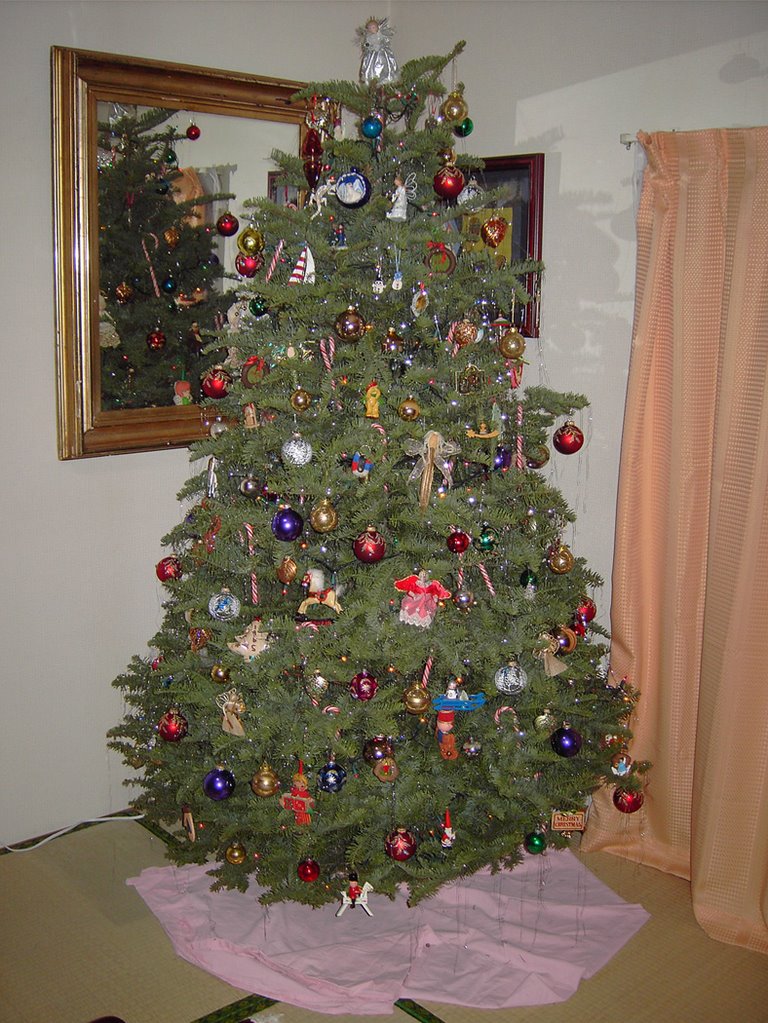
Here you go. Real adventure coming soon (Miyuki's school, Thanksgiving), but in the meantime, here are a couple of photos. I know, the "snow" is pink. But it was the only sheet I had that I was willing to use as a tree skirt. Behold, the world's dryest Christmas tree. I think they cut them in the US in September and put them on a slow boat to Japan. Yes, Virginia, that IS a Christmas tree on a tatami mat floor. (For those who care, there is traditional tinsel, even if I didn't manage the popcorn and cranberry strings, and the lights are multi-colored. The lights are always multi-colored. We keep a diverse tree, thankyouverymuch.)
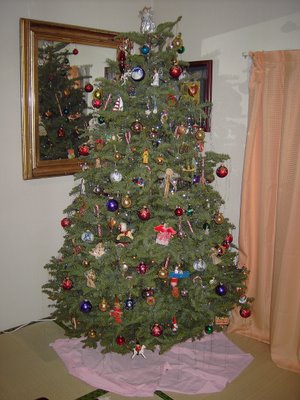 I do have to admit...I Photoshopped out the cord for the star. It's pretty ugly, and since we have no outdoor outlets, the black cord travels down the wall and into the house via the mail slot. Oh well...I love my star, with its gentle glow and its star-shaped holes. All my neighbors aren't quite sure what to think, though.

I've talked a lot about my Japanese friend, Miyuki. She's really an amazing person and a great friend. She started out as my "Know your Cho" volunteer, but we really hit it off and became friends almost instantly. We've spent a LOT of time together...she's taken me on several "tours" of Japanese grocery stores, and I've taught her to cook a couple of American dishes. We watch DVDs together with the English subtitles on (it helps her understand what's being said) and we hit the pause a lot so I can explain nuances. We have half-day adventures together quite often, and I'm so grateful to know her!
 Miyuki teaches English, Morals and "Cultures of Other Countries" at a local junior high school. She has a "homeroom" of seventh graders (ichinensei--literally "first year students") and supervises them in many activities--for example, she had to coach them in a multi-part song for a singing competition they recently had. She also must supervise a "club activity" after school, as each teacher must. Her "club activity" is badminton--a sport she claims to know nothing about, but she has the help of a student's father, who was a competition player...he takes the bus from Nagasaki every weekend to work with the children. Miyuki's day starts at 8am. Classes are over at 4pm...and she has "one-on-one time" with students who need help with studies or just need to talk. Then from 5pm to 7 or 8pm she supervises badminton. She leaves the school between 8pm and 10pm each weeknight--depending on when the principal leaves. The teachers do not leave until he does. Saturday mornings often have academic classes, and there are "club activities" for four hours on Saturday and again on Sunday. That's right...school is 7 days a week, and even includes a week-long overnight camp every summer, supervised by the teachers. If a "club" is doing particularly well (the Hui Jr. High volleyball team is in the nationals!) they might practice 8 hours a day on weekends! Miyuki told me the other teachers consider her very selfish and "not a team player" because she has insisted on having two Saturdays and two Sundays off out of every month. Today (Sunday), when we parted at 1pm, it was so she could go to the school and spend four hours with her badminton students.
 Perhaps 30% of the 7th grade students go from their club activity to cram school until 9 or 10 at night. By 9th grade, Miyuki says 90% or more of the students are in cram school, to get into a good high school. So kids go to school every day, and on weekdays are often not home until 9:30 or 10:00 at night! They choose one club activity...and that's the only one they concentrate on (badminton, volleyball, baseball, music, soccer, drama, etc.) Most do not change from year to year, so their one club activity is their only "hobby" for their entire school career. Miyuki said when she was in school, she played the French horn in the band, and went to cram school three nights a week. So...she played French Horn from 7th grade until graduation, with no other extra-curricular activities! Very different from our "smorgasbord" of kids' activities in the US. And with her crazy schedule, I am thrilled and honored that she chooses to spend her few hours off work with me!
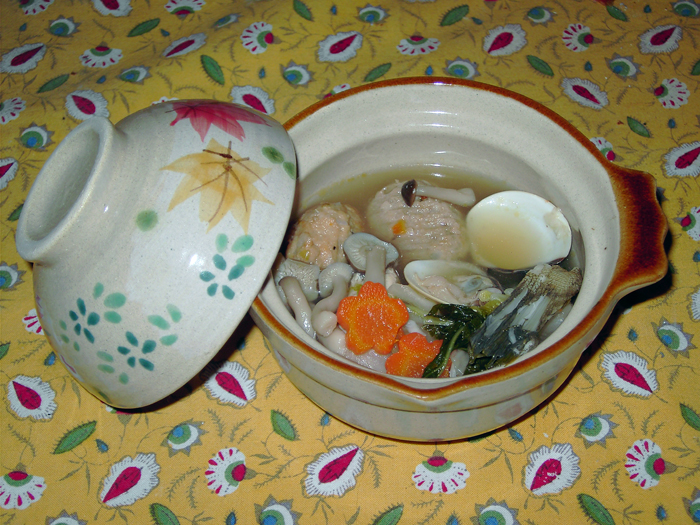
 Miyuki's family sends me little dishes all the time--an amazing beef and potato stew with konnyaku noodles (konnyaku is a sweet potato fiber/starch that can be made into all sorts of shapes..it's translucent, makes great noodles, and is completely free of calories!), a plate of six delicately fried little fish her father had just caught that morning, a plate of the freshest sashimi I've ever eaten (squid, an irridescent fish that is not found in the US, a little 'salad' of horse mackerel tossed with bits of fresh ginger and green onions, and a little smear of fresh wasabi), a traditional autumn soup dish called odon (broth, konnyaku noodles tied in bundles, a whole hardboiled egg, a thick slice of daikon radish, and various shapes of fish paste in various flavors--a patty, a cylinder, etc.), and today, a little bowl of nabe. Nabe is basically a soup..but it can be made in a group situation, where a simmering pot of broth is put in the middle of the table over a heat source, and each person puts in different raw ingredients (seafood, meat, veggies). One fishes out what one wants to eat, and at the end of the meal, the now-flavorful broth is shared. Shabu-shabu is a kind of nabe, but the meat is barely swished in the hot broth before being eaten...thus the name is for the sound. Shabu shabu = swish swish, then eat! I was asking about the differences last night, so Miyuki's mom made me a little nabe this morning and sent it to me, warm, via Miyuki at 10am! It mostly looks really delicious, with carrots cut into flower shapes, meatballs, a little Japanese clam, mushrooms, greens, etc. I'm not so sure about the fish tail I see in there...but I'll try it!
 I have sent them spaghetti, shepherd's pie, and smoked turkey, and they have been thrilled. We've laughed at how they crave American foods, and I crave the Japanese foods! Turkey is very hard to come by here in Japan...it's sold in pieces, NOT whole, and is very, very expensive. Chicken is the same...rarely sold whole. We discussed holiday meals, and the big "meat" meal for Miyuki and her family is roast chicken at Christmas. (They are Buddhist, not Christian, but more and more Japanese are celebrating Christmas as a gift-giving, family-gathering holiday. It's also two days after the current Emperor's birthday, which is always a national holiday.) I am really excited--I've invited Miyuki and her parents for a traditional Thanksgiving spread at my house, and they are thrilled. It should be fun!
This weekend, I got to spend a little time with Miyuki's parents, and with her sister and brother-in-law and their 18-month-old son. They invited me to join them on a family trip to an onsen--a Japanese traditional bath house. I have to admit, I simply am not confident enough to do the public nakedness thing yet, even with the sexes separated, so I told Miyuki I would love to join them, but I was too embarrassed. She assured me that I could have a private bath if I wanted to...that it was ok. She told me to bring a towel and some face soap, and clean underwear...and laughed when I tentatively suggested a bathing suit.
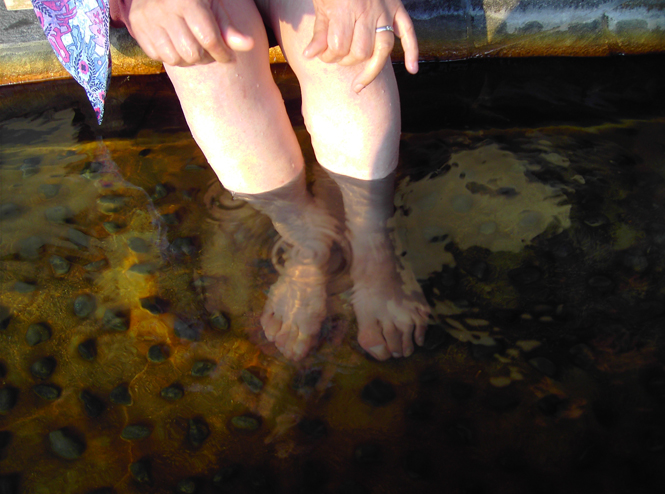
 They picked me up and we drove for about 40 minutes to the onsen. It was on the same grounds as a lovely hotel, with grass-surface tennis courts and a golf course, all overlooking the harbor. The sun was beginning to set, and the light was golden and rich. In front of the onsen was a long, rectangular "pond" about 18" high, with wooden plank seating around the rim, and round stones sticking up out of the bottom surface. It was a traditional footbath, and we all shed our shoes, pulled up pants or skirt hems, and stepped in. The mineral water was hot. REALLY hot! I didn't know if I could take it at first, but got used to it quickly. We nodded and smiled at the others sitting around the tub, each of us gently rubbing our feet over the smooth river stones sticking up from the bottom surface specifically for foot massage. As her parents chatted to the other people, Miyuki told me that the footbath outside and the baths inside were traditionally social gathering places for the Japanese, as they rarely have social events in their own private homes.
 After our legs were good and red, we dried off and slipped our shoes back on temporarily to go inside the onsen. Off came the shoes again (of course) and we all padded into the airy reception area. LOTS of people were completely barefoot, so I felt a little better about my habit of wearing sandals. Miyuki's sister, brother-in-law and little nephew had reserved one private room, and I had another one. A silent man handed us each keys, and showed us to a flight of stairs that went outside and down to the building housing the private baths (we got leather slippers to make the trip from building to building). Miyuki showed me my little private room, with sink, bench, shelves for my clothes, a hook for my towel, a teeny closet with a toilet, and the bath....oh, the bath!!
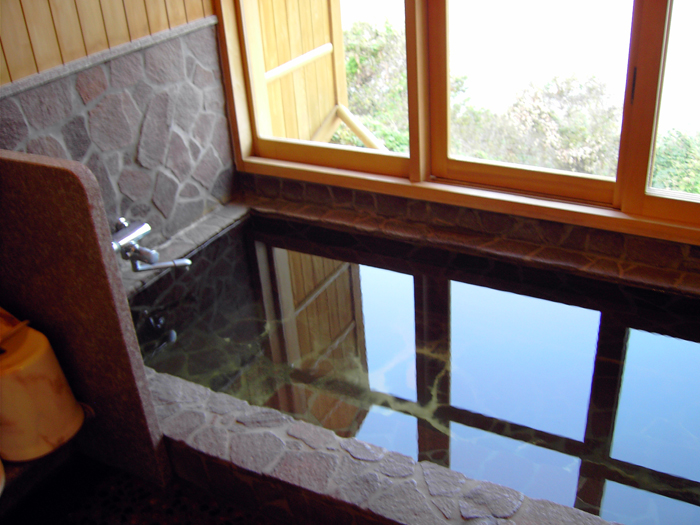
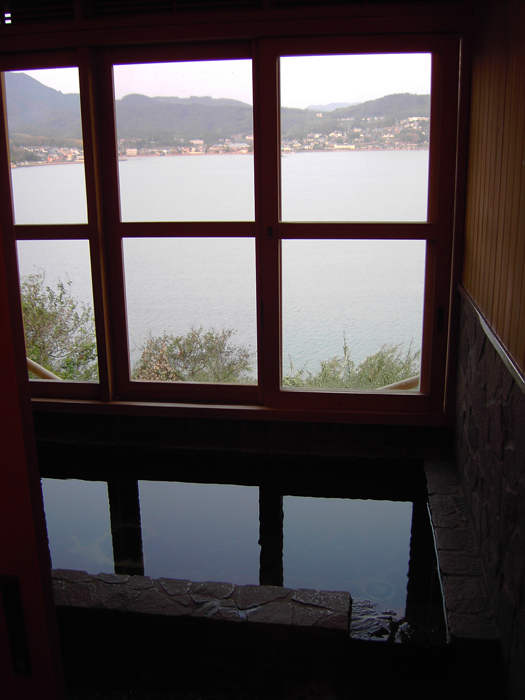
 The bath room was stone, with a place outside the tub to shower off (you are expected to be completely clean before getting into the water!) with two stools, two water basins and a hand-held shower head. The bath itself was completely made of stone, with a step inside because it was deep! It was filled to the brim, and when I got in, the displaced water overflowed through a channel at one end of the bath to a drain. If the water in the bath dropped below a certain level, more hot water came in automatically, in a waterfall from a corner opening. The wall along the bath was a block of windows overlooking the harbor, and the flowers on the grounds below, with wooden "wings" to give privacy from the other private room windows, and they slid open completely, to allow the cool breeze and birdsong into the room. The bath itself was big enough that I could sit in water up to my neck, or float stretched out without touching any of the four sides! Again, it was very, very hot. I had to get out twice during my 45 minutes and rinse off with cool water--which I discovered afterwards is also traditional.
  I am not sure if the water was "natural hot spring" heated or not...many onsen in Japan are, due to all the volcanic activity, but I think the ones in and around Sasebo are manually heated. The water is full of minerals, with the percentages posted on the walls (couldn't tell you WHAT minerals, as it was all in Japanese, of course) but it's supposed to be very healthy. My skin does feel good today!
I hope I can get to the same point as the Japanese women, who are oblivious to the differences in the human body. The very young, the very old, the wizened, the stick-thin, the really fat, those with terrible varicose veins, those with big scars or birthmarks--they all bathe together, sitting in the hot water up to their necks and socializing. No one cares how fat or thin or wrinkled or hairy or whatever you are...you're just a human being. The men (from what I'm told) do the same on their side. There is a large indoor bath on each side, which leads to an outdoor bath for each on deck overlooking the harbor. At this onsen, men and women are completely segregated (unless a couple or a family wants to share a private bath) but that is not always the case...some onsen are mixed use, and no one cares.
 After I luxuriated in the water and watched the moon rise over the harbor, I got dried off and dressed and headed to the common room to wait for Miyuki and her family. There was a big tatami-floored room for bathers to relax in after their baths, complete with coin-operated massage chairs. It's traditional to drink milk after a bath, but I have no clue why...especially as so many Asians are lactose-intolerant. Odd. I sat on a little outdoor deck and watched the almost-full moon over the harbor as gentle music played softly, then joined Miyuki and family inside. Her parents used the massage chairs briefly, and I enjoyed playing with Miyuki's nephew and getting to know her charming sister and brother-in-law. We had a light supper at the in-house restaurant (I had green tea, edamame, and pink rice studded with tiny azuki beans and bits of octopus--delicious!) before heading home.
Oh..the name of the onsen and hotel was Japanese for peacock, as there are many on the grounds. When I spelled out the hiragana and asked Miyuki for a translation, she said "Ummmm...the bird with fancy wings...a cockroach." Her mother doubled over with laughter in the front seat--she may not have much English, but she knew "cockroach!" Miyuki corrected herself, "oh, not cockroach--peacock!!" and we all had a good laugh. But all the way home, every few minutes, we heard from the front seat "hee hee hee...cocka-roach onsen....cocka-roach hotel...hee hee hee..."
More soon...

 We window-shopped (or would that be awning-shopped, when there are no windows?) our way through kitchenwares, fish so fresh it was still flapping, gorgeous vegetables and jewel-like fruit, organic chicken, various homemade condiments, and more. I ended up with some fresh yuzu-koshou (a paste of yuzu rind – a very aromatic citrus fruit – chilies and salt that’s delicious on fresh tofu), the prettiest turnips I’ve ever seen, a packet of sweet potato mochi, a bamboo spatula/spoon, several skeins of yarn from another teensy shop basically lined floor to ceiling with brightly colored balls of yarn, some traditional Japanese New Year decorations, and of course, FH's beef.
 The butcher laid out three different knives, and proceeded to lovingly separate the smaller chunk I’d indicated, then very carefully trim all the exterior fat, inspecting it and turning it and basically making a big production out of the whole thing. Yes, he used all three knives. The meat was then weighed (he was careful to point out that I was paying only for what we’d be eating, not for the trimmings!), then the chunk was carefully wrapped in a flexible, paper-thin piece of wood (yes, wood!), then white paper over that, then more white paper, then finally the swaddled bundle was put into a bag for me and placed on the counter *just* out of my reach.
 I also bought a traditional Japanese New Year’s decoration(shimekazari, which I can’t believe I forgot to photograph!), to go over our front door. It’s a fat, heavy twist of rice straw, with two sprays of rice straw sticking down to either side, a little fountain of rice kernels on their stem in the middle, various bits of folded and rolled special paper, and a sour orange skewered in the center. Most of the houses in our neighborhood already had similar decorations, and Hiroko encouraged me to get one, too.
 The morning of January 1, many Japanese get up very early to watch the first sunrise of the new year…this is considered a harbinger of the year to come, and one is supposed to be at peace, with a smile, to watch the sun rise. Unfortunately, we couldn’t see the sun rising here in Sasebo. Instead, we had fat flakes of snow!
 On the table were plates and plates of food (Chinese cooked pork, fresh mackerel sashimi, knots of savory seaweed, slabs of omelet and slices of ham, etc.) as well as the traditional osechi -- special large wooden divided boxes of very beautiful New Year's foods, each with its own meaning for the New Year (good fortune, money, happiness, fertility, etc.) Traditionally, nobody cooks on January 1, 2 and 3, so the three-layer boxes are all foods that will last. There were all sorts of things, from black beans decorated with gold leaf, to sea cucumber (neither of us liked that AT ALL, but of course had to eat it, as it was fancy and very, very expensive) to tiny carved squashes and pretty fish paste shapes. Champagne was served as well, and the other American couple brought brownies and vegetables with spinach dip. I felt bad that I hadn't contributed to the feast, but luckily, I'd brought gifts for Morinaga-san and her daughter, and a fancy bottle of French wine (regifting what the architect and his wife next door gave us!) and a container of homemade candies. The candies were the insanely simple ones... small pretzels with a Rolo chocolate-and-caramel candy put on top, the whole thing popped in the oven for three minutes, then a toasted pecan half pushed into the Rolo to make it smoosh down on the pretzel. VERY easy, and surprisingly delicious, like a chocolate/caramel/pecan turtle, but with the salty crunch of the pretzel. Luckily, the candies were a HUGE hit, and everyone ate them all up and argued over the last few.
 Over Christmas, FH and I enjoyed Norwegian meatballs and Norwegian Christmas cookies (thank you, Grandma!) from his family traditions. We spent our New Year’s morning quietly together, and had my family’s traditional New Year’s collard greens, black-eyed peas and ham for lunch. At Morinaga-san’s house that afternoon, we sat on tatami mats, with sliding rice-paper doors on two sides, and a painted scroll of cranes hanging in the special alcove, over the ancestor/God offerings of mochi and oranges and shiny wire decorations. It was pretty wonderful to sit in that beautiful and very foreign room, beside my familiar husband, making new Japanese and American friends, at a table covered with food from both cultures, with conversation and laughter flying. What a great way to start the New Year!













 Posts
Posts


