Showing posts with label obachans. Show all posts

Monday, May 04, 2009

Stalking the Savage Fern

Hiroko and family(As always, click on photos for larger versions.) On a recent spectacular April morning, my friend Hiroko and her parents came to pick me up for a day of “picking up wild vegetables.” Off we headed to Mt. Eboshi. We drove up and up and UP the mountain. Hiroko leaned oer and solicitously told me to roll down my window, because "the air is much healthier up here." I was only too glad to do so, because her father's driving, coupled with the lack of guard rails (aaaaaah!) was making me very carsick!

We stopped at an uncle's house (he wasn't home) to use the toilet and pet the uncle's dog. Then Hiroko's taciturn father took me behind the house to a surprisingly dark stand of cedar trees. There were two low bars, with branches (thin logs?) about three feet long propped on either side of the bar, to make sort of an inverted V shape. We leaned close to see the various mushrooms he grows and harvests. There weren't many, but the few that were there were interesting. They said when it rains, the mushrooms spring up overnight. I wish I'd gotten a photo here.

Then we stopped on the side of the road so Hiroko’s father could show me fresh bamboo shoots, the right size for harvesting -- they are mostly underground, which I didn't realize. There were several big holes where wild boars had rooted up some shoots to eat, scattering bits and pieces everywhere.

Bracken, aka warabiWe continued up and up and up. I was shocked to see houses here and there, with electricity and Internet and utilities. We arrived at the aunt's friend's house (the aunt is Hiroko's mother's younger sister...there are five in the family, with Hiroko's mom in the very middle, with an older brother and sister and a younger brother and sister). The friend was just darling, and the aunt was great, too. She put on a heavy velour/velvet bonnet (Little House on the Prairie style, but in velour!) with flowers all over it, parked a wide-brimmed straw hat on top, and off we went to the steep slope behind the house. There was a second, smaller house behind the first house (great landscaping, lots of rocks and TONS of flowers everywhere!) The second, smaller house had a very tall fence around it, with barbed wire at the top. I looked, and realized there were five cat faces at the window. Turns out the woman built the house, complete with beds and those tables with the quilts and heating elements underneath, for her seventeen CATS! The smell...oh my, the smell...was just horrific. I can't imagine how bad it would be when it gets hot!

I wore my sneakers, but I should have worn hiking boots. Next time, I’ll know. We went out back, climbing up a slope, then down. We were walking on matted down briars and brambles and dead ferns, with wild boar holes everywhere. The footing was not good at all. Hiroko was of course being very solicitous of me, pointing out ferns for me to pick. I finally got exasperated with her and told her to go pick her own! Her parents and aunt ranged all over the slope, like little old mountain goats, climbing over rocks and brambles.

Fiddleheads, aka kogomiWe were picking the long stems and uncurling fronds of a kind of fern. They weren't what I’d always thought of as fiddlehead ferns...they were long stems like asparagus, with a white bloom/dust on them that wiped off when we touched them. At the end of each asparagus-like stem were one, two or three little tiny tightly curled fists of fern fronds. When Hiroko looked up the name in her electronic dictionary, it just said they were “bracken” – in Japanese, warabi (蕨 / わらび). To prepare, they are soaked in water with baking soda, then boiled and served with soy sauce.

Hiroko's mom also picked some BIG fern buds (I know they are not buds, but that's what they seem like) which were more like what I think of as fiddleheads, but these were very big, bigger than golf balls, but not quite as big as a tennis ball. The bud things were very heavy for their size, and bright green under a thick, woolly/cottony coating. There was such a lot of cottony coating it looked like someone was wrapping them to pack them up! I took photos, of course, but not while we were picking. I was trying not to break my neck! In Japanese, these are called kogomi (こごみ)… I think. I’m not sure.


Butterbur stalks with leaves still attachedWe also harvested a bunch of things that looked like great big lotus leaves or lily pads, with long thick red and green stems. They looked like pale rhubarb, but were not. They’re called “butterbur” – in Japanese, fuki (菜蕗/ふき) – and they are a member of the daisy family. Hiroko’s family strips off and discards the fat leaves, abrades and scrubs the stems with salt, peels them like one peels celery of its strings, then boils them – a technique known as itazuri, or “removing harshness.” When I looked up butterbur online, I found that it has medicinal properties. Butterbur is supposedly very effective against migraines and asthma, and was used by Native Americans as a remedy for headache and inflammation. It’s also known as “sweet coltsfoot” and “bog rhubarb”, so maybe my rhubarb comparison was not so far off?

After picking for an hour or two, we all sat down on the matted brambles, just *plop* right there, and had plastic bottles of cold, nutty-tasting tea, our sweat drying in the cool mountain breeze. After our tea break, we made our way back to the house with our loot. My bag was the lightest, since my bad knees simply didn’t allow me to go bounding all over the hillside. We took our leave, walking up the very steep driveway with many exhortations from the aunt's friend to come visit again.

The foyer -- check out the slabs of wood!Then we went to the aunt's house, which Hiroko and family had never visited. The aunt married a carpenter, and they had four boys. They were very poor at first, and she worked her fingers to the bone, doing mother/wife things all day, then doing carpentry work beside her husband at night (unheard of, both for a woman to do carpentry, and for them to do it at night!) But they made money and slowly built a good business. A few years ago, they finally gave up their teeny house and decided to build from scratch. So, we got to see the gorgeous home they built together. It was amazing...huge lava rocks (from when Mt. Eboshi was a volcano) created rough, “natural-looking” terraces, with flowers everywhere...huge doors were thrown wide to the mountain breezes...shining slabs of satiny wood were everywhere. The construction was fascinating. The steps where one takes off one's shoes are made of two huge thick slabs of a single tree. Another giant slab of a tree is in the entry way. The beams are incredible.

The front hallWe had green tea in a beautiful, serene tatami room, where the aunt showed off the seven lucky gods her husband carved for her, as well as their family altar, obviously much used. There was a big wooden...thing....on a shelf, with a wheel with a groove in it, and thread or string wrapped around the wheel. I asked what it was, trying to figure out if it was a spinning wheel or what? It was a very large rounded boat or shoe shape. There were turtles carved standing on part of it, and the fattest part had a crane with wings outstretched. Finally I figured it out. It was a chalk line!

Decorative chalk lineThere was an ivory (or bone or plastic) knob with a sharp metal point at the end of the string. One puts the point into the wood, then walks along, paying out the string. The string passes through the fat part of the boat/shoe, which has fabric stuffed in it, impregnated with a black ink stuff that is water soluble. One moistens the wadded fabric just slightly, and the string picks up the ink stuff. Then one spins the wheel to return the string inside the thing. I was obviously fascinated, especially once I knew what it was. Hiroko’s aunt laughed and explained that the big one was decorative, because it was so large. I was disappointed, until she ran out and came back with a smaller version, obviously well-used, and proceeded to demonstrate. She then gave me two of them, a larger and a smaller! They're both used, and of course everyone was saying "oh, you don't want these, you want to buy new ones!" but I said "oh no, I love these...and my father and stepfather will appreciate the fact that they are well used and well loved!!"


Showing off the seven lucky gods and a Sasebo fighting topShe told me I should come back in August to escape the heat in the city. I told her I wanted to move in today -- but first I had to ask, "Do you have Internet?" She said yes, and then had to show me that she had better than Internet...she had a karaoke machine, with a ton of laser disks! Of course, she does not speak English, but Hiroko interpreted, and it's amazing how much one can understand simply with body language and charades. I told her I was definitely moving in, and she laughed and said that was fine, if I would teach her grandchildren English!

We sat around the table, and drank green tea, and peeled and ate oranges I'd never seen before...they are yellow, not orange, and milder than regular oranges, not quite as sweet, and nowhere near as acid, and very fragrant. I thought they were squat lemons when I first saw them. They’re called haruka, which means “far away” in Japanese. Hiroko didn’t know why they were named “far away” – I wish I knew!


Chalk line -- the real thing, usedBefore we headed back to Sasebo for a late lunch, Hiroko and her parents drove me to the very top of Mt. Eboshi, to the lookout. Unfortunately, it was a very hazy day, so the view wasn't great. But there were several hawks, and some signs showing various flowers and various birds to look out for, including one tiny, fluffy little bird the color of the inside of a kiwi fruit.

There was a giant field, with lava rocks just sort of tossed out all over it. I wondered if it was supposed to be a Zen garden, but it was all short grass and not sand, and far more expansive than the Zen gardens I've seen. Then I thought maybe it was supposed to represent the constellations, because there was a big plaque showing the constellations of the summer sky. Hiroko said it was just a park. Who knows? One thing that shocked me -- there was a city bus, just sitting by the side of the road, with the driver reading a book! Hiroko said the city bus comes all the way up to the top of the mountain, up those insane, steep, curvy roads, three or four times a day! So there are lots of people who live way up on the mountain, in relative isolation, but they have utilities and bus service to Sasebo (which is at the foot of the mountain) so nobody is isolated, even without a car.


The front of the houseI received quite an honor -- I was invited to come up the mountain at Obon for the ceremony for Hiroko's uncle, who passed away earlier this year. The first Obon festival after a person dies is the most important. Lamps are hung and lit, and food is put out for three days. The lamps light the ancestor's way home for a visit. Then at the end, the ships are built for anyone who has died during the year, to help the deceased find their way to the spirit world (and keep him or her from haunting the family!) A big ceremony is held, then the ship is taken to the center of town, with fireworks along the way to scare away bad spirits, and much shaking and rocking of the ship to shake off bad spirits...I participated in a small way with Eriko's ship (she works for the base and I wrote about last year's Obon with her and other folks from the base). But this will be much bigger, more solemn, and more…authentic, somehow. I’m really honored to be invited.

The main parlor or guest roomAfter we got back to Sasebo, we headed to a local hotel with an organic, mostly vegetarian Japanese buffet (Hiroko and her family are macrobiotic vegan). I enjoyed several different spring dishes, especially burdock root (gobo in Japanese) in various preparations. Gobo are long, thin carrot-like taproots, with lots of tiny rootlets sticking out. They have brown skin, and cream-colored insides, are much thinner than carrots, and MUCH longer. I also found out that konnyaku, that greyish gelatin-like stuff that is used in many dishes here (I don't like the chunks, but I love the noodles they make from it!) is made from devil's tongue starch. Although I knew that, I had no idea that devil's tongue was the same thing as Jack-in-the-Pulpit! Konnyaku has very little flavor, and can be made in a lot of shapes...and has zero calories and a lot of fiber.

A couple of days after our wild edibles adventure, Hiroko brought me various dishes her mother had made with the butterbur, the young bamboo shoots, and the bracken stems (no big fat fiddleheads, though). All three were savory, slightly sweet, and utterly delicious – the more so, I think, because I got to participate in the “harvesting” of the tender stalks!

Wednesday, April 11, 2007

Showing Off "My" Japan

I'm sorry it's been such a long time since my last post. I'm so busy having adventures that it's hard to find time to write about them! As always, click on the images for larger photos.

Even though I've still got things to write about from last summer and fall (Thanksgiving, meeting various porcelain artists, the Yosakoi festival, a parade I happened upon one day, etc.), I want to give you a glimpse into more recent events, as they are (of course) fresher in my mind. But trust me, I'm keeping notes, so eventually you will hear about it all.

On March 19, my friend (and mentor and ex-employer and author-for-whom-I-design-books) MM came to Japan to visit. His plan was to spend three weeks in this beautiful country, with the first nine or ten days spent based in Sasebo, visiting me. Due to a miscommunication (and a stomach bug) on my end of things, we didn't meet up until the 21st, when I took the train to Fukuoka to escort him back to Sasebo. The train trip was pleasant, as always, as we rode alongside the incredibly green rice paddies and through long tunnels cut through the abrupt and shaggy mountains. Luckily, MM is as adventurous as I am, so when he said he could probably eat something just before we boarded our train (standing in obedient lines--no clustering or shoving here!), I jumped out of the line to purchase a bento lunch at the little food kiosk there on the train platform. I had no idea what specifically was in that particular bento, but I was reasonably sure it would have something from the standard range of rice and pickles, with perhaps shreds of omelette (tamago) or bits of mushroom or pieces of fish. I think it was a great introduction to Japanese life for MM , as we shared the mushroom-studded rice and bits of Japanese pickle (no fork, of course, only chopsticks), and watched the countryside slide by.

That evening, we headed out to Fearless Husband's favorite curry restaurant, Coco Ichibanya (it was FH's last night at home for a while). I'd worried at first that it was a little too "chain-restaurant-with-plastic-booths" for a guest, but decided that MM would have plenty of chances in Japan to go to fancier restaurants, and this was the sort of place that Japanese families frequent on a regular basis...this was the REAL Japan. FH got his usual level 6 or 7 (I don't remember which...either one will blow away mere mortals with powerful heat!) and I got my tamer-but-still-spicy level 3. I think MM got the level 2, and even that was a little much for him! (Note to self: start visitors out with a level 0 or 1, unless you KNOW they're chili-heads!) However, despite the heat, it was a fun evening, talking and laughing and catching up, and showing MM various little things about Japanese life. For example...I hang onto the o-shibori (wet cloth) we're given at the start of a meal, because there usually aren't napkins -- and if there are, they tend to be not-very-absorbent little scraps of tissue -- and I always, ALWAYS need something to wipe my face/hands/shirt/table with...the waiter seats you and gives you menus, but does not come back to the table to bug you ("Ya'll ready to order yet?? *heavy sigh*) until you push a little button to ring a bell...curry in Japan is a saucy, messy dish, and simply can't be eaten with chopsticks, so large spoons are provided, and it's expected that you will use them (much to MM and FH's relief!)

The next morning, I took FH to the ship and said my goodbyes (*sniffle*) and headed back to the house. MM and I had breakfast, and ended up sitting on the kitchen floor (I know...weird!) and yakking away for a couple of hours, catching up on several years of adventures for each of us. Finally, we got our acts together, and headed out the door. We
went to Kashimae Pier to enjoy the spectacular weather -- cool breezes, blue skies and bright sunshine. After woodfired pizzas at Pinocchio's (sounds Italian, but with the various mushrooms and seafood, they were very Japanese-influenced Italian!) we strolled the docks, and MM (of course) ended up discovering some really spectacular architecture sort of hidden away, almost as if the architect had designed the building for his own pleasure. We decided to take the hour-long Kujukushima (literally 99 Islands) cruise around the 208 or so little islands in the harbor. I took a late-afternoon cruise on my own last fall, and it was really beautiful...but it was hazy, and the sun was setting, sending long shadows into the various hollows. This cruise was quite different, with the bright sun, flags snapping in the wind, intensely turquoise water and wind and wave-scoured rocks. We speculated on the various kinds of aquaculture around us (found out later it's almost all oyster farming), and pointed out particularly Japanese-looking twisted pines and interesting wind-scuplted embankments to each other. The first time I took the cruise, the recorded announcements were in Japanese and Australian-accented English. I guess that day there were more English-speakers on board than just me...this time, with MM, we seemed to be the only non-Asians on board, but there were many Chinese tourists, and a tour group from Taiwan. So, the announcements were in Japanese and Chinese...no English at all. Oh well! However, I knew from prior experience that the captions on the illustrated map of the islands were almost identical to the announcements, so we weren't missing much -- and it was interesting to realize that I can now REALLY tell the difference between spoken Japanese, spoken Chinese and spoken Korean. They all used to sound alike to my American ears, but now they're as different as German and French!

After the cruise, we wanderered a little more, and MM suggested the aquarium and shipping museum. As much as I love aquariums, for some reason, I'd never felt particularly drawn to this one. But our cruise tickets entitled us to a reduced admission, so off we went. The place was near empty, but in this land of virtually no unemployment, there were two employees at the ticket desk, and two more to bow and welcome us into the museum itself. I was pleasantly surprised at both the shipping museum and at the aquarium. Both were quite small, but both were really beautifully designed, with a great deal of fascinating information. Though most of the signs were not in English, there were little green boxes on pedestals scattered throughout the shipping museum.
One picked up the single padded earphone and held it to one's ear, and hit the appropriate button on the box (English, Japanese, Chinese, Korean) to hear a recorded spiel about that particular exhibit. There were astonishingly beautiful wooden models and cros-sections of ships and hulls, a scale-model of a Japanese merchant ship that one can walk through, a reproduction of a portion of a Viking longboat (along with a very funny horn-hatted Viking mannequin with a bushy red moustache), a dugout canoe, a timeline of the various boat types through the ages and how each developed (dugouts, reed/rush canoes, etc.) and more. It was really fascinating!

The aquarium was very small, but equally wonderful. The first exhibit I came to was a large table covered in shallow plastic pans, with two plump, grinning grandmother-types with head kerchiefs and rubber gloves. It looked like a temporary craft area for kids, but it was an oyster table, and for 500 yen (about $4) one could purchase an oyster with a cultivated pearl inside, open it then and there with the provided tools, and take home an opalescent shell half and a real (cultured) pearl in pink, black, gold or white (the color was the main "surprise" as each oyster was guaranteed to have a pearl). MM had gone on ahead, so I succumbed to touristy, childlike temptation and plopped into a folding chair, handing over my 500 yen. The two old ladies gave me a glove for my left hand (that was a Charlie Chaplin moment, as the two tried to put the glove on my hand FOR me, at the same time, stuffing my fingers every which way and snapping the latex against my wrist, arguing in Japanese!) Then I was handed an oyster -- very different from the tough, lumpy, granite-colored oysters I'm used to. This one was bronze-colored, with a tear-drop rounded, delicate shell, flanged on one side where the hinge was. I inserted the oyster knife, and tried to follow the pantomime of my two helpers as they contradicted each other, lectured me in smiling Japanese and eventually grabbed my hands to "guide" me in forcing the hinge apart. I sat back for the ride, letting them manipulate the oyster, the knife, and both of my hands. Satisfied that I'd done it right (with their help), they handed me a long pair of tweezers. MM came up at that point, to find me gleefully digging for the pearl, the two ladies laughing at my efforts. Finally, out popped a perfect, luminous white pearl -- really surprising me as it suddenly surfaced in the grey mucous of the oyster like the moon rising from a swamp. The ladies gasped with surprise and pleasure, and I beamed happily. Whether it was real or, as I strongly
suspect, part of their act, they seemed to imply that MY pearl was one of the BEST pearls, and I was supremely lucky. They took it from me, wiped it clean, tucked it in a tiny cellophane bag with a clean (not splintered by three sets of hands) irridescent oyster-shell half, tied the top prettily with a piece of gold ribbon, and ceremoniously presented me with my treasure. Silly? Sure. But I had so much fun!

Off to the next exhibit we went. I was enjoying the brightly lit tanks of colorful saltwater fish set into the fake rock walls of the darkened "cave tunnel" hallway, when I gasped in shock and surprise. Right beside a waist-high exhibit of vivid tropical fish was a tank that reached to the floor level...and my toes were about an inch of glass away from a huge tangle of vicious-looking moray eels in semi-darkness. Wow...THAT was a powerful juxtaposition! Their tangled bodies were each quite a bit thicker than my arm, and their jutting jaws seemed full of malicious intent. I couldn't tear my eyes away from them for a long time....the way their tank seemed to be a long, rock-walled tunnel from ceiling to floor really added to the feeling of secretive and powerful danger. Then movement caught my eye, and I was immediately drawn to the next exhibit...a huge
tank taller than my head with a thick "arm" that jutted out into the room. Recorded gull cries and waves echoed as I stood, fascinated, first staring into a school of silvery fish moving flashing and moving like one sparkling creature instead of hundreds of tiny individuals...then absolutely captivated by several HUGE sea turtles swimming majestically by me, only a couple of inches away from my outstretched fingers. I could've stood there and stared all day. There were other exhibits, of course...glowing, tiny jellyfish pulsing with slow grace to move their impossible, transparent bodies...tanks of pufferfish and luminescent lionfish...a large "touch pool" of urchins and crabs and whelks...tank after tank of astonishingly-colored live corals and aenemones. I'll definitely be going back!

Afterwards, we wandered through the touristy shops in the "cruise terminal", looking over the various items that are specifically "Sasebonian", such as biwa (loquat) pies and jellies, and various bottles of sake and shochu. We bought a little biwa pie for dessert later, and a bottle of shochu, and headed home. Our supposedly "slow paced day of relaxation" was surprisingly tiring for us both! We shared some shochu at home, along with a quick dinner of kielbasa/cabbage/onion/apple, and then were both more than ready to sleep!

Next up: our trip to Huis Ten Bosch!


A trio of videos (I have sharper versions, so let me know if you want me to send you the higher resolution versions):
A Silvery School

Sea Turtle

Jellies

Wednesday, November 22, 2006

Okinawan Hibiscus, Awamori & Shisa

(As always, click on the images for larger photos!)

I took the free shuttle from the base to the airport last Tuesday morning, and flew to Okinawa to visit my cousin Emily. Though I'd packed summer shirts and skirts, I was kind of stupid and wore a black tunic and dark pants for travelling. Okinawa was HOT! Em picked me up at the airport and immediately took me out sightseeing.

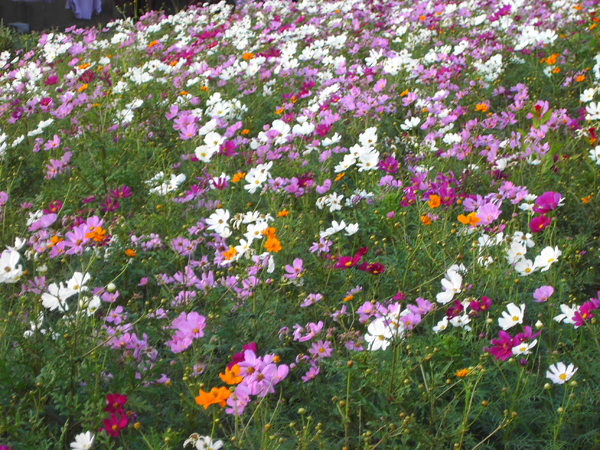
I was fascinated by the differences between Okinawa and the mainland. It's MUCH flatter, of course, and much warmer. The air is ocean-scented, and there are glimpses of incredibly beautiful turquoise water here and there. Flowers are EVERYWHERE, even though it's November. Em said that in the spring and summer, the flowers are astonishing. I was pretty astonished at the November abundance of vast masses of vividly-colored hibiscus, bouganvillea, cosmos, and many other flowers whose name I didn't know. The buildings are relatively low, and are boxy and square and mostly concrete. They're mostly painted in "Key West" colors -- lots of white trimmed in coral, peach, teal and pale turquoise. One reason there are so many concrete buildings (as opposed to the many wooden buildings in Sasebo) is due to the almost total razing of the island during WWII.

We went to a lacquerware factory first, which was totally cool. I had no idea what lacquerware really was until now. The various dishes, cups, platters and bowls are carved in single pieces from light, strong dried wood. Then the wood is coated with lacquer, which is made from several things, including powdered turban shells found in Okinawan waters. The lacquerware is almost all black and maroon -- very traditional. Some is left plain, some is painted, some has designs of mother-of-pearl inlaid into the lacquer, some has designs in relief on it. The relief pieces are made by rolling out a very thin "dough" of lacquer paste of a single color. The design is cut out of the "dough" and pressed onto the lacquerware piece. Details are pressed into the dough while it is still moist. Some designs are simple -- a red hibiscus blossom with green stem and leaves and a yellow stamen -- and other designs are really complex -- a landscape with trees, mountains, houses, etc. in many different colors. The design is pressed and rolled once it's put on the bowl or platter or whatever, so the edges are rounded and it seems part of the piece, not laid on afterwards. It was all really amazing, and now I'm really afraid I might have given away or thrown away good lacquerware, thinking it was plastic! I did buy two soup bowls (plain black with maroon interiors, no designs) and two pairs of chopsticks (both black with painted designs--Fearless Husband's with cranes, mine with wisteria blossoms). NOT cheap, but they are lovely artisanal pieces we'll use and treasure. I ACHED for a delicate lacquerware ceremonial tea set, and for an inlaid "family-sized" bento for picnicking...but both were FAR outside my price range.

Then Em took me to the Ryukyu Glass Factory. She sent me a clear oval glass plate with a swirl of cobalt and sky blue in it a couple of months ago from this particular factory, and I was really looking forward to seeing the place. The outside of the building, including the big support pillars and the wall along the walkway and stairs, was totally covered in vividly colored clear glass bricks. It was lovely! The glass blowing had stopped for the day, which was so very disappointing, but we did see some of the glass furnaces roaring away. Two of the artisans invited us into their work area so we could peer into the annealing kiln and see all the newly made vases and bowls slowly cooling down (if they cooled in the open air, the surface glass would cool faster than the inner glass, and the pieces would shatter). We had a great time in the huge shop, and I had to restrain myself from buying everything I saw! The glass industry in Okinawa started with Okinawans melting down the many, many soda bottles left by the American forces. At first, the pieces were utilitarian (like the well-known glass floats for fishing nets), but the craftsmen began to make pieces with vivid colors, and branched into more decorative work. Most of it is thick, and much of it has bubbles in the glass. It reminded me a little bit of Mexican glass, but with a much larger range of colors and shapes.


I bought a set of four coasters for me and FH, a lemon-yellow glass trimmed in bright green to add to my collection, and a couple of Christmas gifts. On our way out, we went to the "factory seconds" discount store, so Emily could play the "ping pong ball game." For 300 yen (about $2.50) one is given five ping pong balls to toss into a wooden pen filled with glass pieces. If a ping pong ball lands in a piece, you "win" that piece! Em claims to have "won" several pieces. Of course, I had to tease her about how "free" were the pieces -- how many times did she have to pay 300 yen to get all the "free" glass? While I was with her, she did win two pieces and spent only 600 yen, which pleased her very much. I tossed five ping pong balls of my own, but won nothing. As a consolation prize, one is given a little tube of clear glass with a flattened center, to use as a chopstick rest.

We headed for Emily and Dave's house after the glass factory. They have a darling little house with a tidy yard edged in tropical plants. The house has a living room/dining room/kitchen in one big room downstairs, along with a toilet room and a bathroom/laundry room. Upstairs they have three bedroooms, one with tatami flooring. It's a little smaller than our house, but it's nicely laid out and they've done a really nice job with it. The shelves along the stairway are lined with beautiful and unusual Okinawan pieces of pottery and carving, each of which was fascinating. I was exhausted, so we stayed in that night. Em made some rice, and served the curry she'd made during her "cooking lesson" a couple of days previously. It was delicious, and I enjoyed a huge big bowlful! Molly, their little dog, and I became great friends, once I scratched behind her ears. She was very pleased that I wanted to sit on the floor with her, and it wasn't long before she was pushing herself into my lap. I slept really, really well that night!

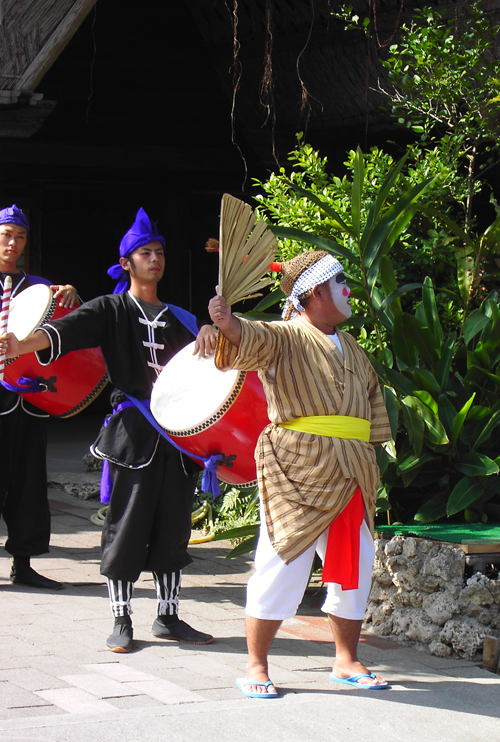
In the morning, we took our time getting going. I enjoyed puttering around, checking e-mail and drinking coffee. We finally got moving (poor Em, dealing with my slow start!) and we drove around looking at all the gorgeous flowers and getting glimpses of the turquoise waters. Em drove us by "Okinawan Hollywood" complete with a miniature "Hollywood" sign on the hillside and several big resort hotels. It seems one twenty-minute scene from an American movie was once filmed on that stretch of beach, thus it was considered "famous" by the locals! We then went to Ryukyu Mura, which is sort of a replica of a pre-war Okinawan village. There were thatched-roofed huts (including the Holy House, above, guarded by the clay shisa dogs, and covered in fluttering strips of paper upon which were written prayers), lively aisa dancing with drums (see the video at the bottom!), sanshen playing (a three-stringed instrument with the round "banjo-head" part made of snake skin--see the video at the bottom!), weaving demonstrations (one could pay to learn to weave their patterns if one wanted to), Okinawan tea, pancakes and doughnuts (tea = yum, pancakes = ok, doughnuts = greasy balls of sawdust -- YUCK!) a pottery factory, a water buffalo turning the crank of an old-fashioned sugar cane press, etc. I found it all fascinating! A couple of the actor-types had on makeup, including one in the photo with Emily to the right who had drawn lines on her face to indicate wrinkles, I guess. But there were also plenty of older folks with their own home-grown wrinkles!


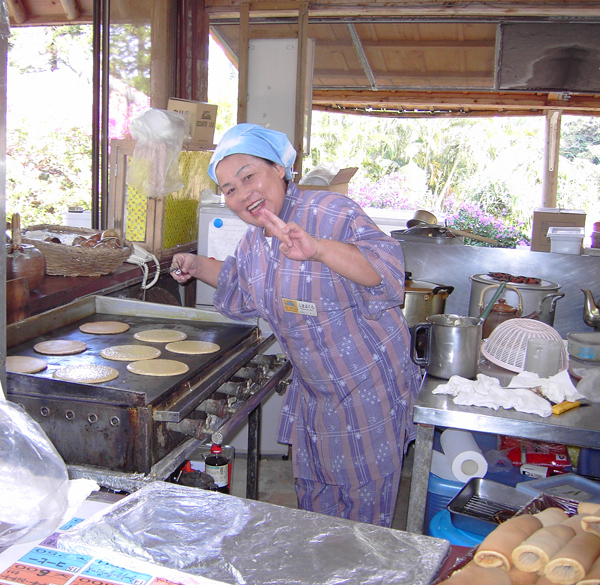
The little old woman serving the tea was particularly adorable. Okinawans are some of the longest-lived people in the whole world, and this little granny was in her 80s, but spry and strong and cute as a button. I bought some of her tea, and she was thrilled! She stood up on the raised platform and stuck her hand straight out almost into Emily's sternum. Em was astonished, then realized the obachan (Japanese for old auntie -- literally "older sister") wanted to shake hands. Then the obachan turned to me--and suddenly grabbed me in one of the tightest hugs I've ever had! She kept giggling and hugging me really tightly. I have to admit, that it was my first human contact since I saw FH last, and I got a little teary-eyed! (And look at the strength in those arms around my neck!) The guy who'd been playing the sanshen came and took my camera out of Emily's hands, and snapped a photo of us. As we left, we saw some of the old "formal" dancing being performed. The women wear very vivid cotton kimono made of an Okinawan fabric called Bingata, and huge round red "lotus" hats. The two women move in unison in very, very slow, stylized movements, accompanied by sort of eerie singing and sanshen playing.

We got a bite to eat at a Mexican place (!!) and talked a bunch...then headed to the beach. Near the beach were two "croquet courts", both filled with elderly folks playing a game with mallets, wire hoops and hard wooden balls, on a neatly-trimmed, rolled-flat grassy expanse. The equipment and manner of play looked identical to the croquet game we know, but the wicket pattern was completely different, and I guess the rules are entirely different as well. Em said there were courts like this all over the island, and that several times a week, the elderly played this game. We nodded and smiled to several folks, and exchanged greetings with a few. One old man wanted to know if we were interested in croquet...then rather than accept our assurances that we did find it interesting, he shook his head and insisted we must like "baysu baru" instead! Em suspected he just wanted to say "baseball" to us, and thus the conversation. We walked down the steep steps to a little cove, and did some shell-hunting. I kept filling my hands, then having to drop some as I found even better ones! I could have beach-combed for hours! Unfortunately, I left my shells outside at Emily's, meaning to rinse them clean before packing them, and forgot them entirely! Oh well! I snapped a couple of good shots of the sunset, and we headed home to Em's house.


That evening, to celebrate Dave passing his PT test, we went out to a yakiniku -- a place where you order a platter of raw meat and veggies and cook them in a grill set into the middle of the table. It was a much bigger restaurant than the yakiniku I like in Sasebo, with LOTS more choices! We took off our shoes at the door, and sat in a booth that had tatami seats at floor level, but a deeper "pit" under the table for our legs. Dave ordered for us all -- two kinds of beef, some very thin pork (sort of like bacon), Japanese mushrooms, asparagus, tomatoes, long onions, a plate of mixed veggies, and a little pot of garlic cloves in oil that we simmered on the grill until soft and delicious! We talked about ordering some seafood as well, but decided to see how full we were...and we were very glad we hadn't ordered any more food! The grill in Sasebo is gas or propane, but the grill in Okinawa used long tubes of charcoal, so the grilled flavor was very different. Of course, we each had rice as well, and lots of water. Dave also got a bottle of awamori, which is an Okinawan rice liquor. It's a lot stronger than sake, but smoother...it's poured over ice, and is 60 proof I think. You can drink it straight or mix it with water...I mixed mine with LOTS of water. It was a fantastic meal, with great food and great conversation. We had a great time, but had to finally go, as they were closing the place!

Thursday, we got a relatively late start again -- Em thought she was waiting for me to be ready, I thought I was waiting for her. It was pretty funny! We got some Okinawan soba at Em's favorite place for breakfast/lunch. The thick soba noodles were served in a huge bowl of savory broth, with a slice of fish paste (fish sausage is what Em's Okinawan friends call it, whereas my Mainland friends call it fish paste), a slice of absolutely delicious red-cooked pork, a little lump of pork spare ribs, and a scattering of scallions. There were maybe five little bites of meat, but it was soooo good and very filling. One of the condiments on the table was a little bottle of awamori filled with tiny chiles. You add it to your soba for a kicked up flavor--it gave a strong hint of the liquor, and a LOT of heat! I loved it, and may have to order some to use at honme. Then we headed to a folk museum Em liked. Even though there wasn't a whole lot of English on the display tags, there was enough to get us through. Fascinating stuff about the old ways of the Okinawans--about their textiles and agricultural ways, about their tombs shaped like wombs (circle of life!) and sunk into hillsides,how the families, even to this day have a funeral picnic in front of the "womb" as if they were sitting between the implied thighs of the earth, about the spirit houses built to hold the remains of the dead (with windows for the spirits to come and go--ancient spirit houses very square and plain, more modern spirit houses made of glazed pottery and very elaborate), about their whole way of life--and both tragic information about the war, and interesting information about how innovative they were, learning to recycle and use the materials the Americans discarded, such as aluminum and glass.

After the museum, we went to a pottery village, where a whole group of potters have set up studios and shops, and share the one huge wood-fired step-kiln. We wandered into two of the shops, and I found several things that would have made great Christmas gifts (including a fantastic sake bottle with a dragon that FH would have LOVED--the head was the spout, and the body looked as if it writhed in and out of the body of the pitcher) but luckily for my finances, they didn't take plastic and I didn't have enough yen to get what I wanted. The pottery was COMPLETELY different from the porcelain in my area, much more rustic, much more "hand made", a lot like the Seagrove pottery FH and I saw on our honeymoon. I really loved it! Then we went to a store that specialized in shisa, the dogs that guard everything from homes to temples to hotels. The two dogs sit on either side of the entrance (they look a lot like temple dogs, but are not the same). The male has an open mouth to capture the good spirits, and the female has a closed mouth to hold the good spirits in and protect them. They have tons of versions of the shisa dogs, including a fat one with a jug of awamori and an awamori cup. Em really loved that one, so I bought it as a thank-you gift for her and Dave. I also bought a pair of shisas for our house--Em is going to mail them through the free MPS, as they were far too heavy to carry home!

We were going to go to a concert given by one of Emily's friends that evening, but it was an hour's drive away, and none of us really felt like going that far. So we walked to a neighborhood izakaya, which is a Japanese drinking establishment with a menu of small dishes, sort of like a Japanese version of a tapas bar. They often don't open until 9 or 10 at night, and stay open until 4 or 5 in the morning! There are cubby-holes along one wall, so one can buy a bottle of awamori, then put one's name on a tag around the bottle's neck and put it in a cubby until the next visit. We sat on benches and stools made from tree-trunks, at a table made from a slab of heartwood. It was quite brightly lit, and relatively small, with perhaps six tables, two little tatami booths in an alcove, and a bar that looked right into the tiny kitchen, with perhaps five tree-trunk stools. On one wall was a big salt-water aquarium, and on the other wall was a television showing a DVD of underwater scenes. The yukata-clad waitress took our order and brought us a bottle
of awamori, and an ice bucket, water pitcher and three glasses, all made at the Ryukyu glass factory. We shared little platters of various snacks--some seasoned fried potatoes, some chunks of fried chicken, some great fried squid, and a platter of tofu champuru -- stir-fried cabbage, carrots, onions, and the best tofu I've ever eaten. We talked on and on, about Dave and Emily's plans after they leave, Dave's various business ideas, the possibilities of the two of them opening an izakaya in the US, etc. It was another evening of good food and great conversation.

Had to get up really early Friday so Em could get me to the airport by 7:30am. On the way to the airport, we passed literally hundreds of people of all ages lining the streets and waving fans--teenagers, little old ladies, businessmen in suits, office ladies in tight little skirts, etc. Some had yellow headbands and yellow t-shirts, others had orange headbands and t-shirts. Each group held banners and placards proclaiming their candidate as the best...it was an election day! I've never seen so many people on the streets for an election! They streamed out of side streets, covered bridges and sidewalks, lined the overpasses, waving and smiling, exhorting voters to get out the vote! Even with all the campaigners, we got to the airport in plenty of time. Before I left, Em and Dave gave me a simply gorgeous little sake set--a pitcher and two little cups, made by one of the most famous of local potters. His kiln has been designated a national treasure, and the three ironstone pieces are simply gorgeous--rich chocolate brown with a design of leaves carved into the dark glaze to reveal the lighter clay beneath. The sake pitcher has a little pottery marble inside, which is supposed to make the sake taste better somehow, but we aren't sure exactly how!

I got back to Sasebo by 1pm, JUST in time to get picked up at the bus station by Miyuki to spend the afternoon at her school, carving Jack o' Lanterns with her ichinensei (seventh graders, literally "first year students"). Yes, Halloween was long past, but that didn't stop us! More on that interesting afternoon soon, I promise. Happy Thanksgiving to all of you...wishing you all the blessings and happiness you desire. FH should be home soon, and we hope to actually have some adventures TOGETHER for a change. Yippee!


Videos (the sound isn't great--the Aisa drums played havoc with my camera's microphone!):