skip to main |
skip to sidebar
 (As always, click on photos for larger versions.) On a recent spectacular April morning, my friend Hiroko and her parents came to pick me up for a day of “picking up wild vegetables.” Off we headed to Mt. Eboshi. We drove up and up and UP the mountain. Hiroko leaned oer and solicitously told me to roll down my window, because "the air is much healthier up here." I was only too glad to do so, because her father's driving, coupled with the lack of guard rails (aaaaaah!) was making me very carsick!
We stopped at an uncle's house (he wasn't home) to use the toilet and pet the uncle's dog. Then Hiroko's taciturn father took me behind the house to a surprisingly dark stand of cedar trees. There were two low bars, with branches (thin logs?) about three feet long propped on either side of the bar, to make sort of an inverted V shape. We leaned close to see the various mushrooms he grows and harvests. There weren't many, but the few that were there were interesting. They said when it rains, the mushrooms spring up overnight. I wish I'd gotten a photo here.
Then we stopped on the side of the road so Hiroko’s father could show me fresh bamboo shoots, the right size for harvesting -- they are mostly underground, which I didn't realize. There were several big holes where wild boars had rooted up some shoots to eat, scattering bits and pieces everywhere.
 We continued up and up and up. I was shocked to see houses here and there, with electricity and Internet and utilities. We arrived at the aunt's friend's house (the aunt is Hiroko's mother's younger sister...there are five in the family, with Hiroko's mom in the very middle, with an older brother and sister and a younger brother and sister). The friend was just darling, and the aunt was great, too. She put on a heavy velour/velvet bonnet (Little House on the Prairie style, but in velour!) with flowers all over it, parked a wide-brimmed straw hat on top, and off we went to the steep slope behind the house. There was a second, smaller house behind the first house (great landscaping, lots of rocks and TONS of flowers everywhere!) The second, smaller house had a very tall fence around it, with barbed wire at the top. I looked, and realized there were five cat faces at the window. Turns out the woman built the house, complete with beds and those tables with the quilts and heating elements underneath, for her seventeen CATS! The smell...oh my, the smell...was just horrific. I can't imagine how bad it would be when it gets hot!
I wore my sneakers, but I should have worn hiking boots. Next time, I’ll know. We went out back, climbing up a slope, then down. We were walking on matted down briars and brambles and dead ferns, with wild boar holes everywhere. The footing was not good at all. Hiroko was of course being very solicitous of me, pointing out ferns for me to pick. I finally got exasperated with her and told her to go pick her own! Her parents and aunt ranged all over the slope, like little old mountain goats, climbing over rocks and brambles.
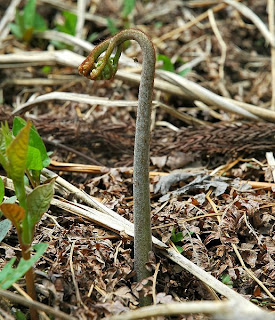
 We were picking the long stems and uncurling fronds of a kind of fern. They weren't what I’d always thought of as fiddlehead ferns...they were long stems like asparagus, with a white bloom/dust on them that wiped off when we touched them. At the end of each asparagus-like stem were one, two or three little tiny tightly curled fists of fern fronds. When Hiroko looked up the name in her electronic dictionary, it just said they were “bracken” – in Japanese, warabi (蕨 / わらび). To prepare, they are soaked in water with baking soda, then boiled and served with soy sauce.
Hiroko's mom also picked some BIG fern buds (I know they are not buds, but that's what they seem like) which were more like what I think of as fiddleheads, but these were very big, bigger than golf balls, but not quite as big as a tennis ball. The bud things were very heavy for their size, and bright green under a thick, woolly/cottony coating. There was such a lot of cottony coating it looked like someone was wrapping them to pack them up! I took photos, of course, but not while we were picking. I was trying not to break my neck! In Japanese, these are called kogomi (こごみ)… I think. I’m not sure. We also harvested a bunch of things that looked like great big lotus leaves or lily pads, with long thick red and green stems. They looked like pale rhubarb, but were not. They’re called “butterbur” – in Japanese, fuki (菜蕗/ふき) – and they are a member of the daisy family. Hiroko’s family strips off and discards the fat leaves, abrades and scrubs the stems with salt, peels them like one peels celery of its strings, then boils them – a technique known as itazuri, or “removing harshness.” When I looked up butterbur online, I found that it has medicinal properties. Butterbur is supposedly very effective against migraines and asthma, and was used by Native Americans as a remedy for headache and inflammation. It’s also known as “sweet coltsfoot” and “bog rhubarb”, so maybe my rhubarb comparison was not so far off?After picking for an hour or two, we all sat down on the matted brambles, just *plop* right there, and had plastic bottles of cold, nutty-tasting tea, our sweat drying in the cool mountain breeze. After our tea break, we made our way back to the house with our loot. My bag was the lightest, since my bad knees simply didn’t allow me to go bounding all over the hillside. We took our leave, walking up the very steep driveway with many exhortations from the aunt's friend to come visit again.
 Then we went to the aunt's house, which Hiroko and family had never visited. The aunt married a carpenter, and they had four boys. They were very poor at first, and she worked her fingers to the bone, doing mother/wife things all day, then doing carpentry work beside her husband at night (unheard of, both for a woman to do carpentry, and for them to do it at night!) But they made money and slowly built a good business. A few years ago, they finally gave up their teeny house and decided to build from scratch. So, we got to see the gorgeous home they built together. It was amazing...huge lava rocks (from when Mt. Eboshi was a volcano) created rough, “natural-looking” terraces, with flowers everywhere...huge doors were thrown wide to the mountain breezes...shining slabs of satiny wood were everywhere. The construction was fascinating. The steps where one takes off one's shoes are made of two huge thick slabs of a single tree. Another giant slab of a tree is in the entry way. The beams are incredible.
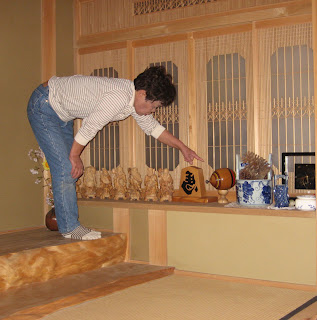
 We had green tea in a beautiful, serene tatami room, where the aunt showed off the seven lucky gods her husband carved for her, as well as their family altar, obviously much used. There was a big wooden...thing....on a shelf, with a wheel with a groove in it, and thread or string wrapped around the wheel. I asked what it was, trying to figure out if it was a spinning wheel or what? It was a very large rounded boat or shoe shape. There were turtles carved standing on part of it, and the fattest part had a crane with wings outstretched. Finally I figured it out. It was a chalk line!
 There was an ivory (or bone or plastic) knob with a sharp metal point at the end of the string. One puts the point into the wood, then walks along, paying out the string. The string passes through the fat part of the boat/shoe, which has fabric stuffed in it, impregnated with a black ink stuff that is water soluble. One moistens the wadded fabric just slightly, and the string picks up the ink stuff. Then one spins the wheel to return the string inside the thing. I was obviously fascinated, especially once I knew what it was. Hiroko’s aunt laughed and explained that the big one was decorative, because it was so large. I was disappointed, until she ran out and came back with a smaller version, obviously well-used, and proceeded to demonstrate. She then gave me two of them, a larger and a smaller! They're both used, and of course everyone was saying "oh, you don't want these, you want to buy new ones!" but I said "oh no, I love these...and my father and stepfather will appreciate the fact that they are well used and well loved!!"
 She told me I should come back in August to escape the heat in the city. I told her I wanted to move in today -- but first I had to ask, "Do you have Internet?" She said yes, and then had to show me that she had better than Internet...she had a karaoke machine, with a ton of laser disks! Of course, she does not speak English, but Hiroko interpreted, and it's amazing how much one can understand simply with body language and charades. I told her I was definitely moving in, and she laughed and said that was fine, if I would teach her grandchildren English!
We sat around the table, and drank green tea, and peeled and ate oranges I'd never seen before...they are yellow, not orange, and milder than regular oranges, not quite as sweet, and nowhere near as acid, and very fragrant. I thought they were squat lemons when I first saw them. They’re called haruka, which means “far away” in Japanese. Hiroko didn’t know why they were named “far away” – I wish I knew! Before we headed back to Sasebo for a late lunch, Hiroko and her parents drove me to the very top of Mt. Eboshi, to the lookout. Unfortunately, it was a very hazy day, so the view wasn't great. But there were several hawks, and some signs showing various flowers and various birds to look out for, including one tiny, fluffy little bird the color of the inside of a kiwi fruit.
There was a giant field, with lava rocks just sort of tossed out all over it. I wondered if it was supposed to be a Zen garden, but it was all short grass and not sand, and far more expansive than the Zen gardens I've seen. Then I thought maybe it was supposed to represent the constellations, because there was a big plaque showing the constellations of the summer sky. Hiroko said it was just a park. Who knows? One thing that shocked me -- there was a city bus, just sitting by the side of the road, with the driver reading a book! Hiroko said the city bus comes all the way up to the top of the mountain, up those insane, steep, curvy roads, three or four times a day! So there are lots of people who live way up on the mountain, in relative isolation, but they have utilities and bus service to Sasebo (which is at the foot of the mountain) so nobody is isolated, even without a car. I received quite an honor -- I was invited to come up the mountain at Obon for the ceremony for Hiroko's uncle, who passed away earlier this year. The first Obon festival after a person dies is the most important. Lamps are hung and lit, and food is put out for three days. The lamps light the ancestor's way home for a visit. Then at the end, the ships are built for anyone who has died during the year, to help the deceased find their way to the spirit world (and keep him or her from haunting the family!) A big ceremony is held, then the ship is taken to the center of town, with fireworks along the way to scare away bad spirits, and much shaking and rocking of the ship to shake off bad spirits...I participated in a small way with Eriko's ship (she works for the base and I wrote about last year's Obon with her and other folks from the base). But this will be much bigger, more solemn, and more…authentic, somehow. I’m really honored to be invited.
 After we got back to Sasebo, we headed to a local hotel with an organic, mostly vegetarian Japanese buffet (Hiroko and her family are macrobiotic vegan). I enjoyed several different spring dishes, especially burdock root (gobo in Japanese) in various preparations. Gobo are long, thin carrot-like taproots, with lots of tiny rootlets sticking out. They have brown skin, and cream-colored insides, are much thinner than carrots, and MUCH longer. I also found out that konnyaku, that greyish gelatin-like stuff that is used in many dishes here (I don't like the chunks, but I love the noodles they make from it!) is made from devil's tongue starch. Although I knew that, I had no idea that devil's tongue was the same thing as Jack-in-the-Pulpit! Konnyaku has very little flavor, and can be made in a lot of shapes...and has zero calories and a lot of fiber.A couple of days after our wild edibles adventure, Hiroko brought me various dishes her mother had made with the butterbur, the young bamboo shoots, and the bracken stems (no big fat fiddleheads, though). All three were savory, slightly sweet, and utterly delicious – the more so, I think, because I got to participate in the “harvesting” of the tender stalks!
 Here is another vignette from our lives here in Japan. There is so much more to tell you, but not enough time to tell it in! More to come, of course. Please forgive the blurry photos, as I was dealing with the dark, and my camera was NOT behaving. (Of course, I felt flash photography would not be appropriate in the least!) As always, click on the photos for larger images.
Last summer, when we got back to Japan after Annette's funeral, my Japanese friend Miyuki felt it was imperative to take Fearless Husband to the Obon festival. She was very serious about it, and insisted that we join her. For three days every summer, the Japanese believe the spirits of family and friends who have passed on come to visit for a time, especially those who have departed in the past year. In other parts of Japan, Obon is in July, but in a few towns, Sasebo included, Obon is always in August.
 Family members put out special sugar cakes molded into beautiful flower shapes, rice cakes, various fruits, and liquor for the visiting spirits. On the third night, there is a HUGE festival downtown. One particular part of the festival is specific to Nagasaki prefecture (of which we are a part) and is a tradition that comes from China. One may pay a token amount to purchase a paper lantern to honor the spirit of the deceased. The lanterns are square, and delicate, in white and yellow and pink with lotus flower blossoms and messages for world peace printed on them.
 One buys a lantern, writes messages to the departed on the lantern (in past days, I'm sure elegant calligraphy brushes were used, but in this case, there was a multitude of Sharpies available). The lantern is handed to the first in a line of twelve Buddhist monk apprentices in black pants, white dress shirts and sober ties, lined up on a floating dock that juts out into the river. The apprentices pass the lantern down the line, and the last man in line carefully sets the lantern onto the river to float away to the nearby ocean, using a long pole to ensure they don't clump up, or drift back to shore. The view of hundreds and hundreds of flickering paper lanterns drifting down the winding river to the sea in the gathering darkness is both poignant and beautiful.
 Miyuki purchased a lantern for Annette, as her tribute to the mother of her friend, and FH wrote messages to his mother before handing it to the acolytes to set adrift. We stood together, watching the lantern join hundreds of others on its journey to the sea, and I think we both felt a sense of closure within our sorrow. We watched until Annette's lantern was out of sight.
Many of the Japanese around us were dressed in traditional kimono, including the children. Others were in very casual clothes. There is sorrow, and some people and children are quietly crying as they prepare their lanterns...others are purchasing and eating street food like chicken skewers, squid-on-a-stick, roasted ears of corn, and snow-cones from the various vendors lined up along the riverside, and laughter drifts through the crowds. It's a celebration of both life and death, of honoring family, and of letting go. For many, it seems to bring closure -- a final goodbye.
After the lanterns are set afloat, people make their way to the main streets, to watch the "floats" go by. The floats are large platforms carried by teams of men and women in matching happi coats, with a roofed structure on top, and many large lanterns hanging under the roof. From what I understood at the time, most of the floats are specifically  dedicated to the owners of various corporations who have passed away in the past year (or years?), and the bearers are workers from the companies. Glittering signs are carried on poles to escort each float, and Miyuki told us the signs specify the name of the company. She explained that years ago, the wealthy and powerful (the elite, the movers and shakers, etc.) were able to pay for such tribute, but now only corporations can afford to have the floats and bearers, signs and fireworks. Each float is carried (sometimes for miles) through the streets of Sasebo, to come together in a large municipal sports field next to the city library.
 There, under brilliant floodlights (think night baseball game), each incredibly heavy platform is brought to the center, one at a time, and then jerked and turned and "danced" in circles as the teams shout and yell, firecrackers explode and columns of heavy smoke rise to the skies. This supposedly scares away any evil spirits who might be hanging around the spirit of the executive. The various teams vie to dance the fastest, shake their float the hardest, and make the most noise. A small but steady stream of townspeople come, each delivering a football-shaped straw package containing the various offerings (rice cakes, fruits, etc.) that have been sitting out for three days for the ancestral spirits. The pile of straw bundles grows and grows, to epic proportions as each family brings their offerings. These "footballs" will be burned in a HUGE bonfire after the event itself, to send the offerings up in smoke to heaven, carrying the offerings back to the spirit world.
 As one enters the field, whether carrying a float, bearing a straw bundle, or just coming to see the spectacle, one may stop at a white tent canopy with roof and three walls, to pray. Under the canopy are many bouquets of flowers and various offerings, and a lovely statue of Buddha. Three priests kneel and bow, chanting and swaying without cease, and the public may pause outside the encircling fence to pray and to light incense and candles and place them in the sand-filled troughs on the fence top.
Though the entire thing was very foreign to our eyes, it was also very beautiful. There was a sense of kinship, of universal humanity as people recognized the inevitability of death, the pain of loss, the joy of living, and the hope of the world to come.
I'm trying to catch up....I'm sorry for the delay! I'm headed to Hong Kong in about two weeks to see Fearless Husband, and I am so excited! I'll take lots of photos, and promise to post them and our adventures there before the end of November! We're hopeful that he will be home for Thanksgiving, and again for Christmas.
Back in June, I had one of the most foreign experiences I've ever had in my life. Miyuki invited me to join her on a trip to a temple with Rumi, a 12-year-old 7th grade student. Rumi’s parents are both dead, and she had asked her teacher, Miyuki, to join her as she went to say prayers at the temple where her parents "sleep".
 Rumi is shy and awkward and just darling--very eager to please. She and her 14-year-old brother are being shuffled back and forth between two aunts and an uncle. No one wants them, so they spend one month with one relative, then get sent for one month with another relative.
The brother is really going down the juvenile delinquent road, according to Miyuki, but this little girl is still bright and bouncy. She doesn't show her sorrow at all...but I'm afraid in a couple of years she could become a very hard case. Her mom died of cancer three years ago, and then a year ago her dad died of a heart attack from "overwork and stress." I want to adopt them both! But I don't think FH would jump for joy at the idea of adopting a 12 year old and a 14 year old, neither of whom speak English!
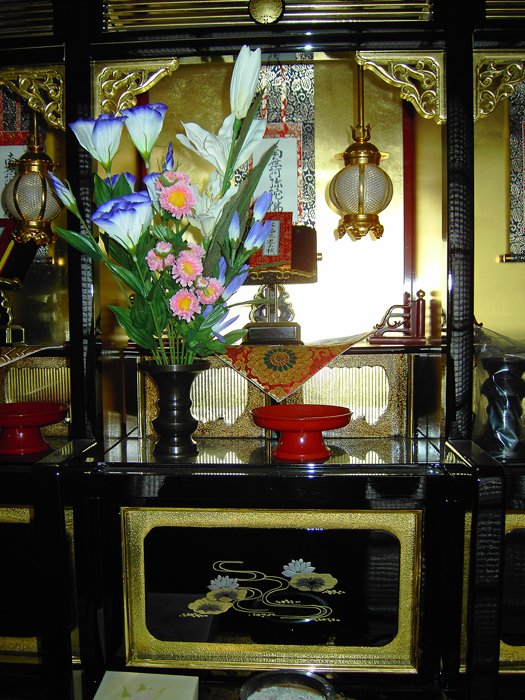
Going to the temple was not sad at all though. The temple itself was simply a two-story, relatively non-descript building on the main road. The only thing that distinguished it from its neighboring shops was a particularly fine tile roof. We found parking (amazing!) and walked up the stairs to the front door on the second floor. Inside, we took off our shoes and put on leather slippers before moving through the main temple room, with a beautiful gold-leafed statue of Buddha at the altar area at the front of the room. We went down some narrow stairs, past a photocopy machine and some boxes and stacked newspapers (like an office storage room) into a plain room with fluorescent lights and a wooden floor…very much as if we’d walked through an American church and into the fellowship hall in the basement! The room might have been a fellowship hall, or a classroom or an office, except for the fact that it is the resting place for the remains of hundreds of people. Shiny black cabinets trimmed in gold line the walls and march in long rows down the length of the room. The bottom part of each cabinet is a closed cupboard; the top is an open shelf/alcove, lined in gleaming red and gold paint. Each shelf has a little tiny golden altar, some silk flowers, a little book with the names of the deceased written in it in flowing and beautiful calligraphy (each person receives a new name at death), a little dish for burning incense, and a little dish for offerings. The bottom closed cabinet holds the ashes of the dead for that family. All Japanese are cremated. There is not enough land for them to be buried whole. Lots of containers of ashes can fit in each cabinet, so the family stays together even after death!
 Some offering dishes had cans of beer for the deceased, one shelf had soda and candy--Miyuki said it was for a child who’d died. A modern disposable lighter was placed beside each incense bowl. Rumi lit some incense, looped the prayer beads over her folded hands and said a prayer. Then Miyuki said a prayer, and then I said a prayer...all silently. The whole time, when they weren’t praying, they were both laughing and talking in normal, happy voices.
Miyuki said I should "introduce myself to Rumi's parents" when I said my prayer. It was not the way Americans act at cemeteries, full of sorrow and longing. Instead, it was as if we were really visiting her parents, and I felt as if my prayer should have begun “It’s very nice to meet you!” Then they both laughed and talked about how surprised Rumi's parents were going to be to meet an American. It was very upbeat, as if her parents were on a higher plane, but they were ghosts, not far away in heaven—as if her dad would enjoy being offered a cold beer, and her mother would be ducking her head in shyness to meet an American.
During the three day Obon holidays in August, Miyuki said that Rumi would host a memorial service for her parents in the main part of the temple...but people here do not go to regular services. There are no "weekly services", just funerals and memorials at the temples, weddings at the shrines, and visitors to both temples and shrines whenever anyone feels the need to pray for strength, hope or luck, or for the spirits of the departed. During Obon, families make trips to the resting places of their ancestor's ashes...some in the city, some far out in the country. The spirits of departed ancestors are invited "home" and offerings are given of new rice and other food. Many people picnic at the outdoor cemetaries, eating what they've first offered their ancestors. At the end of the three day festival, lanterns are lit and floated down the river in huge numbers, to "light the way back to the underworld" so no ghosts stick around to bother the living. The river filled with lanterns in the twilight is an amazing sight.
 I felt so odd in the fellowship-hall-mausoleum, like I should whisper, and I was embarrassed that I had bare feet in the provided leather slippers, because I’d worn sandals to the temple. Miyuki said bare feet were no problem, but 99% of the people I've seen have had socks. The young women wear knee-highs peeking out at the tops of their stiletto-heeled boots, and everyone seems to wear socks or stockings. I'm going to start carrying a pair of socks or knee-highs in my handbag for when I wear sandals. I wonder if it's sort of too casual to go barefooted, for health reasons, cleanliness, etc. The traditional Japanese outfit includes tabi socks with the zori--the wooden thong shoes like clunky flip-flops. Tabi socks are like mitten socks, with a single divider between the toes for the thong, and they button up on the inside of the ankle.
Miyuki and Rumi were giggling and laughing, and didn’t seem to think that my bare feet were a problem at all. Miyuki asked if I wanted to take a photo, which really surprised me. It turned out that made Rumi very proud, as she was the "owner" of her parents’ altar, and could give me permission to photograph her parents “home”. So I'm thrilled to have photos of that...but of course I didn't take photos of the Buddha in the temple. (That’s frowned upon.) They even directed me as to what photos I should take, so I have one photo of Rumi's parents' shrine, one photo of a line of little altars, a photo of Miyuki with Rumi in front of the altars, and one of me and Rumi ("Say Cheese!" insisted Miyuki in English!)
My heart goes out to that little girl because of her current situation of being tossed from aunt to uncle once a month...but her laughter and pleasure at “introducing me” to her parents seemed somehow healthier than our American obsession with grieving for many years after death.
More soon...
 (As always, click on photos for larger versions.) On a recent spectacular April morning, my friend Hiroko and her parents came to pick me up for a day of “picking up wild vegetables.” Off we headed to Mt. Eboshi. We drove up and up and UP the mountain. Hiroko leaned oer and solicitously told me to roll down my window, because "the air is much healthier up here." I was only too glad to do so, because her father's driving, coupled with the lack of guard rails (aaaaaah!) was making me very carsick!
 We continued up and up and up. I was shocked to see houses here and there, with electricity and Internet and utilities. We arrived at the aunt's friend's house (the aunt is Hiroko's mother's younger sister...there are five in the family, with Hiroko's mom in the very middle, with an older brother and sister and a younger brother and sister). The friend was just darling, and the aunt was great, too. She put on a heavy velour/velvet bonnet (Little House on the Prairie style, but in velour!) with flowers all over it, parked a wide-brimmed straw hat on top, and off we went to the steep slope behind the house. There was a second, smaller house behind the first house (great landscaping, lots of rocks and TONS of flowers everywhere!) The second, smaller house had a very tall fence around it, with barbed wire at the top. I looked, and realized there were five cat faces at the window. Turns out the woman built the house, complete with beds and those tables with the quilts and heating elements underneath, for her seventeen CATS! The smell...oh my, the smell...was just horrific. I can't imagine how bad it would be when it gets hot!
 We were picking the long stems and uncurling fronds of a kind of fern. They weren't what I’d always thought of as fiddlehead ferns...they were long stems like asparagus, with a white bloom/dust on them that wiped off when we touched them. At the end of each asparagus-like stem were one, two or three little tiny tightly curled fists of fern fronds. When Hiroko looked up the name in her electronic dictionary, it just said they were “bracken” – in Japanese, warabi (蕨 / わらび). To prepare, they are soaked in water with baking soda, then boiled and served with soy sauce.
 We also harvested a bunch of things that looked like great big lotus leaves or lily pads, with long thick red and green stems. They looked like pale rhubarb, but were not. They’re called “butterbur” – in Japanese, fuki (菜蕗/ふき) – and they are a member of the daisy family. Hiroko’s family strips off and discards the fat leaves, abrades and scrubs the stems with salt, peels them like one peels celery of its strings, then boils them – a technique known as itazuri, or “removing harshness.” When I looked up butterbur online, I found that it has medicinal properties. Butterbur is supposedly very effective against migraines and asthma, and was used by Native Americans as a remedy for headache and inflammation. It’s also known as “sweet coltsfoot” and “bog rhubarb”, so maybe my rhubarb comparison was not so far off?
 Then we went to the aunt's house, which Hiroko and family had never visited. The aunt married a carpenter, and they had four boys. They were very poor at first, and she worked her fingers to the bone, doing mother/wife things all day, then doing carpentry work beside her husband at night (unheard of, both for a woman to do carpentry, and for them to do it at night!) But they made money and slowly built a good business. A few years ago, they finally gave up their teeny house and decided to build from scratch. So, we got to see the gorgeous home they built together. It was amazing...huge lava rocks (from when Mt. Eboshi was a volcano) created rough, “natural-looking” terraces, with flowers everywhere...huge doors were thrown wide to the mountain breezes...shining slabs of satiny wood were everywhere. The construction was fascinating. The steps where one takes off one's shoes are made of two huge thick slabs of a single tree. Another giant slab of a tree is in the entry way. The beams are incredible.
 We had green tea in a beautiful, serene tatami room, where the aunt showed off the seven lucky gods her husband carved for her, as well as their family altar, obviously much used. There was a big wooden...thing....on a shelf, with a wheel with a groove in it, and thread or string wrapped around the wheel. I asked what it was, trying to figure out if it was a spinning wheel or what? It was a very large rounded boat or shoe shape. There were turtles carved standing on part of it, and the fattest part had a crane with wings outstretched. Finally I figured it out. It was a chalk line!
 There was an ivory (or bone or plastic) knob with a sharp metal point at the end of the string. One puts the point into the wood, then walks along, paying out the string. The string passes through the fat part of the boat/shoe, which has fabric stuffed in it, impregnated with a black ink stuff that is water soluble. One moistens the wadded fabric just slightly, and the string picks up the ink stuff. Then one spins the wheel to return the string inside the thing. I was obviously fascinated, especially once I knew what it was. Hiroko’s aunt laughed and explained that the big one was decorative, because it was so large. I was disappointed, until she ran out and came back with a smaller version, obviously well-used, and proceeded to demonstrate. She then gave me two of them, a larger and a smaller! They're both used, and of course everyone was saying "oh, you don't want these, you want to buy new ones!" but I said "oh no, I love these...and my father and stepfather will appreciate the fact that they are well used and well loved!!"
 She told me I should come back in August to escape the heat in the city. I told her I wanted to move in today -- but first I had to ask, "Do you have Internet?" She said yes, and then had to show me that she had better than Internet...she had a karaoke machine, with a ton of laser disks! Of course, she does not speak English, but Hiroko interpreted, and it's amazing how much one can understand simply with body language and charades. I told her I was definitely moving in, and she laughed and said that was fine, if I would teach her grandchildren English!
 Before we headed back to Sasebo for a late lunch, Hiroko and her parents drove me to the very top of Mt. Eboshi, to the lookout. Unfortunately, it was a very hazy day, so the view wasn't great. But there were several hawks, and some signs showing various flowers and various birds to look out for, including one tiny, fluffy little bird the color of the inside of a kiwi fruit.
 I received quite an honor -- I was invited to come up the mountain at Obon for the ceremony for Hiroko's uncle, who passed away earlier this year. The first Obon festival after a person dies is the most important. Lamps are hung and lit, and food is put out for three days. The lamps light the ancestor's way home for a visit. Then at the end, the ships are built for anyone who has died during the year, to help the deceased find their way to the spirit world (and keep him or her from haunting the family!) A big ceremony is held, then the ship is taken to the center of town, with fireworks along the way to scare away bad spirits, and much shaking and rocking of the ship to shake off bad spirits...I participated in a small way with Eriko's ship (she works for the base and I wrote about last year's Obon with her and other folks from the base). But this will be much bigger, more solemn, and more…authentic, somehow. I’m really honored to be invited.
 After we got back to Sasebo, we headed to a local hotel with an organic, mostly vegetarian Japanese buffet (Hiroko and her family are macrobiotic vegan). I enjoyed several different spring dishes, especially burdock root (gobo in Japanese) in various preparations. Gobo are long, thin carrot-like taproots, with lots of tiny rootlets sticking out. They have brown skin, and cream-colored insides, are much thinner than carrots, and MUCH longer. I also found out that konnyaku, that greyish gelatin-like stuff that is used in many dishes here (I don't like the chunks, but I love the noodles they make from it!) is made from devil's tongue starch. Although I knew that, I had no idea that devil's tongue was the same thing as Jack-in-the-Pulpit! Konnyaku has very little flavor, and can be made in a lot of shapes...and has zero calories and a lot of fiber.







 Posts
Posts

